


(יא) רַבִּי יוֹחָנָן הַסַּנְדְּלָר אוֹמֵר, כָּל כְּנֵסִיָּה שֶׁהִיא לְשֵׁם שָׁמַיִם, סוֹפָהּ לְהִתְקַיֵּם. וְשֶׁאֵינָהּ לְשֵׁם שָׁמַיִם, אֵין סוֹפָהּ לְהִתְקַיֵּם:
(11) Rabbi Yochanan Hasandlar said: every assembly which is for the sake of heaven, will in the end endure; and every assembly which is not for the sake of heaven, will not endure in the end.
What do you think is the difference between a gathering for the sake of heaven, and one not for the sake of heaven?
אָמַר רַבִּי יוֹחָנָן מַאי דִּכְתִיב אַשְׁרֵי אָדָם מְפַחֵד תָּמִיד וּמַקְשֶׁה לִבּוֹ יִפּוֹל בְּרָעָה אַקַּמְצָא וּבַר קַמְצָא חֲרוּב יְרוּשָׁלַיִם אַתַּרְנְגוֹלָא וְתַרְנְגוֹלְתָּא חֲרוּב טוּר מַלְכָּא אַשָּׁקָא דְרִיסְפַּק חֲרוּב בֵּיתֵּר אַקַּמְצָא וּבַר קַמְצָא חֲרוּב יְרוּשָׁלַיִם דְּהָהוּא גַּבְרָא דְּרָחֲמֵיהּ קַמְצָא וּבְעֵל דְּבָבֵיהּ בַּר קַמְצָא עֲבַד סְעוֹדְתָּא אֲמַר לֵיהּ לְשַׁמָּעֵיהּ זִיל אַיְיתִי לִי קַמְצָא אֲזַל אַיְיתִי לֵיהּ בַּר קַמְצָא אֲתָא אַשְׁכְּחֵיהּ דַּהֲוָה יָתֵיב אֲמַר לֵיהּ מִכְּדֵי הָהוּא גַּבְרָא בְּעֵל דְּבָבֵאּ דְּהָהוּא גַּבְרָא הוּא מַאי בָּעֵית הָכָא קוּם פּוֹק אֲמַר לֵיהּ הוֹאִיל וַאֲתַאי שִׁבְקַן וְיָהֵיבְנָא לָךְ דְּמֵי מָה דְּאָכֵילְנָא וְשָׁתֵינָא
§ Apropos the war that led to the destruction of the Second Temple, the Gemara examines several aspects of the destruction of that Temple in greater detail: Rabbi Yoḥanan said: What is the meaning of that which is written: “Happy is the man who fears always, but he who hardens his heart shall fall into mischief” (Proverbs 28:14)? Jerusalem was destroyed on account of Kamtza and bar Kamtza. The place known as the King’s Mountain was destroyed on account of a rooster and a hen. The city of Beitar was destroyed on account of a shaft from a chariot [rispak]. The Gemara explains: Jerusalem was destroyed on account of Kamtza and bar Kamtza. This is as there was a certain man whose friend was named Kamtza and whose enemy was named bar Kamtza. He once made a large feast and said to his servant: Go bring me my friend Kamtza. The servant went and mistakenly brought him his enemy bar Kamtza. The man who was hosting the feast came and found bar Kamtza sitting at the feast. The host said to bar Kamtza. That man is the enemy [ba’al devava] of that man, that is, you are my enemy. What then do you want here? Arise and leave. Bar Kamtza said to him: Since I have already come, let me stay and I will give you money for whatever I eat and drink. Just do not embarrass me by sending me out.
For Discussion:
-
At how many points could this conflict have been stopped from escalating? Why wasn’t it stopped?
-
What role does public embarrassment play in the escalation of the conflict?
-
Why won't the host of the Seudah compromise with bar Kamtza?
אֲמַר לֵיהּ לָא אֲמַר לֵיהּ יָהֵיבְנָא לָךְ דְּמֵי פַּלְגָא דִּסְעוֹדְתָּיךְ אֲמַר לֵיהּ לָא אֲמַר לֵיהּ יָהֵיבְנָא לָךְ דְּמֵי כּוּלַּהּ סְעוֹדְתָּיךְ אֲמַר לֵיהּ לָא נַקְטֵיהּ בִּידֵיהּ וְאוֹקְמֵיהּ וְאַפְּקֵיהּ אָמַר הוֹאִיל וַהֲווֹ יָתְבִי רַבָּנַן וְלָא מַחוֹ בֵּיהּ שְׁמַע מִינַּהּ קָא נִיחָא לְהוּ אֵיזִיל אֵיכוֹל בְּהוּ קוּרְצָא בֵּי מַלְכָּא אֲזַל אֲמַר לֵיהּ לְקֵיסָר מְרַדוּ בָּךְ יְהוּדָאֵי אֲמַר לֵיהּ מִי יֵימַר אֲמַר לֵיהּ שַׁדַּר לְהוּ קוּרְבָּנָא חָזֵית אִי מַקְרְבִין לֵיהּ אֲזַל שַׁדַּר בִּידֵיהּ עִגְלָא תִּלְתָּא בַּהֲדֵי דְּקָאָתֵי שְׁדָא בֵּיהּ מוּמָא בְּנִיב שְׂפָתַיִם וְאָמְרִי לַהּ בְּדוּקִּין שֶׁבָּעַיִן דּוּכְתָּא דִּלְדִידַן הָוֵה מוּמָא וּלְדִידְהוּ לָאו מוּמָא הוּא סְבוּר רַבָּנַן לְקָרוֹבֵיהּ מִשּׁוּם שְׁלוֹם מַלְכוּת אֲמַר לְהוּ רַבִּי זְכַרְיָה בֶּן אַבְקוּלָס יֹאמְרוּ בַּעֲלֵי מוּמִין קְרֵיבִין לְגַבֵּי מִזְבֵּחַ סְבוּר לְמִיקְטְלֵיהּ דְּלָא לֵיזִיל וְלֵימָא אֲמַר לְהוּ רַבִּי זְכַרְיָה יֹאמְרוּ מֵטִיל מוּם בַּקֳּדָשִׁים יֵהָרֵג אָמַר רַבִּי יוֹחָנָן עִנְוְותָנוּתוֹ שֶׁל רַבִּי זְכַרְיָה בֶּן אַבְקוּלָס הֶחְרִיבָה אֶת בֵּיתֵנוּ וְשָׂרְפָה אֶת הֵיכָלֵנוּ וְהִגְלִיתָנוּ מֵאַרְצֵנוּ שַׁדַּר עִלָּוַיְיהוּ לְנֵירוֹן קֵיסָר כִּי קָאָתֵי שְׁדָא גִּירָא לְמִזְרָח אֲתָא נְפַל בִּירוּשָׁלַיִם לְמַעֲרָב אֲתָא נְפַל בִּירוּשָׁלַיִם לְאַרְבַּע רוּחוֹת הַשָּׁמַיִם אֲתָא נְפַל בִּירוּשָׁלַיִם אֲמַר לֵיהּ לְיָנוֹקָא פְּסוֹק לִי פְּסוּקָיךְ אֲמַר לֵיהּ וְנָתַתִּי אֶת נִקְמָתִי בֶּאֱדוֹם בְּיַד עַמִּי יִשְׂרָאֵל וְגוֹ׳ אָמַר קוּדְשָׁא בְּרִיךְ הוּא בָּעֵי לַחֲרוֹבֵי בֵּיתֵיהּ וּבָעֵי לְכַפּוֹרֵי יְדֵיהּ בְּהָהוּא גַּבְרָא עֲרַק וַאֲזַל וְאִיגַּיַּיר וּנְפַק מִינֵּיהּ רַבִּי מֵאִיר שַׁדְּרֵיהּ עִילָּוַיְיהוּ לְאַסְפַּסְיָינוּס קֵיסָר אֲתָא צָר עֲלַהּ תְּלָת שְׁנֵי הֲווֹ בַּהּ
הָנְהוּ תְּלָתָא עַתִּירֵי נַקְדִּימוֹן בֶּן גּוּרְיוֹן וּבֶן כַּלְבָּא שָׂבוּעַ וּבֶן צִיצִית הַכֶּסֶת נַקְדִּימוֹן בֶּן גּוּרְיוֹן שֶׁנָּקְדָה לוֹ חַמָּה בַּעֲבוּרוֹ בֶּן כַּלְבָּא שָׂבוּעַ שֶׁכׇּל הַנִּכְנָס לְבֵיתוֹ כְּשֶׁהוּא רָעֵב כְּכֶלֶב יוֹצֵא כְּשֶׁהוּא שָׂבֵעַ בֶּן צִיצִית הַכֶּסֶת שֶׁהָיְתָה צִיצָתוֹ נִגְרֶרֶת עַל גַּבֵּי כְּסָתוֹת אִיכָּא דְּאָמְרִי שֶׁהָיְתָה כִּסְתּוֹ מוּטֶּלֶת בֵּין גְּדוֹלֵי רוֹמִי חַד אֲמַר לְהוּ אֲנָא זָיֵינָּא לְהוּ בְּחִיטֵּי וּשְׂעָרֵי וְחַד אֲמַר לְהוּ בִּדְחַמְרָא וּבִדְמִלְחָא וּמִשְׁחָא וְחַד אֲמַר לְהוּ בִּדְצִיבֵי וְשַׁבַּחוּ רַבָּנַן לִדְצִיבֵי דְּרַב חִסְדָּא כֹּל אַקְלִידֵי הֲוָה מָסַר לְשַׁמָּעֵיהּ בַּר מִדְּצִיבֵי דְּאָמַר רַב חִסְדָּא אֲכַלְבָּא דְחִיטֵּי בָּעֵי שִׁיתִּין אֲכַלְבֵּי דְצִיבֵי הֲוָה לְהוּ לְמֵיזַן עֶשְׂרִים וְחַד שַׁתָּא הֲווֹ בְּהוּ הָנְהוּ בִּרְיוֹנֵי אֲמַרוּ לְהוּ רַבָּנַן נִיפּוֹק וְנַעֲבֵיד שְׁלָמָא בַּהֲדַיְיהוּ לָא שַׁבְקִינְהוּ אֲמַרוּ לְהוּ נִיפּוֹק וְנַעֲבֵיד קְרָבָא בַּהֲדַיְיהוּ אֲמַרוּ לְהוּ רַבָּנַן לָא מִסְתַּיְּיעָא מִילְּתָא קָמוּ קְלֹנְהוּ לְהָנְהוּ אַמְבָּרֵי דְּחִיטֵּי וּשְׂעָרֵי וַהֲוָה כַּפְנָא
The host said to him: No, you must leave. Bar Kamtza said to him: I will give you money for half of the feast; just do not send me away. The host said to him: No, you must leave. Bar Kamtza then said to him: I will give you money for the entire feast; just let me stay. The host said to him: No, you must leave. Finally, the host took bar Kamtza by his hand, stood him up, and took him out. After having been cast out from the feast, bar Kamtza said to himself: Since the Sages were sitting there and did not protest the actions of the host, although they saw how he humiliated me, learn from it that they were content with what he did. I will therefore go and inform [eikhul kurtza] against them to the king. He went and said to the emperor: The Jews have rebelled against you. The emperor said to him: Who says that this is the case? Bar Kamtza said to him: Go and test them; send them an offering to be brought in honor of the government, and see whether they will sacrifice it. The emperor went and sent with him a choice three-year-old calf. While bar Kamtza was coming with the calf to the Temple, he made a blemish on the calf’s upper lip. And some say he made the blemish on its eyelids, a place where according to us, i.e., halakha, it is a blemish, but according to them, gentile rules for their offerings, it is not a blemish. Therefore, when bar Kamtza brought the animal to the Temple, the priests would not sacrifice it on the altar since it was blemished, but they also could not explain this satisfactorily to the gentile authorities, who did not consider it to be blemished. The blemish notwithstanding, the Sages thought to sacrifice the animal as an offering due to the imperative to maintain peace with the government.
Rabbi Zekharya ben Avkolas said to them: If the priests do that, people will say that blemished animals may be sacrificed as offerings on the altar. The Sages said: If we do not sacrifice it, then we must prevent bar Kamtza from reporting this to the emperor. The Sages thought to kill him so that he would not go and speak against them. Rabbi Zekharya said to them: If you kill him, people will say that one who makes a blemish on sacrificial animals is to be killed. As a result, they did nothing, bar Kamtza’s slander was accepted by the authorities, and consequently the war between the Jews and the Romans began. Rabbi Yoḥanan says: The excessive humility of Rabbi Zekharya ben Avkolas destroyed our Temple, burned our Sanctuary, and exiled us from our land.
The Roman authorities then sent Nero Caesar against the Jews. When he came to Jerusalem, he wished to test his fate. He shot an arrow to the east and the arrow came and fell in Jerusalem. He then shot another arrow to the west and it also fell in Jerusalem. He shot an arrow in all four directions of the heavens, and each time the arrow fell in Jerusalem. Nero then conducted another test: He said to a child: Tell me a verse that you learned today. He said to him as follows: “And I will lay My vengeance upon Edom by the hand of My people Israel” (Ezekiel 25:14). Nero said: The Holy One, Blessed be He, wishes to destroy His Temple, and He wishes to wipe his hands with that man, i.e., with me. The Romans are associated with Edom, the descendants of Esau. If I continue on this mission, I will eventually be punished for having served as God’s agent to bring about the destruction. So he fled and became a convert, and ultimately Rabbi Meir descended from him. The Roman authorities then sent Vespasian Caesar against the Jews. He came and laid siege to Jerusalem for three years. There were at that time in Jerusalem these three wealthy people: Nakdimon ben Guryon, ben Kalba Savua, and ben Tzitzit HaKesat. The Gemara explains their names: Nakdimon ben Guryon was called by that name because the sun shined [nakad] on his behalf, as it is related elsewhere (see Ta’anit 19b) that the sun once continued to shine in order to prevent him from suffering a substantial loss. Ben Kalba Savua was called this because anyone who entered his house when he was hungry as a dog [kelev] would leave satiated [save’a]. Ben Tzitzit HaKesat was referred to by that name because his ritual fringes [tzitzit] dragged along on blankets [keset], meaning that he would not walk in the street with his feet on the ground, but rather they would place blankets beneath him. There are those who say that his seat [kiseh] was found among the nobles of Rome, meaning that he would sit among them. These three wealthy people offered their assistance. One of them said to the leaders of the city: I will feed the residents with wheat and barley. And one of them said to leaders of the city: I will provide the residents with wine, salt, and oil. And one of them said to the leaders of the city: I will supply the residents with wood. The Gemara comments: And the Sages gave special praise to he who gave the wood, since this was an especially expensive gift. As Rav Ḥisda would give all of the keys [aklidei] to his servant, except for the key to his shed for storing wood, which he deemed the most important of them all. As Rav Ḥisda said: One storehouse [akhleva] of wheat requires sixty storehouses of wood for cooking and baking fuel.
These three wealthy men had between them enough commodities to sustain the besieged for twenty-one years.
There were certain Zealots among the people of Jerusalem. The Sages said to them: Let us go out and make peace with the Romans. But the zealots did not allow them to do this.
The zealots said to the Sages: Let us go out and engage in battle against the Romans.
But the Sages said to them: You will not be successful.
It would be better for you to wait until the siege is broken. In order to force the residents of the city to engage in battle, the zealots arose and burned down these storehouses [ambarei] of wheat and barley, and there was a general famine.
Discussion Questions:
-
What does the silence of the Sages actually imply?
-
How is polarization likely to cause us to act like Rabbi Zekharia?
-
Why won’t Rabbi Zekharia compromise his position?
-
In what ways is cancelling a lecture, or the show of a “non politically correct speaker” analogous to throwing out Bar Kamtza?
-
How does this conflict have to do with boundaries? Why is it so important to draw a boundary? What risks do we run when we actively set boundaries to exclude others?
-
Why does Bar Kamtza select a sacrifice as the key question that will spring the trap on the Sages, and start a conflict between the Rabbis and Rome?
Why is Jerusalem destroyed? - Compare: Thucydides, in The Melean Conference, identifies three key things that are typical causa belli Honor, Self interest, Fear. Which of these is most at play here?
At first the Romans ruled Judaea through a vassal king, Herod the Great, remembered for his cruelty, and building campaigns such as the Temple mount, Caesarea and Masada.
Following Herod's rule, King Agrippas made a brief bid for power.
After his fall, the Roman procurators ruled Judaea directly.
They levied taxes, which greatly troubled the Jewish people.
The breaking point came about as a result of the ruthless rule of Procurator, Florus whom Josephus depicts as deliberately provoking a Jewish revolt in order to create social chaos and thereby cover up his own crimes.
In May, 66 AD, in the twelfth year of the government of Nero, the first unrest erupted. It happened after a disagreement between the Jews and the Greeks in Caesarea and when Florus imprisoned the Jewish delegation (who had actually been in the right and seeking redress of their grievances). Florus then came to Jerusalem and stole part of the treasure from the Jewish Temple. This triggered a wave of public opposition in Jerusalem; People started attacking Roman soldiers. Florus retreated to Caesarea following heavy fighting in the streets. Word of the rebellion spread quickly, and the official Roman investigation was entrusted to the administrator of Syria – Cestius.
The Jewish King Agrippa II tried to appease the rebellion and at first he spoke persuasively to the people in Jerusalem, but he was not able to successfully dissuade all of the Zealots from their plan of revolt at all costs. (Book II, 185-192)
Meanwhile a group of Jews conquered the supposedly impregnable fortress of Masada and slaughtered the local Roman garrison.
Also the rebel leaders and Eleazar, the son of the high priest Ananias, held that it was forbidden to receive sacrificial tributes from foreigners, i.e. non-Jews; and refused Caesar´s offering. War was now inevitable.
by Josephus
Concerning Masada, and those Sicarii who kept it:
And how Silva betook himself to form the siege of that citadel.
Eleazar’s speeches to the besieged.
1. When Bassus was dead in Judea, Flavius Silva succeeded him, as procurator there [about A.D. 73]. Who when he saw that all the rest of the country was subdued in this war, and that there was but one only strong hold that was still in rebellion, he got all his army together, that lay in different places, and made an expedition against it. This fortress was called Masada. It was one Eleazar, a potent man, and the commander of these Sicarii that had seized upon it. He was a descendant from that Judas, who had persuaded abundance of the Jews, as we have formerly related,16 not to submit to the taxation, when Cyrenius was sent into Judea to make one. For then it was that the Sicarii got together against those that were willing to submit to the Romans, and treated them, in all respects, as if they had been their enemies: both by plundering them of what they had; by driving away their cattle; and by setting fire to their houses. For they said, that they differed not at all from foreigners, by betraying, in so cowardly a manner, that freedom which Jews thought worthy to be contended for to the utmost: and by owning that they preferred slavery under the Romans, before such a contention. Now this was in reality no better than a pretence, and a cloak for the barbarity which was made use of by them, and to colour over their own avarice: which they afterward made evident by their own actions. For those that were partners with them in their rebellion, joined also with them in the war against the Romans: and went farther lengths with them in their impudent undertakings against them. And when they were again convicted of dissembling in such their pretences, they still more abused those that justly reproached them for their wickedness. And indeed that was a time most fertile in all manner of wicked practices: insomuch that no kind of evil deeds were then left undone. Nor could any one so much as devise any bad thing that was new: so deeply were they all infected, and strove with one another in their single capacity, and in their communities, who should run the greatest lengths in impiety towards God, and in unjust actions towards their neighbours. The men of power oppressing the multitude: and the multitude earnestly labouring to destroy the men of power. The one part were desirous of tyrannizing over others; and the rest of offering violence to others; and of plundering such as were richer than themselves. They were the Sicarii who first began these transgressions; and first became barbarous towards those allied to them; and left no words of reproach unsaid, and no works of perdition untried; in order to destroy those whom their contrivances affected. Yet did John demonstrate by his actions, that these Sicarii were more moderate than he was himself. For he not only slew all such as gave him good counsel to do what was right; but treated them worst of all; as the most bitter enemies that he had among all the citizens. Nay he filled his entire country with ten thousand instances of wickedness: such as a man who was already hardened sufficiently in his impiety towards God, would naturally do. For the food was unlawful that was set upon his table; and he rejected those purifications that the law of his country had ordained. So that it was no longer a wonder, if he who was so mad in his impiety towards God, did not observe any rules of gentleness, and common affection towards men. Again therefore, what mischief was there which Simon, the son of Gioras, did not do? Or what kind of abuses did he abstain from as to those very free men who had set him up for a tyrant? What friendship or kindred were there that did not make him more bold in his daily murders? For they looked upon the doing of mischief to strangers only, as a work beneath their courage: but thought their barbarity towards their nearest relations would be a glorious demonstration thereof. The Idumeans also strove with these men, who should be guilty of the greatest madness. For they [all], vile wretches as they were, cut the throats of the High-priests: that so no part of a religious regard to God might be preserved. They thence proceeded to destroy utterly the least remains of a political government; and introduced the most complete scene of iniquity, in all instances that were practicable. Under which scene that sort of people that were called Zealots grew up: and who indeed corresponded to the name. For they imitated every wicked work. Nor if their memory suggested any evil thing that had formerly been done, did they avoid zealously to pursue the same. And although they gave themselves that name from their zeal for what was good, yet did it agree to them only by way of irony: on account of those they had unjustly treated by their wild and brutish disposition; or as thinking the greatest mischiefs to be the greatest good. Accordingly they all met with such ends as God deservedly brought upon them in way of punishment. For all such miseries have been sent upon them as man’s nature is capable of undergoing, till the utmost period of their lives; and till death came upon them in various ways of torment. Yet might one say justly, that they suffered less than they had done: because it was impossible they could be punished according to their deserving. But to make a lamentation according to the deserts of those who fell under these men’s barbarity, this is not a proper place for it. I therefore now return again to the remaining part of the present narration.
2. For now it was that the Roman general came, and led his army against Eleazar, and those Sicarii who held the fortress Masada17 together with him. And for the whole country adjoining he presently gained it, and put garrisons into the most proper places of it. He also built a wall quite round the entire fortress; that none of the besieged might easily escape. He also set his men to guard the several parts of it. He also pitched his camp in such an agreeable place as he had chosen for the siege; and at which place the rock belonging to the fortress did make the nearest approach to the neighboring mountain: which yet was a place of difficulty for getting plenty of provisions. For it was not only food that was to be brought from a great distance [to the army], and this with a great deal of pain to those Jews who were appointed for that purpose; but water was also to be brought to the camp: because the place afforded no fountain that was near it. When therefore Silva had ordered these affairs beforehand, he fell to besieging the place.
Let's explore some of the ideas that drove the Zealots and Sicarii to behave as they did. We start with some history by the much respected Israeli Professor Menachem Stern.
by Menchem Stern
It was the outlook of Judah of Gaulanitis and his successors which constituted the most extreme expression of opposition to Roman rule and of Jewish independence. The yearning for the redemption of Israel was the heritage of virtually all sections and classes of the people, but among the adherents of the Fourth Philosophy it led them to immediate action and an activism which knew no compromise, as well as to the recognition that divine aid would come to the energetic and the bold. Acknowledgment of Roman rule was tantamount in their eyes to an affront to divine rule and constituted Ḥillul ha-Shem. Consequently they maintained adamantly that it was essential to come out openly in war against Roman rule and also to compel those who disagreed with them to join the struggle. The Hasmoneans in their time had taken up arms when the situation became impossible and the danger of extermination threatened the Jewish faith, but only when the opportune moment came did they act to realize the ancient aspirations of the people for political freedom. The freedom fighters of the school of Judah of Gaulanitis, on the other hand, raised the banner of freedom and opposition to mortal rule without taking account of the realities of the situation. Their ideas fell on fertile ground as a result of the developments which had taken place in the province of Judea and in Jewish society during the last years of the Second Temple period. The eschatological tension which was characteristic of that generation fitted in exactly with the Fourth Philosophy. Nevertheless, only a small number of the fighters for the freedom of Judea during the Great Revolt accepted the specific ideology of the Sicarii of the school of Judah or of the Zealot priests of Jerusalem, between whom and the Sicarii one can posit only a hypothetical connection, as will be seen below. It can also be assumed that, among other groups, the question of leadership and the realization of the eschatological hopes of Menahem constituted from the outset an obstacle to complete identification with the ideology of the Sicarii. ...
Among many scholars and in general works one frequently finds that the extreme wing of the freedom fighters which crystallized in the period immediately prior to the destruction of the Temple is identified with the Zealots (Ζηλωταί, Kanna'im). Judah of Gaulanitis is regarded as the founder of the Zealots, who are identified as the proponents of the Fourth Philosophy. In the original sources, however, no such identification is anywhere clearly made, and the question is hardly raised of the relationship between the Sicarii, the upholders of the Fourth Philosophy, and the Zealots. Josephus himself in his general survey of the various groups of freedom fighters (War 7:268–70) enumerates the Sicarii first, whereas he mentions the Zealots last. "In this lawlessness the so-called Zealots excelled, a class which justified their name by their actions; for they copied every evil deed, nor was there any villainy recorded in history that they failed to emulate zealously. And yet they took their name from their professed zeal for virtue, either in mockery of those they wronged, so brutal was their nature, or reckoning the greatest of evils good." In presenting the events themselves Josephus first mentions the Zealots in connection with the composition of the temporary government in Jerusalem under the leadership of Joseph ben Gorion after the victory over *Cestius Gallus in the year 66 c.e. Josephus explains why *Eleazar b. Simeon, who distinguished himself in the fighting against the Romans, undoubtedly playing a decisive role, and took possession of most of the booty and the treasury of Cestius Gallus, was not appointed to the government. He explains that he was passed over "because they observed his despotic nature and that the Zealots under him conducted themselves like his bodyguard" (War 2:564). One gains the impression that Josephus is referring here to the Zealots who placed themselves under Eleazar's command as a phenomenon which had existed for some time and does not therefore realize that the reader has not heard of their appearance before.
Despite the fact that Eleazar b. Simeon was temporarily overlooked and not included either in the government of Jerusalem or in the list of the area commanders of the country who were appointed after the victory over the governor of Syria, he nevertheless maintained his decisive influence. In the words of Josephus, "Gradually, however, financial needs and the intrigues of Eleazar had such influence with the people that they ended by yielding the supreme command to him" (War 2:565). Josephus returns to the Zealots in his description of the subsequent events at the end of Book 2 (651) against the background of the preparation for the war against the Romans in 66–67 and underlines the antagonism which existed between Anan b. Anan and those called the Zealots. This latter name becomes more frequent in the context of the fratricidal war which broke out in Jerusalem after the war in Galilee. The war approached Jerusalem towards the end of 67 c.e.; the Roman army was already in control of *Jabneh and *Ashdod and large numbers of refugees and fighters streamed from the different places to the capital and joined the extreme elements there (War 4:138). These reinforced units began to take action against the moderate elements who until then had been in control of the city, particularly against individuals who were suspected of wishing to come to terms with the Romans. ...
It fell to John of Giscala's lot to be the last of the fighters of Galilee. Whereas Josephus surrendered in Jotapata and the last Jewish strongholds in Galilee were captured by the army of *Vespasian and their defenders put to the sword or taken prisoner en masse, John succeeded in escaping from Gush Ḥalav at the head of his men and making his way to Jerusalem (War 4:84–111).
In Jerusalem John at first enjoyed prestige as the outstanding fighter against the Romans and the open opponent of Josephus, who had failed in the defense of Jotapata and whose surrender to the Romans cast suspicion on all his previous conduct of the war. As against this, the success of John in extricating himself with all his men, and bringing them to aid in the defense of Jerusalem, stood out prominently. The fact that he was at the head of an armed force wholeheartedly devoted to him, and subject to his personal command, gave him an advantage over all the other leaders in Jerusalem. The possibility that other refugees from Galilee joined him, since it is a fact that many Jews from Galilee fought in the defense of Jerusalem, including no less than 2,000 from Tiberias alone (Life 354), should be taken into consideration. After his arrival in Jerusalem, John maintained his old ties with the existing Jewish leadership. On the other hand, however, he benefited from the influence of Zealot circles who opposed that leadership, since they saw in him a man of energy and an uncompromising fighter against the Romans. According to Josephus he infused a spirit of courage and hope in the inhabitants of Jerusalem, "extolling their own power, and ridiculing the ignorance of the inexperienced; even had they wings, he remarked, the Romans would never surmount the walls of Jerusalem, after having had such difficulty with the villages of Galilee and having worn out their engines against the walls" (War 4:126–7). When the conflict broke out in Jerusalem between the Zealots and the traditional leadership under Anan b. Anan, John still belonged to the party of Anan but, in consequence of the prestige he enjoyed also among the Zealots, he was chosen by Anan as the intermediary between him and them. According to Josephus he betrayed Anan and it was he who encouraged the Zealots to call upon the Idumeans for aid against the existing leadership (War 4:208–23). Reference has already been made above to the development of the relations between John and the Zealots of Jerusalem which brought about close military cooperation between his men and the less numerous Zealots. In point of fact it was only the appearance of Simeon bar Giora which prevented the concentration of the high command in besieged Jerusalem in the hands of John. After his entry into the capital Simeon remained his sole rival and both served as commanders in the city.
Josephus consistently attempts to place the blame for the desecration of the Temple squarely on the shoulders of John. According to him John requisitioned the wood which had been stored for Temple purposes in order to erect towers for military purposes (War 5:36). When he and his men seized control of the Temple from Eleazar and the Zealots, not only did they exploit the Passover for their own purposes, but the majority of his men were not even ritually clean when they penetrated the Temple precincts (War 5:100), and he concludes, "For he had unlawful food served at the table and abandoned the established rules of purity of our forefathers" (War 7:264). The main purpose of these accusations was to put John in as bad a light as possible. John fulfilled a task of primary importance in the defense of the fortress of Antonia. After its fall he sought refuge in the tunnels, but finally met a fate similar to that of Simeon bar Giora and fell into the hands of the Romans, unlike the Sicarii and the Zealots. But whereas Simeon was put to death by the Romans, John was sentenced to life imprisonment (War 6:434).
John of Giscala represents an outstanding example of the spread of the ideal of liberty into the widest sections of the people. A moderate and peace-loving man from Galilee, an intimate of Rabban Simeon b. Gamaliel and not unacceptable to the ruling oligarchy of the high priesthood (Anan b. Anan), he joined the revolt out of the necessity of the situation at the same time as even the recognized leaders of Jewish society (the heads of Bet Hillel and the high priestly circles) were swept into it by the general enthusiasm. In the course of events, when he came to Jerusalem after the collapse in Galilee, he felt a spiritual affinity to the Zealots there and joined them in their war against the existing leadership, but there is no need to assume that there was any decided ideological identification on his part with the Zealots.
Despite all of Josephus' attempts to besmirch him more than all the other individuals who were active at that period in Jerusalem, he hardly ascribes to him any special acts of cruelty, as he does to Simeon bar Giora. Nor is there any evidence of a socialistic revolutionary outlook or messianic-eschatological ideology in his personality. Nevertheless he was filled with the conviction that God would defend His city (War 6:98–99).
Although it cannot be denied that the picture given here of the various currents in the Jewish freedom movement is to a considerable extent hypothetical, one thing is nevertheless indisputably clear, namely, that the unifying factors among them outnumbered the divisive ones. From this point of view there is perhaps some justification for the view of those historians who are accustomed to speak generally of a Zealot movement which fearlessly raised the standard of revolt against the Roman Empire when it was at the height of its power.
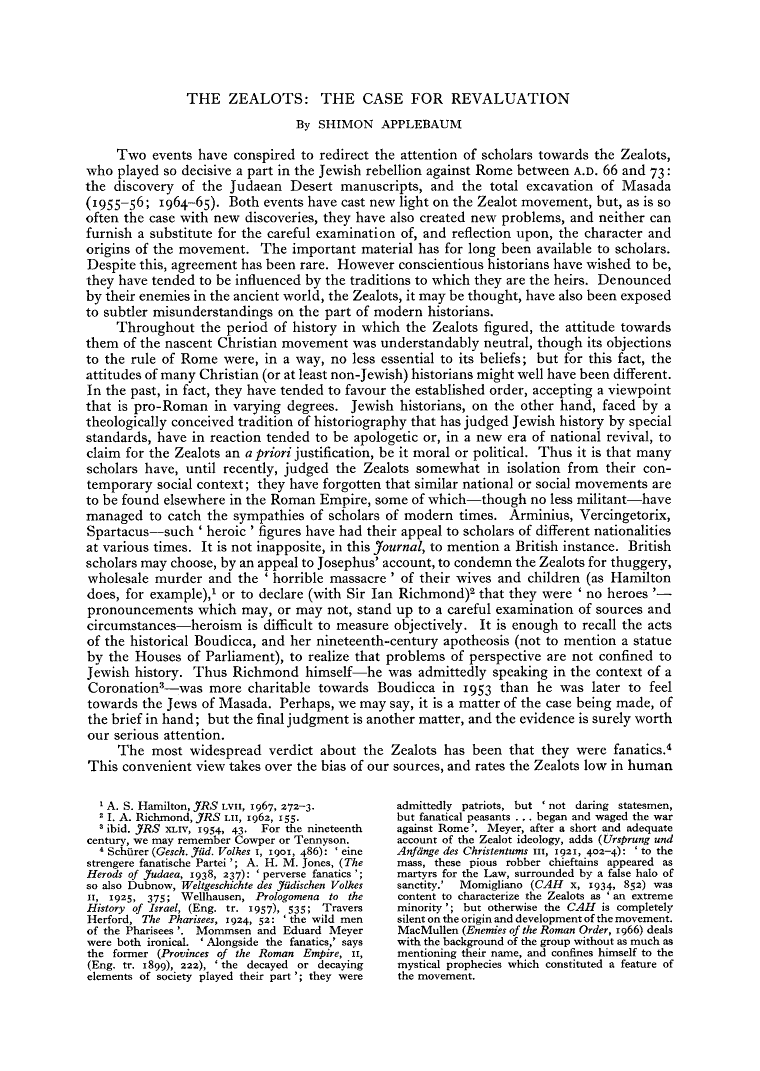
In recent years, scholars have tried to rehabilitate the image of the Zealots and the Sicarii. Here is one such attempt by Applebaum.
Final Act: Hopelessly Defending Jerusalem
In the midst of the Roman Siege of Jerusalem, the defenders were split into several factions. To summarize this hopeless moment: Simon Bar Giora and John of Giscala, the two prominent Zealot leaders, placed all blame for the failure of the revolt on the shoulders of the moderate leadership.
John of Giscala's group murdered another faction leader, Eleazar ben Simon, whose men were entrenched in the forecourts of the Temple.
The Zealots resolved to prevent the city from falling into Roman hands by all means necessary, including the murder of political opponents and anyone standing in their way. There were still people who wanted to to negotiate with the Romans and bring a peaceful end to the siege. The most prominent of these was Yohanan ben Zakkai, whose students had to smuggle him out of the city in a coffin in order to meat with Vespasian. This, however, was insufficient to change the minds of the Zealots' leadership in Jerusalem who instead unleashed a reign of terror upon the population of the city. Josephus describes the stunning variety of savage murders and foolish leadership that led to Jerusalem's grim fall, including the burning of the city's food supply in an apparent bid to force the defenders to fight for their lives.
However, neither did Eleazar once think of flying away; nor would he permit any one else to do so. But when he saw their wall burned down by the fire; and could devise no other way of escaping, or room for their farther courage; and setting before their eyes what the Romans would do to them, their children, and their wives, if they got them into their power; he consulted about having them all slain. Now as he judged this to be the best thing they could do in their present circumstances, he gathered the most courageous of his companions together, and encouraged them to take that course: by a speech which he made to them, in the manner following: (15) “Since we long ago, my generous friends, resolved never to be servants to the Romans, nor to any other than to God himself, who alone is the true and just lord of mankind; the time is now come that obliges us to make that resolution true in practice. And let us not at this time bring a reproach upon our selves for self contradiction; while we formerly would not undergo slavery, though it were then without danger; but must now, together with slavery, chuse such punishments also as are intolerable. I mean this upon the supposition that the Romans once reduce us under their power while we are alive. We were the very first that revolted from them; and we are the last that fight against them. And I cannot but esteem it as a favour that God hath granted us, that ’tis still in our power to die bravely, and in a state of freedom. Which hath not been the case of others, who were conquered unexpectedly. ’Tis very plain that we shall be taken within a days time: but ’tis still an eligible thing to die, after a glorious manner, together with our dearest friends. This is what our enemies themselves cannot by any means hinder: although they be very desirous to take us alive. Nor can we propose to our selves any more to fight them, and beat them. It had been proper indeed for us to have conjectured at the purpose of God much sooner; and at the very first; when we were so desirous of defending our liberty; and when we received such sore treatment from one another, and worse treatment from our enemies: and to have been sensible that the same God, who had of old took the Jewish nation into his favour, had now condemned them to destruction. For had he either continued favourable, or been but in a lesser degree displeased with us, he had not overlooked the destruction of so many men, or delivered his most holy city to be burnt; and demolished by our enemies. To be sure we weakly hoped to have preserved our selves, and our selves alone still in a state of freedom; as if we had been guilty of no sins our selves against God; nor been partners with those of others. We also taught other men to preserve their liberty. Wherefore consider how God hath convinced us, that our hopes were in vain, by bringing such distress upon us, in the desperate state we are now in, and which is beyond all our expectations. For the nature of this fortress, which was in it self unconquerable, hath not proved a means of our deliverance. And even while we have still great abundance of food, and a great quantity of arms, and other necessaries, more than we want, we are openly deprived by God himself of all hope of deliverance. For that fire which was driven upon our enemies, did not, of its own accord, turn back upon the wall which we had built. This was the effect of God’s anger against us, for our manifold sins, which we have been guilty of in a most insolent and extravagant manner, with regard to our own countrymen. The punishments of which let us not receive from the Romans, but from God himself, as executed by our own hands. For these will be more moderate than the other. Let our wives die before they are abused; and our children before they have tasted of slavery. And after we have slain them, let us bestow that glorious benefit upon one another mutually; and preserve our selves in freedom, as an excellent funeral monument for us. But first let us destroy our money, and the fortress by fire. For I am well assured that this will be a great grief to the Romans; that they shall not be able to seize upon our bodies, and shall fall of our wealth also. And let us spare nothing but our provisions. For they will be a testimonial, when we are dead, that we were not subdued for want of necessaries: but that, according to our original resolution, we have preferred death before slavery.”
(יז) כָּל מַחֲלֹקֶת שֶׁהִיא לְשֵׁם שָׁמַיִם, סוֹפָהּ לְהִתְקַיֵּם. וְשֶׁאֵינָהּ לְשֵׁם שָׁמַיִם, אֵין סוֹפָהּ לְהִתְקַיֵּם. אֵיזוֹ הִיא מַחֲלֹקֶת שֶׁהִיא לְשֵׁם שָׁמַיִם, זוֹ מַחֲלֹקֶת הִלֵּל וְשַׁמַּאי. וְשֶׁאֵינָהּ לְשֵׁם שָׁמַיִם, זוֹ מַחֲלֹקֶת קֹרַח וְכָל עֲדָתוֹ:
(17) Every dispute that is for the sake of Heaven, will in the end endure; But one that is not for the sake of Heaven, will not endure. Which is the controversy that is for the sake of Heaven? Such was the controversy of Hillel and Shammai. And which is the controversy that is not for the sake of Heaven? Such was the controversy of Korah and all his congregation.
What defines a Machloket as Leshem Shamayim, an Argument for the Sake of Heaven?
Rabbi Zecharyah Gelley (1933-2018; Rosh Yeshiva in Sunderland, England,
and later the rabbi of K’hal Adath Jeshurun, i.e. “Breuer’s” in New York City)
Hillel and Shammai (and their students) had only one goal–to understand what is written in the Torah. Their relentless pursuit of the truth led them to sometimes disagree; however, if one side proved that its view was correct, the other side gave in (see, for example, Gittin 41b). That is what happens when the goal is discovering the truth. Korach, in contrast, was interested in what he wanted, not in the truth. He cared only about proving that his viewpoint was correct.
Midrash Rabbah relates that Korach refused to reply when Moshe addressed him. Korach knew that he could never best Moshe in a debate, so he chose to keep silent. In contrast, King David writes (Tehilim 119:99), “I have learned from all who taught me.” One whose only interest is ascertaining the truth is not afraid to engage with, and learn from, everyone–even from his students (see Ta’anit 7a).
(Cited by Shlomo Katz, See R Gelley Yeshurun Vol.40, 644)
Concluding Reflection Questions:
- How you do make sense of this history?
- In your own words, what missteps guaranteed the defeat of the Jewish rebellion against Rome?
- For a moment, just presume that this war with Rome, could have been won as Josephus and the Rabbis both imagine. On this Tisha b'Av, what can we learn from this decisive defeat?
- How does the Rabbinic memory distill the lessons of this history?
- What is the essential difference between an argument for the sake of heaven, and one that is not?
- Are these lessons still relevant? In other words, looking back following more than 1900 years of Exile from our land, do you feel that these lessons are big enough, to continue to learn from them all these years later?
(Would you like to read more Josephus? Let me know. Because I find that the more things change, the more they stay the same.)
Tags:
Polarization
No Compromise
Escalation
Public Shaming
Tisha b'Av
Sacred Boundaries
Tacit Consent
Implicated
Tragedy
Infighting