19 Shevat 5776 | January 29, 2016
Parshat Yitro
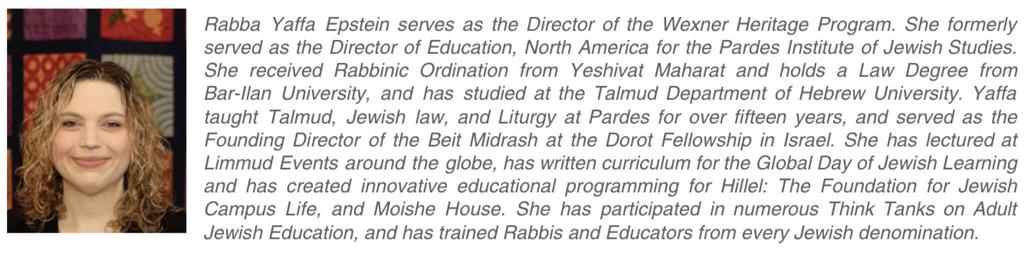
Rabba Yaffa Epstein
Advanced Kollel: Executive Ordination Track Class of 2015
This week’s Parsha describes one of the most extraordinary moments of leadership in the entire Torah. The moment where a leader recognizes his limits and decides to step back from his power. Moshe Rabeinu, in an act of complete humility, which is quite true to his character, is able to hear and listen to Yitro, his father-in-law when he suggests Moshe delegate some of his responsibilities.
We are told Yitro hears about all of the wondrous things that have befallen the Jewish people and comes to join them and Moshe in the desert. After his arrival, he has a chance to observe Moshe and his practice of judging the people. Yitro is greatly disturbed by Moshe’s practice, which causes both the people and Moshe to spend the entire day in judgment or waiting to be judged.
Yitro confronts Moshe, and tells him this is not the correct way to go about doing things. He says: (Shemot 18:17-18)
17 But Moses' father-in-law said to him, "The thing you are doing is not right; 18 you will surely wear yourself out, and these people as well. For the task is too heavy for you; you cannot do it alone.
Rather, Yitro suggests to Moshe that he appoint others to help him. He teaches him to delegate and allow himself to be helped.
This phrase - Lo Tov Hadavar Asher Ata Oseh – It is not good what you are doing – is reminiscent of another time the language of “this is not good” is used.
In the Garden of Eden, after God has created the human being, we are told - lo tov heyot haadam levado, it is not good for a person to be alone. Rather, a person needs someone – an ezer kenegdo – a help mate, a Havrutah, a partner to help them to live in this world.
Interestingly, the Seforno on Breishit 2:18 says that the task of the Human being is to reflect the divine, and a person is unable to fulfill their entire mission if they are bogged down in the daily tasks of life. They will be unable to fulfill the tov – the goodness – of their mission on this earth. Rather, a person needs an equal partner, who is able to reflect for them what their needs are and to work together with them to fulfill their task in this world.
The same idea is clear there – leading and living should not be done in solitude. There is something inherent in the human creation that needs a partner, that needs companionship, in order to fulfill our purpose in this world.
It is poignant that Yitro, Moshe’s father-in-law is the one to point this out, and particularly, at this time when he reunites Moshe with his own family! He brings Moshe’s wife and children and his message to Moshe is – it is not good for you to be alone – neither in your leadership, nor in your life.
It is also fascinating that Moshe learns the lesson of relationship immediately before the Jewish people are to enter into the most important relationship of their history, the covenantal relationship with God, a completely binding contract. It is as if Moshe here acts as a microcosm for the whole Jewish people. Moshe needs to learn the lesson of relationship and how important it is for his own life, and the Jewish people as well, need to work on their relationships before they are to enter into this important relationship with God.
The Midrash Tanchuma on Shmot 19:2 points this out as well. Picking up on the textual difficulty found in this pasuk – where the word Vayachanu (and they camped) changes from plural to singular – from Vayachanu to Vayichan. The Midrash explains this shows the unity of the Jewish people. The Jewish people had to undergo a transformation from being individuals, each person looking out for themselves, full of disunity and disharmony into one being, one body with one heart. In other words, the Torah is only fit to be given to those who have created peaceful and loving relationships.
The Midrash explains to us that this is what is meant by the phrase Darcheha Darchei Noam- that all of the Torah’s ways are ways of pleasantness. The Jewish people first needed to become a people of pleasantness, a people who were able to create peace, a people who were able to prioritize relationships over selfish motives. The Jewish people came to understand that Lo Tov - it is not good – to be divided, to be alone, to be motivated by the self. They understood that they needed to come together, and become one people.
In other words, in order to enter into the covenantal relationship with the Divine, the Jewish people first needed to enter into relationship with each other. They had to understand that no one person is enough and no one person can do it all. Not even Moshe Rabeinu. We all desperately need each other, and we all need to find peace and understanding one for another. If we can do this, then, and only then, will we truly be worthy to have the Divine presence rest upon us.