10 Adar I 5776 | February 19, 2016
Parshat Tetzaveh
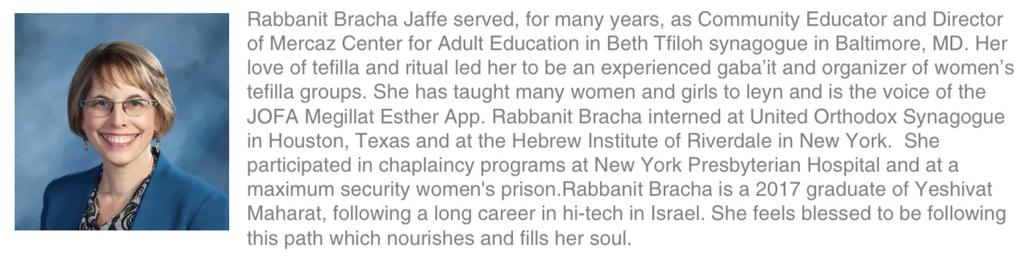
Rabbanit Bracha Jaffe
Class of 2017
In memory of my sister Geela who has since passed away
Originally given as a d’var Torah at the Hebrew Institute of Riverdale
Parshat Tetzave is full of light and gold, shining and dazzling.
And ever since I was a little girl, I have loved this Parsha.
It opens with the olive oil used to light the Menorah and closes with the golden altar for burning incense. In between is a long and fabulous description of the radiant garments of the Cohanim - the priests. Gold, bright blues and scarlet, glittering jewels - Tetzaveh is all brightness and light.
I never imagined that I would see darkness within this light.
And yet...there is one person who has receded into the dark.
That person is Moshe Rabeinu. Tetzave is the only Parasha where Moshe’s name is not mentioned starting from the time of his birth in Shmot - except for the Parshiot in Sefer Devarim when he himself is speaking.
Why does Moshe recede into darkness in this parashah so full of light?
It is curious to note that Moshe recedes into darkness just as Aharon steps into the spotlight.
The commentaries offer various explanations as to why Moshe’s name is absent. The Midrash in Shmot Rabba suggests that it was Moshe who was originally supposed to be the Cohen Gadol - the High Priest. However, at the Burning Bush, Moshe kept protesting to God that he did not want to lead the Israelites. God’s anger was kindled and God took the kehuna - the priesthood - away from him.
Let us imagine what is going on for Moshe.
How does he feel as Aharon dons the clothes originally meant for him?
Perhaps - Moshe is graciously stepping aside to give Aharon room.
Or, perhaps, the lack of Moshe’s name in this Parsha is a hint to what Moshe is going through, surrounded by light, yet shrouded in darkness, struggling with his loss and his disappointment.
I am familiar with this. I have watched people dear to me recede into darkness and withdraw from the world. I have watched family and friends struggle with depression. It hurts to see this. The smiles and joy disappear, replaced by pain and numbness, even an inability to simply get out of bed.
I am not claiming here that Moshe struggled with depression.
But something about the way Moshe’s name is absent brought up for me how other people in my life have seemed to disappear at times into darkness.
This is what I want to talk about today: The Double Darkness of Depression
There is the internal darkness: the feelings of despair and loneliness experienced by the person suffering from depression.
There is also the external darkness that surrounds the person, the empty space they no longer occupy, their very withdrawal making it difficult to still see and remember them.
It is a fact that depression affects 14.8 million American adults.
About 7% of the US population will suffer from depression sometime during their lifetime. This means that there are people with us in this room suffering from depression. There are people in this room who have family members and friends struggling with depression.
I know what this feels like. My sister Geela z”l - my chevruta, my study partner - suffered from depression and other illnesses for over 30 years. She had been hospitalized, she had years of medication and endless therapy.
Learning Torah with her was a joy for me and was a window to the world for her as she was so often housebound. More than anything else - Geela yearned to fully interact with the world but she simply could not. When I told her I would be talking about depression, her voice filled with tears as she said to me:
“Please tell my story. The fact that I can be of assistance about something that is so important to me is very meaningful and gratifying.”
It used to be that people didn’t talk about depression at all.
But now - on the cover of the latest Oprah magazine, in huge letters it says:
“You are not alone!”.
The feature article is about ANXIETY, DEPRESSION, HELP and HOPE.
And - in a recent NY Times article profiling a world-renowned brain surgeon, he opened up about his challenges with depression and psychiatric hospitalization. Twenty years ago, this would not have been part of a medical professional’s public story.
This is good. This is the right way. This brings depression out into the light.
This public discussion is the first step. Now I want to invite you to take the next step. Geela had shared with me:
“The worst feeling isn’t being lonely but being forgotten, feeling invisible.”
Let’s return to Moshe.
We have all seen Moshe mentioned over and over, every week, every Shabbat. And yet...how many of us noticed that Moshe’s name was missing from this Parsha? How many of us did not make it to shul today because of depression? Do we notice each other missing? Do we understand what the other is going through?
Depression can be as debilitating as any other severe medical illness.
But because all of us experience sadness and disappointment at times, we might think we understand depression. It may be hard for us to understand why a person with depression can’t just get over it and move on with his or her life. Many of us subconsciously believe if someone with depression would just try harder, the depression could be managed.
But depression is not sadness, and it cannot be overcome by sheer willpower.
A psychiatrist told me this story about one of his patients:
Andy had a good position in a large company. He was successful in his job, well-liked by his colleagues. It was Friday and he was leaving to go home when he found a “pink slip” in his mailbox.
Andy was devastated! He spent the whole weekend trying to make sense of what happened and why he was fired.
On Monday he was called into the HR office. They apologized profusely - there had been a computer error - the “pink slip” was not meant for him at all!
But while the world slipped back to normal, the shock of what Andy went through slid him into depression. Even after the trigger issue was resolved, the chemical imbalance remained. It required a long treatment of Prozac to help get him back on track.
"You Are Not Alone" is shouted on the Oprah magazine cover, but didn’t Andy feel alone? Didn’t the brain surgeon feel alone? Didn’t Moshe, shrouded in darkness, feel alone? How many of us still feel alone?
This month - February - is Jewish Disability Awareness Month
It is a month to focus on fostering inclusion in Jewish communities worldwide.
You may be saying to yourself:
-
How do I do that?
-
I’m not sure what to say
-
I’m not sure how to act
I get that. I often felt the same way as well.
I saw the impact depression had on Geela’s life.
I would hurt for her. I am her sister and loved her dearly but I too did not always know what to say. I felt awkward. I felt helpless. I missed her so many times during her lifetime.
Each week I would hear the excitement in Geela’s voice as she made plans to attend: A Women’s tefilla, a shiur, a Shabbat meal, a social gathering. Many times she could not show up - even to events that she dearly loved and looked forward to. And so - she was often forgotten and I did not know how to help.
When I am overwhelmed, I often turn to Jewish text and wisdom for answers.
It says in Parshat Ki Tavo: וְהָלַכְתָּ בִּדְרָכָיו - You shall walk in God’s ways.
See what God does and emulate it.
Looking back in Parshat Tetzave, God shows us what to do:
We may think Moshe is forgotten - but God does not forget him.
The very first words in the Parsha are:
|
כ"ז:כ וְאַתָּה תְּצַוֶּה אֶת־בְּנֵי יִשְׂרָאֵל |
20 And YOU shall command the children of Israel, |
The Kli Yakar points out that the word ואתה - YOU - is superfluous.
God could have said: צו את בני ישראל: Command the children of Israel.
I believe that by adding the word ואתה God is sending a loving message to
Moshe: I see you...
Yes, you are in the darkness.
Perhaps you cannot bear to be in the light and be named.
But I have not forgotten you.
Throughout the Parsha, Moshe is very present as God continues to address Moshe lovingly in second person, often adding the word אתה YOU.
We can do that as well...
We cannot fix their depression.
But we can send this message: In person, on the phone, in an email, in a text
I see you. I am here for you. I am listening. I care. You are not alone.
What can we do as a community?
Rav Steven tells us: look around in shul and see if someone is missing. Reach out to him or her. Make sure people know they are not forgotten.
If you are friends with family members of people suffering from depression, be aware of their struggles and be there for them as well. Give them a safe space to listen to them and hold them in their pain and loneliness.
***
We have looked at Parshat Tetzave and seen that even within the light, there can be darkness. The question is: what will we do to help banish the darkness?
In closing, I would like to share with you something that gives me comfort - every night in Tefilat Arvit - the evening prayer.
A dear teacher once illuminated these lines for me. I finally felt there was a tefillah that spoke to my feelings of both helplessness and hope.
We say the following before Sh’ma Yisrael.
|
בורא יום ולילה גולל אור מפני חושך וחושך מפני אור |
God creates day and night Rolling away the light before the darkness And darkness before the light |
Indeed, sometimes God rolls away the light before the darkness. But we know God also rolls away the darkness to make room for the light. May God roll away the darkness and allow light to shine on our lives and the lives of those we love.
Shabbat Shalom!