25 Tammuz 5782 | July 23, 2022
Parshat Pinchas
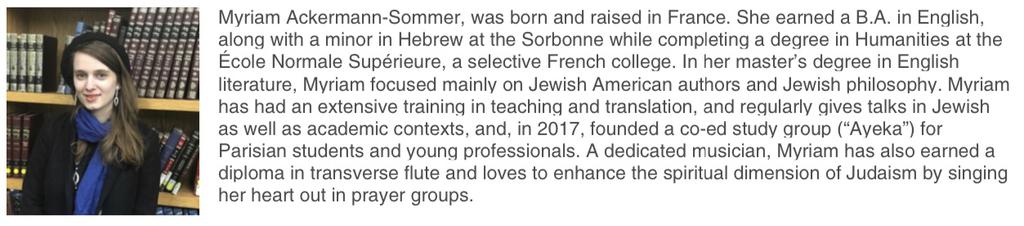
Myriam Ackermann-Sommer
What do the characters of Pinchas and the daughters of Zelophehad have in common? The story of the daughters of Zelophehad could have appeared in Parshat Korach, where they are first mentioned. But their story appears in Parshat Pinchas and indeed, they are much more closely aligned with Pinchas.
At first sight, the differences seem obvious. Pinchas is one man, the daughters of Zelophehad are five women. Pinchas carries out crisis management, while the daughters of Zelophehad pose a carefully considered request. Pinchas’s act of piercing the lovers Zimri and Kozbi with his spear is a violent act, while the daughters of Zelophehad present Moshe with a peaceful demand to receive their share of their father's inheritance and to preserve his name and his memory. While Pinchas acts impetuously, before receiving divine approval, the daughters of Zelophehad wait for Moshe’s acquiescence. Despite all these differences, Pinchas and the daughters of Zelophehad share a common philosophy: human activism in reflection of the divine.
On the other hand, Korach is a revolutionary, who acts on his own behalf, while the daughters of Zelophehad are prudent reformers, who do not act without divine confirmation. In fact, they make the point to Moshe that their father did NOT die as part of the episode of Korach and his followers, further distancing themselves from his parasha.
Parshat Pinchas follows closely after Parshat Korach and Parshat Balak, some of the only portions named after a person. We know that Korach and Balak had serious character flaws, which leads us to question whether Pinchas is regarded as good or bad. At the end of Parshat Balak, Pinchas has just murdered two people. We don’t find out until the following week whether or not this action merits divine approval.
Indeed Hashem approves. Pinchas acted with zeal, echoing Hashem’s zeal, but using that zeal to kill the individual perpetrators rather than destroying the entire people. He was the hero who saved the day.
Pinchas, son of Eleazar son of Aaron the priest, has turned back My wrath from the Israelites by displaying among them his passion for Me, so that I did not wipe out the Israelite people in My passion.
What allows him to override the divine will and take action himself? Was it not such an impetuous gesture that cost the lives of his uncles, Nadav and Avihu, who were also driven by a sacrificial zeal? In his heroism, he is more like Nahshon ben Aminadav, whom the midrash (Mekhilta of Rabbi Yishmael 14:22) describes as having thrown himself into the stormy Red Sea with the Egyptians close behind, allowing the waters to part. Rashi even tells us at the end of Balak that he acts according to a divine law that Moshe had forgotten, the law of “Qanayim pogin bo,” which states that those who are full of zeal can directly intervene by assaulting a Jew who sleeps with a non-Jew. This would explain why it is up to Pinchas to intervene, he who is defined by his zeal, this divinely inspired kin’ah.
Herein lies a major similarity between the stories of Pinchas and the daughters of Zelophehad. In both cases, Moshe does not know how to handle the situation. Moshe seems either clueless or powerless to stop the debauchery among B’nei Yisrael until the arrival of Pinchas, whom Hashem later affirms has behaved correctly. Similarly, Moshe doesn't know what to say to the daughters of Zelophehad until Hashem answers that their request is right.
The actions of Pinchas and Zelophehad’s daughters are characterized by a direct relationship with the divine, which is an active and knowledge-based relationship, based on intuition. And at the same time, there is a deep need to attach this intuition to a law, to a continuity.
Regarding the daughters of Zelophehad, Sifri Bamidbar records my favorite midrash (133:1):
כיון ששמעו בנות צלפחד שהארץ מתחלקת לשבטים ולא לנקבות, נתקבצו כולן זו על זו ליטול עצה.
When the daughters of Zelophehad heard that the land is divided among tribes, and women do not have access to it, they gathered to take advice from each other.
There is strength in unity. Perhaps we should learn from this when we want change, we should aim to make ourselves heard together, as a group. They state:
אמרו: לא כרחמי ב"ו רחמי המקום! ב"ו רחמיו על הזכרים יותר מן הנקבות,
They said: the mercies of Hashem are not like those of human beings who prefer males over females!
Here, the daughters of Zelophehad call out patriarchy by asserting the world we live in has a preference for Men.
אבל מי שאמר והיה העולם אינו כן, אלא על הזכרים ועל הנקבות, רחמיו על הכל, שנאמר (תהלים קמה) טוב ה' לכל ורחמיו על כל מעשיו:
But He Who Spoke and The World Came Into Being is not like this, His mercy is on both males and females, as the psalm says (145:9): Hashem is good to all and His mercy is on all his creations.
Thus, the daughters of Zelophehad push us to affirm that Hashem is egalitarian even if the original wording of the Law is not necessarily so. They argue that the Torah, because it is divine, cannot intrinsically have a preference for one sex over the other. Perhaps, this is proto-feminism. The God of Tehilim cannot, from a logical and ethical point of view, be the God of an injustice who would want to exclude women from the access to the land or from the preservation of the paternal memory. This ethical intuition is validated by Hashem, who calls it a hukat mishpat, a decree of justice. It is only fair that daughters should have access to Eretz Yisrael for the sake of the land and, in the case of the daughters of Zelophehad, for the sake of the father.
To summarize: Pinchas and the daughters of Zelophehad take the lead in the face of a situation they consider problematic or iniquitous. This interventionism is lishma, disinterested, not for their own benefit: Pinchas acts as a representative of Hashem's zealotry to save the people; the daughters of Zelophehad act for the preservation of their father's name, not a desire for personal appropriation. This stands in contrast to Korach, who acted for his own aggrandizement.
This form of activism is based on a knowledge or an intuition of the divine. An intuition of a God of vengeance on the one hand, who cannot allow debauchery and corruption to go on, and God of justice on the other, who cannot deny daughters access to the land. It is the solidity of this intuition that will bring them confirmation with, as we have seen in both cases, a positive evolution of their social status. Is this model of divine intuition an unattainable ideal or something we should aspire to? It is up to us to decide. In any case, it testifies to a consideration of moral intuition in action.
Finally, the names listed in this parsha are significant. Pinchas is named, and perhaps more surprisingly, the daughters of Zelophehad are also named, one by one: Mahla, Noa, Hogla, Milka and Tirtsa. Why more surprisingly? Because in the Torah, perhaps even in the Tanakh, there is a tendency to omit the names of women.
The tribes are only men. But is it possible that all these biblical characters really only had boys? There could not have been a total absence of women in entire generations. Moreover, it is often the midrash that fills in the gaps in the text by adding girls who were not mentioned in the original text. Rabbi Rebibo of Strasbourg asserts that only women who have left their mark on biblical history are mentioned. Men are mentioned because of the responsibilities they assume, and women are mentioned when they stand out, when they know how to bring out an individuality and make themselves heard. In Parshat Pinchas, the daughters of Zelophehad are the perfect example of this voluntary inscription in history and in the text through interventionism. For a woman to be in the Biblical text she must earn it, especially given the preference mentioned by the daughters of Zelophehad of people for men. So it's up to us to try to reach the level of the daughters of Zelophehad, to try to change our reality from within the Law, following its own codes, as we are all doing at Maharat without revolutionary fervor but with the certainty of having a just voice to carry. We will thus write our names in History.