Rosh Hashanah 5777/2016
Rosh Hashana
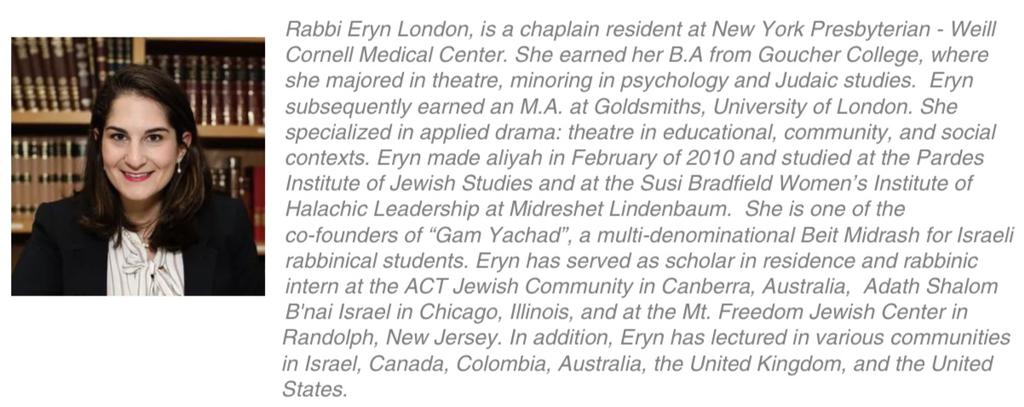
Rabbi Eryn London
Class of 2017
The meaning and significance of Rosh Hashana has changed for me over the years, as I am sure it has for most people. Growing up, my father was the Ba’al Toekah (the one who blew the shofar), and so the excitement of going to shul was not so much for prayer part of the service, but rather for the shofar blowing. Since then, I have gone to services in a retreat center for older adults, a nursing home, and in shuls in both the United States and the Uniked Kingdom. My most memorable prayer services took place during the five years that I spent celebrating Rosh Hashana in Alon Shvut, a Yeshuv in Israel. It was there that I attended services at 5:30am, feeling the chilly wind while walking to shul, but then watching a beautiful sunrise through the progression of the Shacharit (morning) service.
Something that I remember from all of these places is the way that they prayed. What was sung out loud, what was said quietly, and which tunes were used during the service. A regular complaint that is made, especially when one moves to a new shul or there is a new chazen is “they didn’t use my tune”. We all have ideas of what tefilla (prayer) is, what it should be, and how it should sound.
On the first day of Rosh Hashana the Torah and Haftora readings tell us about forms of prayer. In the first few verses of Genesis, Chapter 21, we see that God remembered Sarah, and she gave birth to a son, to Isaac. She praises God for the great gift that she was given, as it says in verses 6-7:
And Sarah said, “God has made joy for me; whoever hears will rejoice over me.” And she said, “Who would have said to Abraham that Sarah would nurse children, for I have borne a son to his old age!”
She was witness to a miracle and her initial reaction was to thank God and praise Him and His actions.
A few verses later (Genesis Chapter 21, Verses 9-18) we hear about Hagar being sent out of the house of Abraham. She and her son Yishmael go into the desert and run out of water. She does not know what to do. She does not know how to help her child or herself, and so she calls out to God in despair. I can almost imagine the image of her leaving Yishmael under a tiny shrub so there is shade, walking a bit further away and just breaking down in tears in the vast desert.
In the Haftorah (Samuel I 1:1-2:10) we read about Chana. Chana was barren just like Sarah. She goes to the Mishkan, the Holy Tabernacle, to pray to God, to plead that she should be able to conceive. She has a different type of prayer than both Sarah and Hagar. She is praying in pain, but not in despair. She goes to the “House of God”, but does not call out loud. She prays silently, with only her lips moving. It is a private prayer or conversation, between herself and God.
There are times that each of these models of prayer are fitting. Over Rosh Hashana and the month of Tishrei, we spend quite a bit of time in shul praying. At times we are given the opportunity to have a quiet conversation with God, pleading for the things that we need or want. At times we are given the opportunity to call out in pain, both our personal suffering, but also for the communal and global pain that we bare witness to. And we are given the chance to sing out loud with the entire community, praising and thanking God for all that we do have.
May this year be filled with times to sing out and praise God, but may we also find words and strength in our times of need.
May you have a happy, healthy and sweet New Year.