Yom Kippur 5777/2016
Yom Kippur
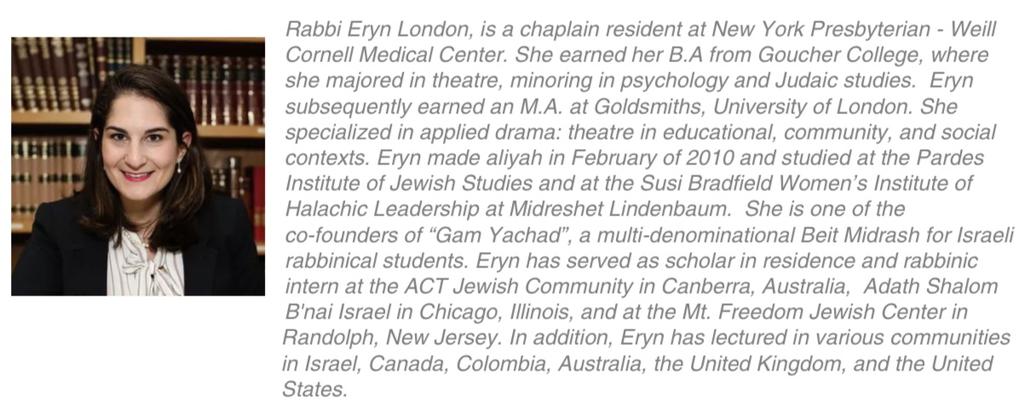
Rabbi Eryn London
Class of 2017
While skimming through the Virgin Atlantic on-flight magazine, I came across an article called “Total Recall”, an article about how many of us have lost the ability to remember because we have the internet to “remember” for us. Bill Aronson says:
Memory is something that I think about often. I directed plays and forced others to memorize pages of text. In my studies I am required to memorize a year’s worth of information for exams. In many roles that I have, people expect me to know certain texts off the top of my head.
But nowhere was the place of memory more poignant than in my work in nursing care. For over four years I worked with residents who have dementia. The resident’s memories did not work in the same way that my memory work for me. Some had no idea what year it was or where they were, but would remember how old I was and that I was not yet married. Part of my job was to be there with the residents: to sit and talk and listen. At times it was easy, hearing stories about their family or friends, or what they did when they were younger. At times I felt helpless because all they wanted was to “go home”, to a place they had not lived in for over 50 years.
I agree with Aronson: there is less of a need to remember things. I don’t need to remember phone numbers because my phone will remember them all for me. I don’t need to remember how to get somewhere because I am able to get detailed directions to almost everywhere I go. I don’t need to remember facts, because as long as it is not a holiday or Shabbat, most likely I will have access to a very quick way to look it up.
At the same time, I don’t believe that Aronson’s theory is completely true. Some things will never be able to be stored in Google or “the cloud.” There are experiences that only we have. The sound of a good friend’s laugh; the imagined worlds created with siblings; the look that you got from your spouse on your wedding day; the feeling of holding your child after they were born. These experiences cannot be saved in the Cloud. These are the memories that make up each and every one of us; they act as our connection with other people.
Remembering is part of the Jewish experience. We are commanded not only to keep the Sabbath, but to also remember the Sabbath. We are commanded to remember the exodus from Egypt. We are commanded to remember what Amalek did to us in the desert.
Over Rosh Hashana, one of the sections of Musaf is called Zichronot, remembrances. It is when we call out to God to remember us. To remember our deeds. To remember the deeds of our foremothers and forefathers. We recite verses from all three sections of the Tanach where God remembered, asking that as He remembered in the past, so to should He remember us now.
It is today, on Yom Kippur that we are told to recall our actions of the past year, that we are also called to remember those who we have lost in our lives. During Yizkor, we are given an opportunity to remember and reflect on our loved ones who are no longer with us. Those we have lost, be it in our recent history or years ago when we were younger. We recall their names and the names of their parents. We remember something special about them, about our connection to them, or even meaningful times we spent with them.
In Deuteronomy 32:7 it says, זְכֹר יְמוֹת עוֹלָם בִּינוּ שְׁנוֹת דּוֹר־וָדוֹר שְׁאַל אָבִיךָ וְיַגֵּדְךָ זְקֵנֶיךָ וְיֹאמְרוּ לָךְ׃
“Remember the days of old; reflect upon the years of [other] generations. Ask your father, and he will tell you; your elders, and they will inform you.” We are commanded to remember our past, our history. We are commanded to learn about and from those who came before us. To learn from the lives they lived; where they struggled and where they succeeded; where they saw miracles; how they influenced the world around them.
According to Yosef Hayim Yerushalmi, at Sinai there was a religious imperative to the entire Jewish people – including those who were not present at the time. From this we can see that there is a continuous connection between the generations. There will always be those who came before us, and there will always be those who come after us -- be it through our children or grandchildren or those who we consider our children and grandchildren and will be carrying our stories, our ideas and our teachings.
According to Deborah Lipstadt,
Yizkor is a time of remembrance, which connects us to those who have passed. Just by remembering, even when our loved ones are not physically with us, we are connected back to the stories, the smells, and the sounds of those who we can no longer see or speak to.
It is through remembering that we can change and grow. It gives us a moment to think back on those who might have had high hopes for us, or believed we could do many things that we might not feel are attainable. It gives us a moment to reflect on the attributes of our loved ones, traits that one might have momentarily forgotten, that one can try to aspire to or learn from. Yizkor is not a time to dwell on the loss, rather it is a time to recollect the legacy that they have left behind. Something that we are still trying to maintain and grow.
Rabbi Jonathan Sacks writes in the introduction to the Koren Yizkor book: