Sukkot 5777/2016
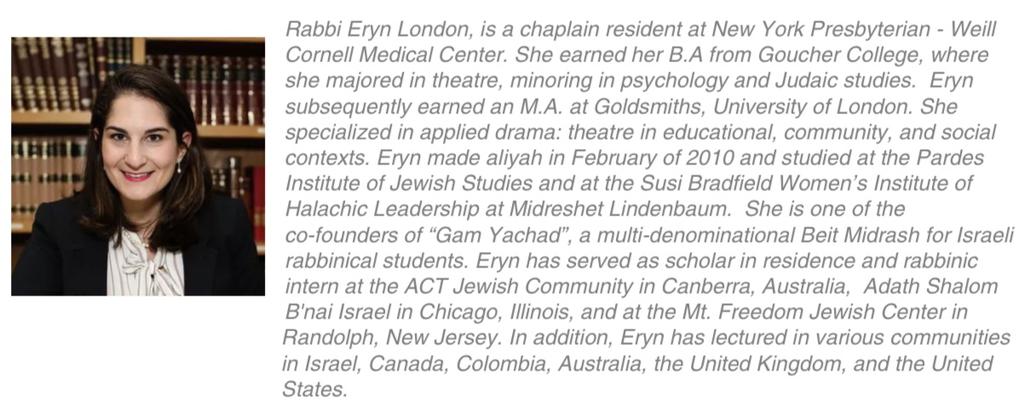
Rabbi Eryn London
Class of 2017
After the intensity of personal introspection of Rosh Hashana and Yom Kippur, Sukkot is the holiday allows for the reintegration into being part of the community.
There are two main mitzvot of Sukkot; taking the Arba Minim (the Lulav, Etrog, Hadasim, and Aravot), and sitting in a Sukkah.
Taking the lulav is an action of the individual. One must have ownership of the lulav they use to fulfill the mitzvah. Additionally, there is an idea that the arba minim represent the different limbs that make up a person.
It is not just that an individual takes the lulav, but the Lulav is the representation of the individual. In a way, one is using themselves to connect to God.
The Sukkah on the other hand is an external mitzvah. It is made outside. We are forced to sit in public places. Everyone around us can hear what is going on. The entrance might be easy to enter, more so than our house are. And unlike the lulav, a person can fulfill the mitzvah of sitting in the sukkah no matter what sukkah they sit in.
The verse “every citizen of Israel shall sit in a sukkah” is the source that teaches us that we must sit in the sukkah, and it is also the source that teaches that there is no maximum size of a sukkah. Theoretically, the gemara explains, there should be a sukkah that could house the entire Jewish people.
In practice such a sukkah would be difficult to build, but the idea of including others in our sukkah is preserved in the custom of Ushpizen. The Zohar teaches the concept of Ushipizen, that each night of Sukkot we invite one of our forefathers and great leaders of Bible into our sukkah.
The Zohar, as well as other texts seem to learn from this that it should not only be a custom of welcoming in spiritual guests, but rather a person has an obligation to bring in physical people as well,
It is the responsibility of those with a sukkah to look outside of themselves, outside of their individual unit and reach out to the people that are living around them.
The seven days of Sukkot are the period that helps us transition from being in the world of the individual to the world of the community. The mitzvah of the 4 species highlights the individual, and encourages continued introspection. While the mitzvah of sukkah forces us to go outside of ourselves, outside of our walls, and to go out of your way to notice who needs an invitation. Together these mitzvot help us in our transition so that we are able to fully celebrate and dance with the Torah, as a community on Simchat Torah.
Shabbat Shalom & Moadim L’simcha.