16 Kislev 5777 | December 16, 2016
Parshat Vayishlach
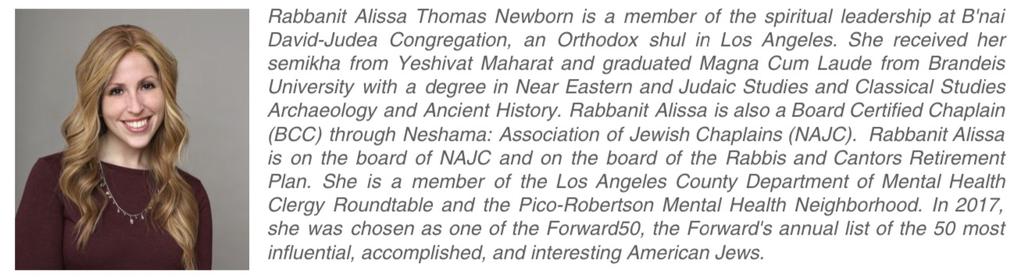
Rabbanit Alissa Thomas Newborn
Class of 2016
What’s in a name?
Twice, in our parsha, Yaakov’s name is changed. First after wrestling with Yaakov, the איש changes Yaakov’s name to Yisrael, כי שרית עם אלקים ועם אנשים ותוכל, for you have struggled with God and with man and have prevailed (Bereshit 32:29). Later on, a second time, we see God change Yaakov’s name to Yisrael as part of God’s bracha, לא יקרא שמך עוד יעקב כי אם ישראל יהיה שמך, your name will no longer be Yaakov but Yisrael (Ibid 35:10).
Why does this name change occur twice in our parsha? And for that matter, why change Yaakov’s name at all? What’s in this new name?
Rashi, trying to make sense of this repetition of name changes, explains that Yaakov’s encounter with the איש was not an actual name change, but instead a foreshadowing, a prelude to the main event of God’s changing Yaakov’s name to Yisrael. Rashi picks upon the future tense verb in the first case, יאמר, you will be called Yisrael-- that is, once God has rightfully changed your name (Rashi on 32:29 לא יעקב).
But even if we can make sense of the multiple name changes, we are still left wondering, why change Yaakov’s name at all?
We know that Avraham and Sarah were given new names by God, and that Yitzchak was named by God. So too, Yaakov needed to be given a name by God as part of his initiation into the role of biblical patriarch.
Yet Yaakov, unlike Avraham, Sarah, and Yitzchak, is known throughout his life by both names, Yaakov and Yisrael. The Midrash brings a penetrating insight here. In Bereshit Rabbah 78:4 we learn, אין לנו שם קבוע, we have no permanent name, משתנין שמותינו, our names change, הכל לפי מצות עבודת השליחות שאנו משתלחים, all according to the work we are commanded to do in the given moment.
Our names change, just like our circumstances and perspectives change. We are influenced by our experiences and the wisdom they give us and have different roles to play. Sometimes I step into the name ‘daughter’, other times ‘wife’, ‘sister’, and ‘friend’. These names are all parts of me that are equally and authentically me. There cannot be a שם קבוע, a fixed name, because we are not קבוע, we are not permanent or unchanging.
Based on this Midrash, God changes Yaakov’s name to teach us that we should not get lost in names and terms. We have a variety of jobs to do in our lifetimes and all of them compose who we are in our entirety. We are both Bnot Yaakov and Bnei Yisrael. Rather than lose ourselves in the fear of unknown change and impermanence, we learn from the Midrash that we must view the multiplicity of potential names as a gift, as a mission through which to serve God.
What’s in a name? Sometimes names can divide and even hurt.
In Shakespeare’s Romeo and Juliet, Juliet discovers that her beloved Romeo is from the Montague family, the arch rival family of her’s, the Capulets. Trying to convince herself that names do not matter, that their families cannot stop their love, Juliet famously says, ‘'Tis but thy name that is my enemy; Thou art thyself, though not a Montague’ (Act II Scene II).
For Juliet, a different name threatens and tears her away from her beloved Romeo. The name ‘Montague’ symbolizes the ‘other’, the ‘enemy’. This is one of the dangers that we face daily when we use names to separate and divide. It is natural to want clarity of terms, but we must genuinely ask ourselves if we are using names to push out difference, to isolate and alienate, to make the ‘other’ even more other. Denominations, political parties, sports fans-- all the names that come with our associations and values are essential and helpful. And yet with those organizing names, we must still develop the sensitivity to hear the needs of both those who are ‘in’ and those who are ‘out’.
Returning to our original question: Why change Yaakov’s name at all? We now see two possible ways of approaching this name change. The Midrash explains that the use of both Yaakov and Yisrael as names teaches us that we live with a multiplicity of names and purposes. Names and people are not meant to be static, and change is a gift. Shakespeare’s Juliet takes this even further. She shows us that names have the potential to draw arbitrary or even painful lines. In this light, Yaakov’s name change challenges us to reevaluate how attached we are to names and whether or not they are helpful.
I would like to offer a third approach that is based on the Aish Kodesh. The Aish Kodesh hones in on the name ‘Yisrael’ itself. Why ‘Yisrael’? At the core of this new name is the word ‘שר’, ‘officer’ or ‘prince’. The Aish Kodesh tell us that Yaakov’s name was changed to Yisrael because, ג׳׳כ שרית לא נפל רוחך בקרבך רק גם אז היית בקרבך שר, even when he was struggling and wrestling, he did not lose sight of the officer, the prince within him. He did not allow his suffering and fear to conceal his dignity and value.
Yes, like the Midrash we have many concurrent names and purposes. Yes, like Juliet we struggle with the divisive potential that names can take on. At our core though, we all actually share the same root name, ‘שר’. We are each officers and princes with invaluable, humbling, and unifying human dignity. This is what Yaakov’s name change teaches us. Even when we are lost, even when we are struggling, we all still share the same name, we are all God’s creations. May we know the unifying potential in a name, ביום ההוא יהיה ה׳ אחד ושמו אחד, that we can bring about that day when God’s name will be one and unified.
What’s in a name? Really--nothing-- and everything all at once.