15 Tevet 5777 | January 13, 2017
Parshat Vayechi
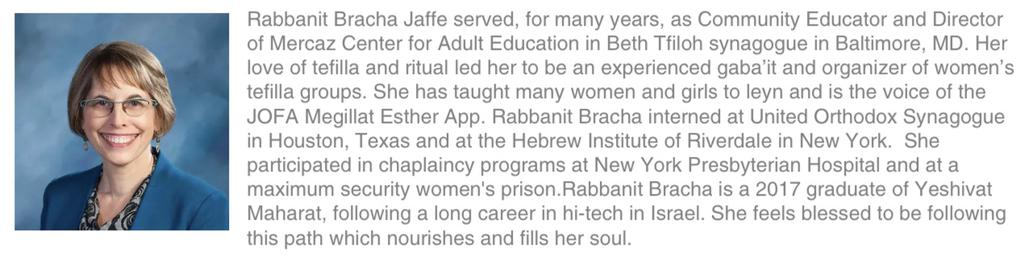
Rabbanit Bracha Jaffe
Class of 2017
In Parshat VaYechi - we find the following encounter. Yaakov is on his deathbed and his children and grandchildren come near to receive his last blessing.
Yosef - his beloved son - enters the room with his children: Menashe and Ephrayim. As was customary, he placed Menashe - the elder son, the bechor - near Yaakov’s right hand, signifying a place of honor. However - to Yosef’s surprise - Yaakov does something unexpected. He crosses his hands - placing his right hand on Ephrayim’s head and his left hand on Menashe’s head.
14 And Israel stretched out his right hand, and laid it upon Ephraim's head, who was the younger, and his left hand upon Menashe's head, guiding his hands wittingly; for Menashe was the first-born.
Yosef was upset and tried to correct his father. But Yaakov insisted that he knew what he was doing. Not only was Yosef upset - a lot of the commentaries are bothered as well. Hadn’t Yaakov learned anything from the trials and travails that Yosef and his other sons went through? Didn’t he realize that favoritism does not work?
The Netziv, Rav Naftali Tzvi Yehuda Berlin of Volozhin, in his commentary on the Torah, gives a beautiful and insightful answer to this conundrum that flips the whole scenario into a positive light.
Imagine yourself in the room and notice where the boys are standing vis-a-vis Yaakov, their grandfather. Yaakov has crossed his arms: Menashe is now standing near Yaakov’s left arm and his right leg. Ephrayim is now standing near Yaakov’s right arm and left leg.
The Netziv explains: Yaakov’s arms (on the top of his body) symbolize the spiritual strengths while his legs (on the bottom of his body) symbolize worldly matters. Yaakov understood that Ephrayim’s strengths lay in cerebral and spiritual matters while Menashe’s strengths lay in the natural world and “getting things done” on the ground.
This position is strengthened by the Midrash in Breishit Rabba 19 which describes Yosef’s right-hand man (הממונה על ביתו) and the one who carried out his word and “got things done” as his son Menashe.
What the Netziv is telling us is that Yaakov knew exactly what he was doing and in fact was very sensitive to the strengths and weaknesses of his grandchildren.
We often quote the verse in Mishlei:
6 Train a child in his own [particular] path, and even when he is old, he will not depart from it.
We know that Yaakov and Eisav developed in striking contrast to each other; Yaakov was a gentle man who lived by his spirit, while Eisav lived by the sword.
R. Shimshon Rafael Hirsch offers this commentary on Yaakov and his twin brother Eisav. He says that not following this path is the precise reason that the brothers developed so differently: Eisav being uncouth and wild while Yaakov was gentle and studious. R. Hirsch presents their parents - Yitzchak and Rivka - as bringing them up in exactly the same manner, without noticing their vastly different temperaments and needs until their personalities were fully formed.
Chazal perceived this need for individualized recognition as well. The Mishna in Avot 2:10-11 lists the five great disciples of R. Yochanan ben Zakai and then adds the following about each one:
הוּא הָיָה מוֹנֶה שִׁבְחָן. רַבִּי אֱלִיעֶזֶר בֶּן הוֹרְקְנוֹס, בּוֹר סוּד שֶׁאֵינוֹ מְאַבֵּד טִפָּה. רַבִּי יְהוֹשֻׁעַ בֶּן חֲנַנְיָה, אַשְׁרֵי יוֹלַדְתּוֹ. רַבִּי יוֹסֵי הַכֹּהֵן, חָסִיד. רַבִּי שִׁמְעוֹן בֶּן נְתַנְאֵל, יְרֵא חֵטְא. וְרַבִּי אֶלְעָזָר בֶּן עֲרָךְ, מַעְיָן הַמִּתְגַּבֵּר.
He used to recount their praise: R. Eliezer ben Hyrcanus - a plastered pit that never loses a drop. R. Yehoshua ben Chanania - happy is the one who gave birth to him! R. Yosi the Priest is pious. R. Shimon ben Netanel - a man who fears sin. R. Elazar ben Arakh - an ever-flowing fountain.
R. Yochanan ben Zakai is teaching us how to raise our students (and our children) - by using focused praise that speaks to each one’s specific strength. And - I would add - where they need encouragement and buttressing.
By the end of Yaakov’s life, he has learned to recognize the importance of individuality; he has taken notice of each of his son’s positive and negative traits and confers his blessings accordingly:
28 All these are the twelve tribes of Israel, and this is it what their father said to them and blessed them; he blessed each of them according to his [particular] blessing.
We would do well to follow Yaakov’s path. When raising our children and when teaching children we must ask ourselves about each and every one:
Where do they shine?
Where do they need help?
What inspires them and what pulls them down?
The answers will guide us along the path to reach each heart and touch each precious soul.