26 Iyar 5782 | May 27, 2022
Parshat Bechukotai
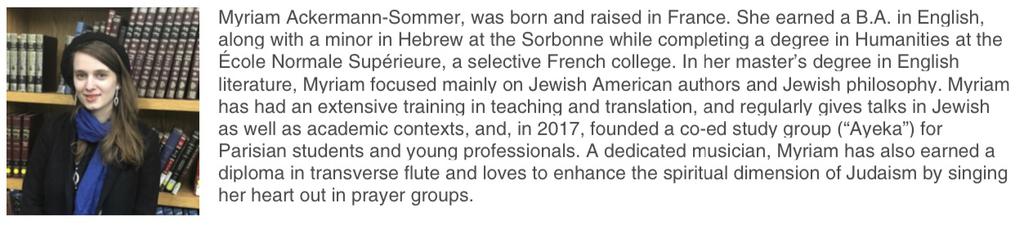
Myriam Ackermann-Sommer
Class of 2023
Is one man really worth two women? Well, that seems to be what we learn in Parashat Bechukotai.
In Vayikra’s final chapter we begin a new subject: the arakhin (estimated values). If a person vows the value of themselves, they must dedicate a prescribed amount of money to the Temple treasury, which will then be used for the Bedek haBayit, the maintenance of the Temple, and other expenses related to the holy place.
The value of each person is determined according to the biblical equivalent of an actuarial table, and is based on both gender and age. Let me summarize the hierarchy of human arakhin.
- A person in the prime of life, between the ages of 20 and 60, must give 50 shekels if he is a man and 30 shekels if she is a woman.
- A person between the ages of 5 and 20 must give 20 shekels if he is a man and 10 shekels if she is a woman.
- A person between one month and 5 years old owes 5 shekels if he is a little boy and 3 shekels if she is a little girl.
- A person over sixty years old gives 15 shekels if he is a man, 10 shekels if she is a woman.
So it is true that I was exaggerating when I said that a man is always worth two women, since this is strictly true only in the 5-20 year age group, but one thing is certain: in each of the four stages of a person's life, the estimated value of a man is greater than that of a woman.
How can we explain this discrepancy? A historicist perspective would allow us to suggest that, at first glance, it would seem that a person's value is estimated according to his or her ability to work. According to a realistic assumption, especially in biblical times, a higher monetary value is attached to a man than to a woman, and the value of each is determined according to his age and productive capacity. Sanhedrin 15a seems to suggest that these sums are consistently the default value of a person in the slave market. In other words, by virtue of innate biological inequalities, men are worth more than women. Judith Antonelli, in her feminist commentary In The Image of God, she argues that men are paid more because they can work harder and carry heavier loads. Mixing historical and apologetic explanations, Antonelli adds that in other cultures, female slaves cost more than men because they were also sold as sex slaves. Citing historian Gordon Murray on slavery in the Arab world, she notes that a white slave woman was four to six times more expensive than a black slave woman, who was more expensive than a man specifically because she could be sold as a sex slave. What the Torah intends to do is to prohibit the sexual slavery of women, reducing the price of men and women to their labor power alone, and it is clear that men are more muscular and more capable of performing heavy work than women.
There are two problems here. First, we must question the statement that a person's best years in the labor market are until the age of sixty. The Torah seems to indicate that the working age is up to fifty, as we read about the Levi'im:
(25) From the age of fifty he shall leave the ranks of Divine service and shall serve no more.
It is also surprising that the value of a person in his most productive years is calculated at fifty shekels, which is much higher than the actual value of a slave:
(לב) אִם־עֶ֛בֶד יִגַּ֥ח הַשּׁ֖וֹר א֣וֹ אָמָ֑ה כֶּ֣סֶף ׀ שְׁלֹשִׁ֣ים שְׁקָלִ֗ים יִתֵּן֙ לַֽאדֹנָ֔יו
(32) If the ox gores a slave or a maid, he shall give the sum of thirty shekels to the master...
Finally, the amount of payment does not take into account the person's health, strength or work potential. Shouldn't the labor of a healthy 62-year-old woman be worth more than that of a sickly 58-year-old man?
Another anomaly is that women often vary in terms of arakhin since, during two stages of life, a woman is worth three-fifths of a man - between the ages of twenty and sixty and from one month to five years. But this ratio is not maintained between the ages of five and twenty. Furthermore, why is the value of a man over sixty (15 shekels) less than its value between the ages of five and twenty (20 shekels), while in the case of a woman there is no difference between these two stages of life, and in both cases the value is 10 shekels? Rashi addresses this issue in his commentary on Vayikra 27:7, quoting the Talmud, Massekhet Arakhin 19a:
שבזכר ושבנקבה מיבעי ליה ומאי שנא נקבה דכי מיזקנא קיימא אתילתא ומאי שנא זכר דלא קאי אתילתא אמר חזקיה אמרי אינשי סבא בביתא פאחא בביתא סבתא בביתא סימא בביתא:
Upon reaching old age, the woman is closer in value to the man; therefore, the man loses more than a third of his value in his old age, (going from 50 down to 15) while the woman loses only a third of her value (going from 30 down to 10). As they say: "An old man in the house is like an obstacle in the house; an old woman in the house is a good sign in the house."
This is very nice but it is not enough.
Rav Amnon Bazak of Yeshivat Har Etzion offers an alternate reading. He suggests that men and women are not at all judged on the same scale because “The value attributed to men is related to a potential for fertility. The value of women is linked to a potential of work.”
For men it is interesting to note that we find the age of sixty mentioned twice in the Tanakh in a different context - that of the end of the fertile years:
וְיִצְחָ֛ק בֶּן־שִׁשִּׁ֥ים שָׁנָ֖ה בְּלֶ֥דֶת אֹתָֽם׃
Yitzchak was sixty years old when they were born.
(21) Then Chetzron came to the daughter of Makhir, the father of Gilad, and he married her when he was sixty years old, and she gave birth to him in Siguv
The only two places in Tanakh where a person is mentioned as being sixty years old concern people who had children at an advanced age. Thus, it would seem that the age of sixty represents the end of the usual period of fertility.
Conversely, twenty, the beginning of the range of a man’s prime, is the age when a man should get married. It is the beginning of the age of building a home, and perhaps the beginning of his years of fertility.
Let us now try to understand why the second highest value is given to the stage between five and twenty years, rather than the one from sixty years and above. In both stages a man is able to achieve fertility, but the stage when he is about to reach his physical peak is not the same as the stage when he becomes old. In a person's later years, sex is no longer considered to have fertile potential, and because of this, the person's value decreases. It is interesting to note that the sum of fifteen shekels is found elsewhere in the context of sexual relations that are not supposed to lead to conception. Here, Hashem metaphorically describes a relationship between the Jewish people and foreign gods, specifying that nothing will come of the relationship:
(2) So I brought her to me for fifteen pieces of silver, a chomer of barley and a letekh of barley.
Rav Hai Gaon notes this connection (as quoted by Rashi in his commentary on verse 3):
We have already mentioned above that the sum of thirty shekels, the maximum value of a woman at the highest stage of her life, is noted in the Torah in a different context: "If the ox gores a male or female servant, he shall pay the master the sum of thirty shekels" (Shemot 21:32). The servant and the maid are worth the same price. We can deduce from this that when it comes to a woman, her value is indeed determined according to her ability to work. The woman loses less in value because she can always work in the house; the man has lost almost all his fertility at the same age as the woman. Beyond the parallelism, we have a fundamental division of evaluations.
It is all very well to have determined that a man pays according to the scale of fertility and a woman according to the scale of the work she can do. But where does that leave me?
Here is how I understand it in my time, in the context in which I live given the premise that the Torah carries a message for all times. For me this text is not asserting a sexist standard but deconstructing our own expectations of what a man's life and a woman's life are worth and mean. We know that we cannot evaluate the value of a person in a spiritual sense, but we can symbolize the orientation of his or her life by assigning a symbolic value that suggests a system of expectations.
According to traditional norms, a man works and a woman makes children. I would therefore expect that the value of a woman would be fixed according to her fertility and that of a man according to his work force. Here it is the opposite. The monetary value of a woman depends on her vigor, and her work force, that of a man, on the potential to have children. Gone is the Jewish mother who gives herself entirely to her home and the Jewish father who works hard outside the home; welcome to the mother who works and the father who begets. In saying this we are following Judith Antonelli's lead in saying that women are not treated as sex slaves in the Torah, but we also go further. This text shatters gendered expectations. So yes, I would go so far as to say that through the prism of the laws of arakhin, it is domesticity, marriage and transmission that characterize the male project; while it is the accomplishment through her actions that the woman dedicates to the Temple, the fruit of her hands, as a good Eshet Hayil or virtuous woman who distinguishes herself through her work and creativity. By turning the tables on traditional expectations and norms, may men and women thrive in a newly found space of freedom.