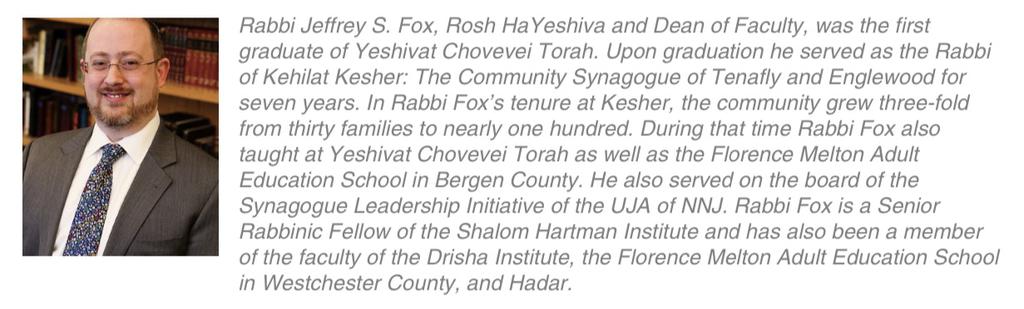
Rabbi Jeffrey Fox
Rosh Yeshiva
Introduction
Are women permitted to receive סמיכה (ordination) according to Jewish law? Yes.
When Yeshivat Maharat opened its doors in 2009, the founders and stakeholders undertook a careful analysis of the various halakhic sources governing the ordination of women. At that time, Rabbi Daniel Sperber and Rabbi Yoel Bin Nun wrote brief תשובות, placing their imprimatur on women and סמיכה. Building on the work that has already been done in this area, at this juncture, I would like to offer an in-depth analysis of two of the central areas in the halakhic debate.
- The nature of סמיכה in the modern period.
- The position of רמב"ם as it relates to שררה.
This paper will be organized into the following sections:
- סמיכה – What does it mean today?
- Understanding the nature of סמיכה in the modern era.
- Women as פוסקות הלכה.
- Mapping the role of the synagogue Rabbi and addressing the concerns therein.
- Understanding concerns of modesty and tradition.
- שררה – What is coercive authority?
- The רמב"ם’s approach to the question of שררה (coercive authority) and his place within the broader halakhic system.
- The debate around suffrage and qualification for office in the early part of the 20th century in Israel.
- Women functioning as משגיחות כשרות – kashrut supervisors.
- The question of women on Synagogue boards.
- Conclusion
I. סמיכה – What does it mean today?
A. Understanding the nature of סמיכה in the modern era.
What is the nature of סמיכה in the modern period? In order to understand this question, we must first look back at the גמרא which outlines the basic contours of this issue. Within the בבלי we can point to three different types of (or phases of) סמיכה.
- First, there was the סמיכה given from Moshe to Yehoshua and that was handed down from generation to generation – איש מפי איש. The גמרא refers to this as מיסמך סבי, “the ordination of the wise (or the elders.)” The details of this kind of סמיכה are given in סנהדרין י"ג ע"ב-י"ד ע"א.
- Second, the גמרא refers to נטילת רשות מבי ריש גלותא או מן הנשיא, “Receiving the permission of the Exilarch (in Bavel) or the Nasi (in Israel).” This type of סמיכה comes with government protections including malpractice insurance (ואי טעה מיבעי למיפטרא). The details of this type of סמיכה are outlined in סנהדרין ד ע"ב-ה ע"א. Note that the first two phases of סמיכה are described in two different סוגיות in the opening chapter of מסכת סנהדרין.
- Third, while describing the סמיכה that is given by the Jewish governmental authorities (נטילת רשות מבי ריש גלותא או מן הנשיא), the גמרא goes on to describe a more informal process of permission granted from teacher to students – נטילת רשות מרבו.
These three different types of ordination seem to function entirely independently of each other. However, over time they came to be viewed as inter-related — not only linguistically, but also legally. The רמב"ם clearly differentiates the third category from the others by listing those laws in פרק ה מהלכות תלמוד תורה, while the first two are codified in פרק ד מהלכות סנהדרין. The laws associated with נטילת רשות מרבו are more closely linked to questions of the appropriate honor and deference accorded to one’s teachers and masters.
However, the first two categories — מיסמך סבי (what has come to be known as “classic” סמיכה) and נטילת רשות מבי ריש גלותא או מן הנשיא — are linked in creative ways by the רמב"ם. He seems to see the relationship as involving much more than just nomenclature, but that the ordination granted by Jewish political authorities is meant to, in some fundamental ways, echo the classic ordination from Moshe to Yehoshua. This connection likely allowed the רמב"ם to innovate the possibility of the renewal of the classic סמיכה through the authority of all (or most) of the Rabbis in the Land of Israel.
Ordination in the modern period is limited to נטילת רשות מרבו. When a student is ordained by a teacher — or a group of teachers — they are being licensed to answer halakhic questions in specific areas of Jewish Law as delineated on the ordination document. סמיכה today is defined as a היתר הוראה (license to pasken) granted from teacher to student.
The גמרא clarifies the nature of the ‘permission’ granted from teacher to student with the following narrative:
אי גמיר רשותא למה לי למישקל משום מעשה שהיה דתניא פעם אחת הלך רבי למקום אחד וראה בני אדם שמגבלין עיסותיהם בטומאה אמר להם מפני מה אתם מגבלין עיסותיכם בטומאה אמרו לו תלמיד אחד בא לכאן והורה לנו מי בצעים אין מכשירין והוא מי ביצים דרש להו ואינהו סבור מי בצעים קאמר...
תנא באותה שעה גזרו תלמיד אל יורה אלא אם כן נוטל רשות מרבו.
If he had already learned, why did he need to receive permission [to pasken]? Because of the following event. It has been taught: One time Rebbi was visiting a certain place and he saw that they were kneading their dough while in a state of tum’ah. He said to them, “Why do you knead your dough in tuma?” They responded to him, “A student once came here and taught (hora) us, ‘water of ponds (bitza’im) does not make food able to become tamei.” When in fact he had taught, “water of eggs (beitzim) does not make food able to become tamei.” And they thought he was referring to pond water… It was taught: at that time they made a decree that no student may issue hora’ah (a halakhic decision) unless they receive permission from their teacher.
The above story teaches us that סמיכה in the modern period is fundamentally a way to make sure that those who are teaching Torah take responsibility for their speech. When teaching Torah, it is essential to express yourself with clarity and precision so that the community understands what is being taught. The clearest statement defining סמיכה in our times can be found in the words of Rav Moshe Isserles (Remah):
דרכי משה הקצר יורה דעה סימן רמב:ב
כתב ריב״ש בתשובה סימן רע״א דין הסמיכה שנהגו בזמן הזה אינו כדי שיוכל הנסמך לדון ואם טעה לא ישלם דלא מהני נטילת רשות זה אלא מריש גלותא או הבא מכחו ונטל רשות ממנו…
וי״ל דסמיכה וזו היא כשהתלמיד הגיע להוראה ומדינא מותר להורות חוץ לשלש פרסאות ואף חייב להורותאלא שגזרו שתלמיד אסור להורות אלא אם כן נטל רשות מרבו או רבו נותן לו רשות לקבוע ישיבה בכל מקום ולדרוש ולהורית לכל הבא לשאול וזהו כשקורין לו רב.
כלומר הרי זה מעתה כאילו איני תלמיד אבל ראוי ללמד לאחרים בכל מקום ולהקרא רב. ואם לא בדרך זה איני רואה שום טעם לסמיכה זו… אבל סמיכה של זמן הזה אינה כלום אלא נטילת רשות בעלמא ולמה שראוי ראוי.
Darkei Moshe (Shortened) Yoreh De’ah 242:2
Rivash wrote in Responsum 271 that the law pertaining to ordination as it is practiced today is not that the ordained person be permitted to judge and if he should err in judgment he would not be liable to pay, for this granting of (ordination) authority is only applicable when bestowed by the Exilarch or his designated representative who received authority…
And one can say that this ordination pertains to when the student attained the status of decisor and according to Jewish Law may render decisions beyond three parsa’ot (Persian miles) and would even be required to pasken, but it was decreed that a student is not permitted to pasken unless he has received permission from his teacher, or his teacher grants him permission to establish a yeshiva in any location and to preach, teach and pasken for anyone who comes to him for guidance; and this is what is meant when someone is called “rabbi.” That is to say, therefore, that from this point forth it is as if he is no longer considered a student but is qualified to teach others in all places and to be called a rabbi. And if it is not [executed in] this fashion I see no rationale for ordination such as this…However ordination in the modern era is nothing but merely the general granting of permission [to pasken] to those who are worthy.
He then restates this position in his glosses on the שולחן ערוך:
הגה ענין הסמיכות שנהגו בזמן הזה כדי שידעו כל העם שהגיע להוראה ומה שמורה הוא ברשות רבו הסומכו ולכן אם כבר מת רבו א"צ לסמיכות וכן בתלמיד חבר כדרך שנתבאר לעיל במקום שא"צ רשות א"צ סמיכות (ריב"ש סי' רע"א ודלא כנחלת אבות פ' שנו חכמים) וי"א דמי שאינו מוסמך למורינו ונותן גיטין וחליצות אין במעשיו כלום ויש לחוש לגיטין וחליצות שנתן אם לא שידוע לכל שמומחה לרבים הוא רק שמצד ענוה ושפלות אינו מבקש גדולות (מהר"ד כהן סי' כ' ומהרי"ו סי' פ"ה וקכ"ב) ויש חולקים ומקילין (תשובת ריב"ש הנ"ל) ובמקום עגון יש להקל אם כבר נתן גיטין וחליצות אבל לא בדרך אחר כי מנהגן של ישראל תורה כן נ"ל ועוד נ"ל שמותר לתת מורינו לאחד שיסדר גיטין ואף על פי שמדין הסמיכה שבימים הראשונים לא הוי דינא הכי מ"מ עכשיו אינו אלא נטילת רשות בעלמא ושרי:
Remah: Regarding the practice of ordination in modern times, [it is done] so that everyone would know that he attained the status of decisor and that which he teaches is with the approval of the teacher who ordained him; therefore, if his teacher has already died, there is no need for ordination. The same is true regarding a peer student (תלמיד חבר)—in similar fashion as to what was explained above—in a place where authority is not required, ordination is [also] not required (Rivash 271 and not like Nachalat Avot in the chapter entitled “Our Rabbis Taught.”)
And there are those who opine that whoever was not ordained with the title ‘our teacher,’ but who writes gittin (divorce decree) and halitsot, his actions are not accepted; and one ought to be concerned regarding gittin and halitsot that he wrote, if it is not known to all that he is an expert to the masses but that due to modesty and humility he does not seek [the glory] of greatness (Mahara”d Cohen Chapter 20 and Mahariv Chapters 85 and 122). There are those who disagree and are more lenient (Responsum of Rivash cited above). And in the case of a nigun one may be lenient if he already gave a get or a halitsah, but not in any other fashion, for ‘the custom of Israel is Torah,’ thus it appears to me. Furthermore it appears to me that our teacher may grant permission for someone to be a mesader gittin (authority to arrange divorces), even though ordination in earlier times did not have this rule, nonetheless today ordination is merely bestowing of authority and is permitted.
Rav Moshe Isserles clearly defines the modern institution of סמיכה as the granting of a kind of license from teacher to student, היתר הוראה. This phenomenon is something different from the first two. It is not: 1) The סמיכה of Moshe to Yehoshua, nor is it 2) permission from the governing authorities. While the one who is ordained is invested with a certain kind of personal authority, that authority is only effectual because the community chooses to grant it. In fact, that is true about (almost) all authority today.
Some have pointed out that Rav Moshe Isserles has a תשובה where he seems to claim that even the modern סמיכה may retain some of the requirements of the classic ordination. In the שו"ת רמ"א כד he deals at length with the status of a שתוקי and whether he may function as a Kohen if the mother claims that the father was, in fact, a Kohen himself. At the end of the תשובה he refers to the position of the רמב"ם that limited סמיכה may only be given to someone who is qualified to receive סמיכה in all areas of Jewish law.
(ח) וְיֵשׁ לָהֶן לְמַנּוֹת כָּל מִי שֶׁיִּרְצוּ לִדְבָרִים יְחִידִים. וְהוּא שֶׁיִּהְיֶה רָאוּי לְכָל הַדְּבָרִים. כֵּיצַד. חָכָם מֻפְלָא שֶׁרָאוּי לְהוֹרוֹת לְכָל הַתּוֹרָה כֻּלָּהּ יֵשׁ לְבֵית דִּין לִסְמֹךְ אוֹתוֹ וְלִתֵּן לוֹ רְשׁוּת לָדוּן וְלֹא לְהוֹרוֹת בְּאִסּוּר וְהֶתֵּר. אוֹ יִתְּנוּ לוֹ רְשׁוּת בְּאִסּוּר וְהֶתֵּר וְלֹא לָדוּן דִּינֵי מָמוֹנוֹת. אוֹ יִתְּנוּ רְשׁוּת לָזֶה וְלָזֶה אֲבָל לֹא לָדוּן דִּינֵי קְנָסוֹת. אוֹ לָדוּן דִּינֵי קְנָסוֹת אֲבָל לֹא לְהַתִּיר בְּכוֹרוֹת בְּמוּמִין. אוֹ יִתְּנוּ לוֹ רְשׁוּת לְהַתִּיר נְדָרִים בִּלְבַד אוֹ לִרְאוֹת כְּתָמִים. וְכֵן כָּל כַּיּוֹצֵא בָּהֶן:
Such judges may appoint whoever they desire for particular matters, provided he is fit to adjudicate all matters. How does this work? A court has the authority to give semicha to a remarkable judge who is fit to issue rulings with regard to the entire Torah and limit his authority to the adjudication of financial matters, but not to what is forbidden and permitted. Conversely, they may grant him authority with regard to what is forbidden and permitted, but not to adjudicate cases involving financial matters. Or they may give him license with regard to adjudicate both such manners, but not laws involving financial penalties, or to rule with regard to financial penalties, but not to rule that a blemish disqualifies a firstborn animal. Or they may give him license merely to absolve vows, to judge stains, or to rule only within other similarly limited parameters.
However, it is clear that we do not apply this limitation to people who receive סמיכה today. As Rav Meshulam Roth has pointed out, the רמ"א must have changed his mind based on the way that he paskens in both the דרכי משה and the הגהות in the שולחן ערוך. If we accept the approach of the רמ"א as authoritative, then סמיכה is fundamentally a היתר הוראה granted from teacher(s) to student(s). We therefore need to address the question of women as פוסקות הלכה — decisors of Jewish Law.
B. Women as פוסקות הלכה
The clearest פסק in support of the permissibility of women as פוסקות הלכה comes from Rav Chaim Yosef David Azulai (the חיד"א) in his commentary on the שולחן ערוך. In חו"מ סימן ז סעיף ד, Rav Yosef Karo codifies that a woman is disqualified as a judge. The חיד"א wrote in his 1011 commentary on חושן משפט:
ברכי יוסף חושן משפט סימן ז ס״ק יב
אף דאשה פסולה לדון, ומכל מקום אשה חכמה יכולה להורות הוראה. וכן מתבאר מהתוספות (יבמות מה: ד״ה מי. גיטין פח: ד״ה ולא. ועוד) לחד שינוייא, דדבורה הייתה מלמדת להם דינים. וכן תראה בספר החינוך דבסימן פ״ג, הסכים דאשה פסולה לדון, ובסימן קנ״ב בענין שתוי כתב וז״ל, ומניית ההורייה וכו׳, וכן באשה חכמה הראויה להורות וכו׳. ע״ש.
Birkei Yosef, Hoshen Mishpat, 7:12
Even though a woman is prohibited from being a judge, in any event an “erudite woman (אשה חכמה)” may render decisions. It becomes clear from Tosafot (Yevamot 45b s.v. mi; Gittin 88b s.v. v’lo and others), according to one explanation, that Devorah would teach them laws. Similarly see in Sefer Ha-Hinukh Mitzvah 83, where he agrees that a woman is prohibited from rendering decisions; and in Mitzvah 152 regarding a drunkard he wrote, “and impeding [the ability] to pasken, etc; and also regarding an erudite woman who is qualified to render decisions, etc.” See in more detail there.
The ברכי יוסף makes clear that the ability to answer questions is based on a person’s experience and wisdom and not their gender. He refers to an אשה חכמה not simply as a theoretical category but rather as a descriptive reality.
Rav Bakshi-Doron wrote similarly in his בנין אב א:סה:
מכל האמור נראה שאשה וגר יכולים לשמש כמנהיגים ואפ׳ לגדולי הדור שכח הנהגתם מחייבת הסמכות. אשה וגר יכולים לשמש מורי הוראה וללמד תורה ופסקים… יכולים הם לדון בלי כפייה. יש ספק אם יכולים הם לקבל סמכויות ע״י בחירות דמוקראטיות שדינם כמי שהקהל קיבלוה עליהם. ולדית הרבה פוסקים הדבר מותר. ולכן יש להקל בדבר, כיון שעצם האיסור יש בה מחלוקת ראשונים , בכל תפקיד יש לחלק ברורות, אם יש בו מכח השמכות או מכח ההנהגה.
From all that was said it would appear that a woman and a convert can serve as leaders and even the ‘greats of their generation’ where the power of their leadership requires authorization. A woman and a convert may serve as decisors of Jewish Law, and to teach Torah and rabbinic decisions… They may judge without coercion. There is disagreement whether they can receive authority through democratic elections was according to Jewish Law they [the elections] are regarded as if the community accepted her upon themselves. And according to many decisors this is permissible. Therefore, one may be lenient on this matter—since the crux of this prohibition is mired in a disputation among the rishonim—and to clarify each role, whether it is based on the power of coercive authority or power of leadership.
Rav Bakshi-Doron’s approach is significant for a number of reasons. First, he makes clear that whatever position might be withheld from a woman must also be withheld from a convert. Second, he accepts the reading of the חיד"א that permits women to function as פוסקות. Finally, he makes an important distinction between leadership (הנהגה) and coercive authority (סמכות).
However, it is important to note that Rabbi Leonard Matanky, the president of the Rabbinical CA at the time, wrote a letter to Rav Bakshi-Doron in June of 2015 asking him to clarify his position. Rabbi Matanky asked Rav Bakshi-Doron if he thought that it was permissible to grant סמיכה to a woman based on the arguments that he put forth.
Rav Bakshi-Doron responded that there are two reasons not to grant a woman הכימס: first, because it appears to be like the Reform movement; second, because it is immodest for a woman to play this role in public. In the middle of those two explanations he wrote:
אמנם כתבתי בתשובה שם שעל פי הלכה יכולה אישה לשמש כמורה הוראה בישראל שכן כתב הרב החיד״א ברכי יוסף (חו״מ ס׳ ז [ס״ק יב]) אולם כל זה בלי כל מינוי או שררה אלא מתוך ידיעתם, אבל כשצריכים הם להתמנות או להסמך אין לסומכן ואין לבחון אותם.
Indeed I wrote in my responsum there, that according to Jewish law a woman may serve as Halakhic decisor for the Jewish People as the Hid”a wrote in the Birkhei Yosef (Hoshen Mishpat 7:[12]). However, all of this is only without an appointment or authority but rather [based on] their knowledge; but in a situation in which they need to be appointed to a position or authorized to serve, they cannot be ordained nor can they be tested [eg. show their mastery of rabbinic subject matter via examination as men would].
He clearly does not want to support the granting of סמיכה to women, but he also does not want to diminish his strong argument pertaining to women as פוסקות or מורות הוראה. While סמיכה today does not grant coercive authority (שררה) and merely serves as a license to decide matters of Jewish Law (היתר הוראה), it would be unfair to claim that Rav Bakshi-Doron is in support of granting סמיכה to women. However, it is still the case that his reasoning helps to provide the basis for which the granting of סמיכה to women can be viewed as within the framework of the מסורה.
C. Mapping the role of the synagogue Rabbi and addressing the concerns therein.
In addition to the fact that סמיכה grants people the permission to decide matters of Jewish Law in particular fields, it also allows someone to lead a community. The roles of a community rabbi vary widely depending on a variety of factors, including the specific communities they serve and the time period in which they lived.
There was a time when the position came along with the requirement to function as a judge. That is simply no longer the case for most community rabbis. Even if this were to be part of the job description, it would be permissible for a woman to serve as a judge on behalf of a community who accepted her authority — as Rav Uziel has shown.
It is fascinating to look at historical documents to get a sense of the development of the ‘job description’ of a rabbi. It is helpful to start with the כתב רבנות, written in 1731 when Rabbi Yaakov Yehoshua Falk, author of the פני יהושע, began to serve the community of Berlin. Here is a list of the eight requirements that are listed in his contract:
- He must display fear of heaven.
- He has to speak twice a year — שבת הגדול and שבת שובה.
- He must function as a judge in monetary cases.
- He must lead davening three times a year — תפילת טל, תפילת גשם ונעילה.
- He receives the third Aliya every Shabbat.
- He is honored to have a special seat in shul by the Western wall.
- He receives a salary.
- He has a place to learn, teach and live.
These eight requirements reflect a set of assumptions regarding the role of the community Rav which are not in consonance with the modern experience. While everyone wants their rabbi to display fear of heaven, and we hope that the rabbi receives a respectable salary, most of these expectations have changed immensely.
Rabbis typically speak at least once every Shabbat and likely more than that. Many rabbis have a מקום קבוע in shul, but that is not always the case. While some rabbis will lead davening, there are many communities in which members lead davening or there is a שליח ציבור. The receipt of סמיכה implies nothing about the person’s voice or permission to lead davening.
Rabbi Yechiel Michel Epstein in his ערוך השולחן wrote a brief outline of the role of the Rabbi:
(כט) וכך הוא בירורן של דברים: דעניין הסמיכה בזמן הזה כדי שידעו כל העם שהגיע להוראה, ומה שמורה הוא ברשות רבו הסומכו. וכתב רבינו הרמ"א דלכן אם כבר מת רבו אינו צריך לסמיכות. וכן בתלמיד חבר אינו צריך לסמיכות. עד כאן לשונו. ולפי הזמנים שלפנינו, ועוד מדורות הקדמונים, שכל עיר בוחרת לה רב מובהק להורות ולדון, ונחשב כרב מובהק לכל העיר והסביבה. ואין רשות לאחר אפילו הגיע להוראה להורות ולדון במקום זה, אלא אם כן נותן לו רב העיר רשות. לזה נותנין לו הסמיכה, כדי שיוכלו לבוחרו לרב באיזה קהילה. אבל בלא סמיכה אסור להיות רב או מורה צדק. וכן נהגו מקדמונינו, וחלילה לשנות. וזהו עיקר עניין הסמיכה בזמן הזה, וזהו כעין נטילת רשות ועדות שהגיע להוראה.
And this is the clarification of the matter. Ordination in the modern era is such that everyone should know that he has attained the status of decisor and that which he teaches is by the authority of the rabbi who ordained him; and our teacher the Remah wrote that “if his teacher is already deceased there is no need for ordination and similarly regarding a peer student (talmid haver) one need not ordain.”
In our times and [also] in previous generations each city chooses for itself a rabbi who is qualified to pasken and to judge, and is regarded as the rabbi to the entire city and its environs. And there is no permission for another—even if they have attained the level of decisor—to render decisions and judgements in this community and place unless the rabbi of the city gives him [express] authority to do so. Ordination is bestowed upon him so that he can be chosen as a rabbi in whatever congregation [and community], without which one is not permitted to be a rabbi or a legal authority. And this was the custom of our ancestors and it is ill-advised to change; and this is the essence of the matter of ordination in our day and it is like granting of authority [to the individual] and testimony that he has earned the right to pasken.
Here, the ערוך השולחן sees the central role of the rabbi as one of deciding matters of Jewish Law (להורות). He also adds an assumption that the rabbi can serve as a judge (לדון). While in some communities that may be the presumption, it is certainly not the case in the vast majority of Modern Orthodox shuls. In the contemporary period many fewer rabbis study for and receive סמיכה in דיינות (ידין ידין) than those who receive the basic היתר הוראה (יורה יורה).
Rabbi Yechiel Yaakov Weinberg in his book of essays לפרקים also produces a list of the core 16 functions of the community rabbi. He lists four main jobs of the current rabbinate:
- A teacher of Torah — מרביץ תורה
- A decisor of Jewish Law — פוסק
- Public speaker — דרשן
- Pastor —לדאוג לחולים, לעניין ולזקנין, לכושלים ולנדכים, בין במובן החמרי ובין במובן הנפשי והמוסרי
- To care for the sick, the poor, the elderly, the weak, the handicapped – both from a physical perspective as well as a spiritual and ethical perspective.
Rav Weinberg’s approach to the rabbinate reflects the reality of the modern pulpit rabbi today. He also displays an understanding that the rabbinate is not only about Torah and Halakha but that it required much more.
It is significant to note the ways in which the roles of the rabbinate have changed from the time of the 1731 (פני יהושע) to the 1954/5 (שרידי אש). Over the course of 300 years the function of the rabbi changed substantially. One might argue that the job description of the contemporary pulpit rabbi has changed even more radically to include CEO, program director, outreach coordinator, caterer and youth director in addition to many of the above roles.
It is also important to separate the role of Rabbi and Chazzan (שליח ציבור). While in smaller shuls the rabbi often leads davening that is not the case in many Orthodox shuls where the membership is empowered to lead tefila. Granting of סמיכה is not related in any way, shape, or form to questions pertaining to the roles that women may or may not play in ritual leadership. When a woman does function in a synagogue it is important to have a strong gabbai in place who can manage and coordinate some of the ritual and logistical issues that take place in the men’s section of the sanctuary.
D. Understanding concerns of modesty and tradition.
The value of modesty or צניעות is extremely important. Some have claimed that the real opposition to the granting of סמיכה comes from a concern about the private role that women are meant to play in the Jewish world. The value of modesty is so important to me that I believe it should be applied to both men and women. The type of immodest behavior sometimes associated with public figures in this country is not acceptable for anyone.
In a deeper sense, I think about modesty as a religious goal that all people need to continue to develop and attain over the course of a lifetime. One would never claim that Moshe Rabbeinu was not a humble person – והאיש משה עניו מכל האדם אשר על פני האדמה (במדבר יב:ג) – and yet he went to Pharaoh, argued with Hashem, and spoke to the entire Jewish People. Moshe was humble because of the way he carried himself, not because he stayed at home.
Rav Uziel wrote beautifully:
שו"ת פסקי עוזיאל בשאלות הזמן סימן מד
ואם באנו לחוש לקח לא שבקת חיי לכל בריה, ואסור יהיה ללכת ברחוב, או להכנס לחנות אחת אנשים ונשים יחד, או שאסור לישא ולתת עם אישה משום שעל ידי כך יבואו לידי קרוב דעת, וממילא גם לידי פריצות, וזה לא אמרו אדם מעולם.
Responsa Piskei Uzi’el On the Questions of Our Time, 44
And if we had come to be concerned about this you would not let any living thing exist, and it would be prohibited for men and women to walk together in the street or to enter a store with each other, or that it would be prohibited to do business with the woman for through this they will come to “closeness of knowledge,” and one way or another also to licentiousness, and [the above statements] were never said by anyone!
He understood that normal healthy interactions between men and women were a natural part of our lives. One could also argue that given the intimate nature of some of the questions the people ask their rabbi, that it would more appropriate — under some circumstances — to have that conversation with someone of the same gender. There is something unsettling about women bringing their underwear to a male rabbi for evaluation. For this reason among others, it is imperative that there be more women fully trained to answer those questions in order maintain appropriate boundaries and צניעות.
Rav Shlomo Wolbe in his ספר דעת שלמה: מאמרי גאולה - בעניני גאולה, פורים ופסח wrote beautifully about the value of צניעות:
כלל הכולל את הכל: אמונה ועבודה, התנהגות והשגה - ״יושב בסתר עליון בצל ש-די יתלונן״. רוחניות נמצאת רק בסתר ובצניעות. בגילוי הנתפס בעיני בשר לא תימצא אמונה, וניתן לומר שמי שאין לו צניעות אינו יכול להיות מאמין.
ממילא כל עבודה צריכה להיות בהצנע לכת, כל התנהגות האדם, כי רק מי שמצניע לכת הוא ״עם ה׳ אלוקיו״, וגם כל השגה תושג רק בהצנע לכת…
ופשוט הוא כי ״צניעות״ הוא בסגנון חיים מושלם, לא רק עניין של לבוש, אלא הנהגה המקיפה את כל החיים במחשבה דיבור ומעשה.
A general principal that includes all matters: faith and service, behavior and understanding – One who dwells in the shelter of the most high, lives in the shadow of the Almighty (Psalms 99:1). Spirituality can only be found in that which is hidden and in humility. In revelations that are perceived by human flesh you will not find faith, and one might even say that one who does not have humility cannot be a true believer.
In any case, all service must be done modestly, any act which man performs, as only one who acts modestly is “with the Lord his God”. Any understanding will be achieved only by acting modestly…
It is clear that “modesty” is expressed as a complete lifestyle, not only in dress, but behavior that encompasses all life; and thought, speech and deeds.
When understood as a core religious value and not simply as a rule about dress, צניעות becomes a reason to encourage women to play a unique role within spiritual leadership. Women have already begun to answer questions in areas of intimacy and it has brought more questions to the table. The fact is that people want to talk to someone of their own gender about the issues that are of vital importance to their lives. Granting women סמיכה and placing them in roles of leadership is a fulfillment of these values.
II. שררה – What is coercive authority?
When the Histadrut, in the early 1910s, was deciding on the question of whether or not women would be given the right to vote or to be elected, there was a fierce מחלוקת. The positions of Rav Kook and Rav Uziel were clearly articulated and formed the backbone of the debate.
Nearly the same analysis was then applied to the question of women as משגיחות כשרות by Rav Moshe Feinstein. Then, in the 1970s, the same debate centered upon the question of women serving as members of synagogue boards or as presidents of synagogues. In each generation there were those who opposed and those who supported this move forward.
The argumentation set out by Rav Uziel and Rav Hayim Hirschensohn regarding questions of suffrage and qualification for office were applied time and again to subsequent questions relating to women and authority within the Orthodox community.
A. The רמב"ם's approach to the question of שררה (coercive authority) and his place within the broader halakhic system.
Much of the debate surrounding the question of the granting of ordination has focused on the issue of authority and the limiting approach of the רמב"ם. This section will help to locate the source of the רמב"ם's approach as well as the position of the majority of other ראשונים.
רמב"ם in his משנה תורה wrote:
(ד) אֵין מַעֲמִידִין מֶלֶךְ מִקְּהַל גֵּרִים אֲפִלּוּ אַחַר כַּמָּה דּוֹרוֹת עַד שֶׁתִּהְיֶה אִמּוֹ מִיִּשְׂרָאֵל. שֶׁנֶּאֱמַר (דברים יז טו) "לֹא תוּכַל לָתֵת עָלֶיךָ אִישׁ נָכְרִי אֲשֶׁר לֹא אָחִיךָ הוּא". וְלֹא לְמַלְכוּת בִּלְבַד אֶלָּא לְכָל שְׂרָרוֹת שֶׁבְּיִשְׂרָאֵל. לֹא שַׂר צָבָא וְלֹא שַׂר חֲמִשִּׁים אוֹ שַׂר עֲשָׂרָה. אֲפִלּוּ מְמֻנֶּה עַל אַמַּת הַמַּיִם שֶׁמְּחַלֵּק מִמֶּנָּה לַשָּׂדוֹת. וְאֵין צָרִיךְ לוֹמַר דַּיָּן אוֹ נָשִׂיא שֶׁלֹּא יְהֵא אֶלָּא מִיִּשְׂרָאֵל. שֶׁנֶּאֱמַר (דברים יז טו) "מִקֶּרֶב אַחֶיךָ תָּשִׂים עָלֶיךָ מֶלֶךְ" כָּל מְשִׂימוֹת שֶׁאַתָּה מֵשִׂים לֹא יְהוּ אֶלָּא מִקֶּרֶב אַחֶיךָ:
(ה) אֵין מַעֲמִידִין אִשָּׁה בְּמַלְכוּת שֶׁנֶּאֱמַר (דברים יז טו) "עָלֶיךָ מֶלֶךְ" וְלֹא מַלְכָּה. וְכֵן כָּל מְשִׂימוֹת שֶׁבְּיִשְׂרָאֵל אֵין מְמַנִּים בָּהֶם אֶלָּא אִישׁ:
Halakha 4
We do not establish a king from among the community of converts even after many generations, until his mother is a born Jewess as it says, “you cannot place over yourself a foreign man who is not your brother.” This not only applies to kingship but to all power positions [serarot] in Israel. [A convert] may not be a chief of the army, a commander of fifty or a commander often. He may not even be appointed to control springs of water from which fields are irrigated. Certainly he may not become a judge or prince.
Halakha 5
A woman may not be established as a monarch as it is said, You shall set over you a king, but not a queen. Similarly, with regard to all appointments in Israel, only a man may be appointed to them.
The classic ad locum מפרשים of the רמב"ם point to the ספרי in שופטים, פיסקא קנז as the source of הלכה ה.
The ספרי extends the limitation of anointing a non-Jew as king to any other appointments of non-Jews to positions of authority.
(י) איש נכרי. [מכאן אמרו (יבמות מה), אין ממנים פרנס על הצבור, עד שתהא אמו מישראל].
(יא) אשר לא אחיך הוא. [זה העבד]. (סוטה מא) כשהיה אגריפס מגיע לזה, היה בוכה עד שהיו גלגלי עיניו דומעות. והיו אומרים לו כל ישראל, "אל תירא אגריפס. אחינו אתה, אחינו אתה".
A foreign man (Deuteronomy17:15)–from here [the rabbis] said that you may not appoint a leader of the community who is not from your kin. When Agripas the king would reach this verse he would cry. The Jewish People would say to him, “You are our brother, you are our brother.”
A similar halakhah is found in the גמרא:
רָבָא אַכְשְׁרֵיהּ לְרַב מָרִי בַּר רָחֵל וּמַנְּיֵיהּ בְּפוּרְסֵי דְּבָבֶל, וְאַף עַל גַּב דְּאָמַר מָר: ״שׂוֹם תָּשִׂים עָלֶיךָ מֶלֶךְ״ — כׇּל מְשִׂימוֹת שֶׁאַתָּה מֵשִׂים אַל יְהוּ אֶלָּא מִקֶּרֶב אַחֶיךָ, הַאי, כֵּיוָן דְּאִמּוֹ מִיִּשְׂרָאֵל — ״מִקֶּרֶב אַחֶיךָ״ קָרֵינַן בֵּיהּ.
Rava said that Rav Mari bar Rachel was kosher and appointed him as an officer in Babylonia. And even though the master has taught, “A foreign man (Deuteronomy17:15) –from here [the rabbis] said that you may not appoint a leader of the community who is not from your kin.” This man [Rav Mari] is considered of your kin because his mother is Jewish.
The law articulates the requirement for leadership - whether for the king or for any position of authority - as being limited to those people who are “מקרב אחיך - from among your brothers (or kin).” The ספרי and the גמרא together clearly extend the limitations of leadership to exclude those who are not your kin beyond the arena of kingship. The רמב"ם, however, took the additional step of extending the same limitations not only to converts, but also to women.
It is therefore difficult to regard this passage in the ספרי or the גמרות as the proof-text for the רמב"ם. In fact, Rav Moshe Feinstein, Rav Eliyahu Bakshi-Doron, Rabbi Hayim Hirschensoh and Rabbi J. David Bleich are all at a loss to locate a true source for the רמב"ם. Rav Hirschensohn refers to a passage in פסיקתא זותרתי but is himself unconvinced.
It is significant that in the Finkelstein edition of the ספרי there appears to be an explicit version of this text that may be the source for the רמב"ם:
איש נכרי. [מכאן אמרו (יבמות מה), אין ממנים פרנס על הצבור ,עד שתהא אמו מישראל]. אשר לא אחיך הוא. [זה העבד]. (סוטה מא) כשהיה אגריפס מגיע ל זה, היה בוכה עד שהיו גלגלי עיניו דומעות. והיו אומרים לו כל ישראל, "אל תירא אגריפס. אחינו אתה, אחינו אתה".
A foreign man (Deuteronomy17:15)–from here [the rabbis] said that you may not appoint a leader of the community who is not from your kin. When Agripas the king would reach this verse he would cry. The Jewish People would say to him, “You are our brother, you are our brother.”
On the face of it this seems to be the obvious source for the רמב"ם. This passage extends the same the limitations of leadership to women as the printed edition did for converts. It is possible that the text in the Finkelstein edition was inserted by the editors on the basis of the רמב"ם, but I find this very hard to believe. We will need to look carefully at other ראשונים who deal with similar issues to find if this text was adopted by any other authorities.
In the final analysis, the רמב"ם has almost unchallenged and incontrovertible authority within the history of halakhah such that he can make a claim that does not necessarily have a source within חז"ל. The question that we need to analyze is how did other ראשונים grapple with this same issue and do they pasken on this question explicitly?
There appears to be only one other ראשון that relies on this text and therefore would agree with the position of the רמב"ם. The ריטב"א, in addressing the question of the status of Devorah — the prophetess and judge — says the following:
ומה שאמר הכתוב על דבורה (שופטים ד') והיא שפטה את ישראל, וכתיב נמי ויעלו אליה בני ישראל למשפט, זה שהיו מתנהגים על פיה לא בתורת מינוי דהא אמרינן בספרי שום תשים עליך מלך (דברים י"ז) ולא מלכה והוא הדין לשאר משימות, אלא שמתנהגים על פי עצתה, או שקבלוה עליהם לדין שהמקבל עליו לדין ולעדות קרוב או פסול דינו דין ועדותו עדות כדאיתא בפרק דיני ממונות (סנהדרין כ"ד ע' א).
And that which Scripture says in Judges 4, “And she judged the Jewish People” and it is also written, “And the children of Israel came up to her for adjudication” means that they would behave according to her words –not as an appointed position, for the Sifrei says in Deuteronomy 17, ‘you must certainly appoint upon the People a King–and not a queen’ and such is law for all other appointments. Rather, this means that they would behave according to her advice, or they accepted her upon themselves as a judge. For one who accepts as a judge or witness a close relative or an invalid [witness or judge], their judgement stands and their testimony is accepted, as the Gemarah says in Sanhedrin 24a.
The question that is bothering the ריטב"א was not a new one, but his answer is different from nearly all other ראשונים who address the problem. If indeed we accept that women are not permitted to sit as judges in halakhic cases, how could the Jewish People have turned to Devorah as a judge?
Contained within the answer of the ריטב"א is a reference to the extension of the limitation on women’s leadership outside of the arena of kingship
בספרי שום תשים עליך מלך (דברים י"ז) ולא מלכה והוא הדין לשאר משימות
In the ספרי: you shall surely appoint a king - a king and not a queen, and such is the law for all other appointments.
It remains unclear whether the ריטב"א is quoting the Finkelstein ספרי or simply assuming the halakhah as cited by the רמב"ם. Regardless, this passage from the ריטב"א clearly is in consonance with the פסק of the רמב"ם.
What about the majority of ראשונים? The intellectual tradition from which the ריטב"א emerged did not seem to agree with his approach. Here we can see the overwhelming position of ראשוני ספרד:
ושמעינן ממתני' דאשה אינה כשרה לדון דכיון דפסולה להעיד פסולה לדון כדתנן כל הכשר לדון כשר להעיד וכלל גדול הוא ולמדין ממנו.
וכן אמרו בירושלמי (ד,א) שאין האשה מעידה ואין האשה דנה ומאי דכתיב והיא שופטה את ישראל פירושו מנהגת שעל פיה ובעצתה היו נוהגין זה עם זה כדין מלכה ואע"ג דאמרינן בספרי שום תשים עליך מלך ולא מלכה נוהגין היו בה כדין מלכה אי נמי מקבלין היו דבריה ברצונם.
And we learn from our Mishna that a woman is not fit to serve as a judge. For since she is disqualified from testimony she is also thereby disqualified from judgment as we learn in Niddah (49b), “whoever is approved to judge is approved to testify and it is a central principle from which we learn much.” And thus it says in the Yerushalmi, “A woman may not testify, a woman may not judge.”
And that which is written, “And she Judged the Jewish People” means that she was a leader. They would behave with one another based on her words and her advice and treated her with the status of a queen.
And even though it says in the Sifrei, “You shall certainly place on yourself king–and not a queen; they [the Jewish People] nonetheless would treat her with the status of a queen. Alternatively, they accepted her words of their own free will.
ואם תאמר הא כתיב (שופטים ד, ד) והיא שופטה את ישראל, יש לומר דלא שופטת ממש אלא מנהגת כשופטים ששפטו את ישראל, ואף על גב דאמרינן בספרי (דברים שופטים כט) שום תשים עליך מלך ולא מלכה, התם לא מנו אותה אלא נוהגין היו על פיה, ואי נמי שופטת ודנה שהיו מקבלין אותה כדרך שאדם מקבל אחד מן הקרובים.
And if you will ask, but behold it is written that she judged the Jewish People? One can answer that she did not really judge but rather lead like the shoftim in Israel. And even though it says in the Sifrei, “You shall certainly place on yourself king–and not a queen; they [the Jewish People] nonetheless would treat her with the status of a queen. Alternatively, they accepted her in similar fashion to someone accepting one of the close relatives.
ולא בפסולין כגון גזלן שהוא פסול מן התורה אל תשת וגו' להיות עד חמס. אלא בראויין להעיד... ומדתנן ולא בנשים שמעינן שהנשים פסולות לדין שאילו היו דנות היאך יהו פסולות להעיד והא דתנן בפרק בא סימן (דף מט:) כל הכשר לדון כשר להעיד והא דכתיב גבי דבורה והיא שופטה את ישראל לאו שופטת קאמר אלא מנהגת ואע"ג דאמרינן בסיפרא שום תשים עליך מלך ולא מלכה התם לא מנו אותה אלא נוהגין היו על פיה וא"נ שופטה ודנה היתה שהיו מקבלין אותה כדרך שאדם מקבל אחד מן הקרובים:
We learn from here that women are disqualified from judgement. For if they could judge, how could they be disqualified from testimony. And that which was taught in the sixth chapter of tractate Nidda (Mishna 4, page 49b) ‘all who are fit to judge, are fit to testify’ (seem to contradict) that which is written regarding Devorah and she Judged the Jewish People? She was not a judge, but rather a leader. And even though it says in the sifrei “You shall certainly place on yourself king–and not a queen; there[in the context of Devorah] they did not appoint her, rather they simply behaved according to her words. Additionally [we could also say that], she in fact judged and adjudicated, for they accepted her as one might accept a close relative [as a judge].
שם בגמרא ולא בנשים מיהא שמעי' שהנשים פסולות לדון שאלו היו כשרות לדון היאך יהו פסולות להעיד והא תנן בפ' בא סימן כל הכשר לדון כשר להעיד: וא"ת והא כתיב גבי דבורה והיא שפטה את ישראל וכו'. י"ל דלא שופטת ממש אלא מנהגת. ואף על גב דאמר בסיפרי שום תשים אליך מלך ולא מלכה התם לא מנו אותה אלא נוהגין היו על פיה וא"נ שופטת ודנה שהיו מקבלין אותה כדרך שאדם מקבל אחד מן הקרובים.
From here we learn that women are disqualified from judgement. For if they were fit for judgement how could they be disqualified from testimony. For it was taught in the sixth chapter of tractate Nidda (Mishnah 4, page 49b) ‘all who are fit to judge, are fit to testify’ (seem to contradict) that which is written regarding Devorah and she Judged the Jewish People ?She was not a judge, but rather a leader. And even though it says in the Sifrei “You shall certainly place on yourself king–and not a queen; there [in the context of Devorah] they did not appoint her, rather they simply behaved according to her words. Additionally [we could also say that], she in fact judged and adjudicated, for they accepted her as one might accept a close relative [as a judge].
All of these ראשונים are dealing with the same question of the puzzling status of Devorah and they offer similar answers. It is significant that none of them make the extrapolation that the ריטב"א made to other appointments. In addition, as part of their answers they refers to Devorah as “מנהגת - leading.” It would be difficult for the רמב"ם or the ריטב"א to use that terminology because, for them, appointed leadership of any kind is prohibited.
These ראשונים even go one step further and say that a woman may attain the status of queen if people relate to her in that way so long as she is not appointed in a coercive fashion. Even if we do not accept this in practice, it is clear that they all rejected the רמב"ם and ריטב"א.
In commenting on the beginning of the fourth chapter of שבועות which outlines the removal of women from testimony, many ראשונים raise the same question and use similar language. The רשב"א and the ר"ן both articulate a similar approach, though with additional answers to the Devorah question.
In addition, when the בעלי התוספות address this question throughout ש"ס they offer three 37 different answers: 1) Women are, in fact, permitted to judge. 2) Devorah was not a judge but a teacher of judges. 3) Since the community accepted her leadership it was permissible.
All three answers are summarized by the ספר החינוך:
בנשים, שאינן דנות, כמו שאמרנו למעלה בהרבה מקומות. ואל יקשה עליך מה שכתוב בדבורה הנביאה (שופטים ד ד) והיא שפטה את ישראל, שאפשר לנו לתרץ שלא היה הדין נחתך על פיה, אבל היתה אשה חכמה ונביאה והיו נושאין ונותנין עמה אפילו בדברים של אסור והתר ודינין גם כן, ולכן כתוב עליה והיא שפטה את ישראל וכו', או נאמר שקבלוה עליהם ראשי ישראל ואחריהם כל אדם לדון על פיה, דבקבלה ודאי הכל כשרים, דכל (כתובות נו א) תנאי שבממון קים. ומכל מקום כל זה שאמרנו שאינן דנות, הוא כדעת קצת המפרשים וכדעת הירושלמי (סנהדרין ג ט) שכן נמצא שם מפרש. אבל לדעת קצת מן המפרשים, כשרות הן לדון. ואמרו כי מקרא מלא הוא שנאמר והיא שפטה.
And women may not serve as judges as we said above on many occasions. And that which is written regarding Devorah the prophetess and she judged the Jewish People should not bother you.
1) For we could answer that the judgment was not decided (literally: cut) on her word, but rather she was a wise and prophetic woman and they [the community] would ask her questions of what was prohibited and permitted and even regarding matters of Jewish Law. Therefore the [Navi] wrote about her that ‘she judged the Jewish People.’
2) Or one could say that the heads of the community accepted her as an authority upon themselves and that everyone else followed suit to be judged by her. Because in a situation in which people ‘accept’ the authority of the judge, certainly all are kosher because one can always make conditions on matters of monetary law.
3) And nonetheless, that which we said that women may not judge is only in accordance with some of the commentators. As is stated explicitly in the yerushalmi (Shevu’ot 4:1, Sanhedrin 3:9). But according to some of the commentators women are acceptable as judges as the verse says openly, “and she judged the Jewish People.”
Regardless of which answer within תוספות we regard as the most reasonable, they all appear to reject the רמב"ם. In addition, the רא"ש cites the same answers as the בעלי התוספות. The חינוך in a number of different places clearly rejects the רמב"ם as well.
It becomes overwhelmingly clear that the positions of the רמב"ם and the ריטב"א are minority voices within the annals of the history of halakhah. Much of what is outlined above can be seen in Rav Moshe Feinstein’s two תשובות about the permissibility of having women serve as משגיחות כשרות. Rav Moshe makes it clear that he thinks that the רמב"ם and ריטב"א represent a minority opinion. Nonetheless, he attempts to make the claim that even according to them it would be permissible to have a woman serve as a משגיחה. We will return to Rav Moshe below.
B. The debate concerning suffrage and qualification for office in the early part of the 20th century in Israel.
We can now understand the shape of the arguments about: passive and active suffrage, women as משגיחות כשרות, women on synagogue boards, as well as the question of סמיכה. The analysis will be nearly the same in each instance.
First, people will debate if we pasken like the רמב"ם (and ריטב"א). Those who want to accord women more leadership opportunities will emphasize the fact that the רמב"ם seems to be very much a minority opinion. Those who want to limit women’s access to this kind of authority will try to move more ראשונים to align with the רמב"ם. Even those who are inclined to permit women, for example, voting rights, will center their argument within the approach of the פוסקים .רמב"ם will then analyze the specific issue at hand to see if it falls within the rubric of שררה according to רמב"ם.
In the early part of the 20th century this issue was being raised the world over. In 1917 among the very few countries which allowed women to vote were: Finland, Norway, Denmark, Iceland and Russia. By 1925 nearly all of the Northern European countries as well as America (1920) granted women the right to vote. However, no country around the Mediterranean basin had yet granted women that right. The Balfour declaration of November 1917 forced this issue in Palestine as the new Yishuv would be forced to elect a governing body. Elections were called for October 1919 and the Second Constitutive Assembly had decided in June of 1918 that women would be permitted to vote and could also be elected to office.
The religious community was quite literally torn apart over this issue. This is what caused the עדה החרדית to split off from the אגודה. The old Yishuv was fighting amongst its פוסקים and many believed that granting women the right to vote would mark the end of traditional religious life for the Yishuv. The Mizrachi community reached out to Rav Kook in hopes that he would offer a more calm approach and allow women to vote. They were surprised at Rav Kook’s strong opposition. It was not until Rav Uziel wrote two foundational תשובות that the community was able to rally around someone who was willing to allow women to vote.
The most comprehensive analysis was actually first undertaken by Rav Hayim Hirschensohn in his מלכי בקדש where he dealt at length with the issues as they related to active and passive suffrage. Rav Uziel in his two important תשובות in 1920 referred on several occasions to Rav Hirschensohn. In these two תשובות he argues that women are certainly permitted to vote and can be elected. Rav Uziel, basing himself in large part on the answers of תוספות regarding the status of Devorah, argues that if the community accepts her—a woman may serve as judge. He then went on to claim that the position of the רמב"ם is not only a minority opinion but refers to it as “הלכה דחיוה – rejected law.”
Rav Uziel was also keenly aware that the debate surrounding this question was not only about how to understand the position of תוספות, but revolved around deep questions concerning the traditional role that women were playing in the home at that time as well as more nefarious assumptions about the potentially limited intellectual abilities of women.
He wrote:
שו"ת פסקי עוזיאל בשאלות הזמן סימן מד
ואם יאמרו לנו להוציאן מכלל הבוחרין מפני שדעתן קלות ואינן יודעות לבחור בראוים לעמוד בראש הציבור, אף אנו נאמר א"כ נוציא מכלל הבוחרים גם את האנשים שהם קלי הדעת שלא יחסרו לעולם מקרב הארץ. ואולם המצאיות מטפחת על פנינו ומראה לנו שגם בעבר וגם בתקופתנו זאת, נשים בנות השכלה ודעת הן כאנשים, לישא וליתן למכור ולקנות ולנהל את עניניהן באופן הכי טוב, והאם נשמע כדבר הזה שממנים אפוטרופסים על אשה גדולה שלא מדעתה?
Responsa Piskei Uziel On the Questions of Our Time 44
And if we were told to take them out of the category of electors since their intellectual [abilities] are weak and they are incapable of electing those who are qualified to serve as communal leaders, we should also say: If this is so, we should also remove weak-minded men—who will never be few in number in our midst—from being electors. However, reality smacks us in the face and shows us that both in the past and in our time, women were products of the enlightenment and their intellect was [equal to] that of men to negotiate to buy and to sell in business and to conduct their matters in the most propitious of ways, and do we hear in this vein that they are appointing guardians for a prominent woman against her will?!
The notion of “reality smacking us in the face” is a powerful reminder of the ways in which we dare not ignore the world in which we live when making halakhic decision. I am not aware of 46 anyone in the modern debate making the claim that women simply do not have the intellectual capacity to study and absorb the content of the סמיכה curriculum. Such a statement would simply be based on ignorance.
It is interesting to note the development of the position of Rav Yechiel Yaakov Weinberg. In 1939 he wrote regarding the question of granting women the right to vote:
שו"ת שרידי אש חלק א סימן קנו
וע״ד זכות הבחירה לנשים - הנה בהאחאכישע קאמיססיאן של אגודת הרבנים האשכנז הוכחתי, כי מצד הדין אין שום יסוד לאסור את הבחירה וסתרתי את ראיותיו של הגאון מרן ר״ד הופמן ז״ל. מ״מ הסכמנו כולנו, שבחירת הנשים היא נגד מנהג ישראל ונגד המוסר הישראלי בחיי הציבור, שהשתדלו תמיד לשמור על כבודה בת מלך פנימה, שהאשה הישראלית תשמור את ביתה ואת חינוך ילדי׳ ואל תהי׳ קולנית ויוצאנית, לפזר כוחה ולהרוס צניעותה, ולאבוד את חינה וטעמה ע״י ריב ומדנים פוליטיים וציבוריים. לכן, בודאי מן הראוי למנוע ככל האפשר את השתתפות הנשים בהנהגת הקהילות וגם בבחירות.
Responsa Seridei Aish Volume 1, Chapter 156
Regarding women’s right to vote—In the Halakhic Commission of the Agudas HaRabbanim of Ashkenaz I proved that, from the perspective of the law there is no basis to ban [a woman] from voting, and I disproved the opinions of Maran HaGaon Rabbi David [Tzvi] Hoffman of blessed memory. Nonetheless we all agreed, that voting by women is against the custom of Israel and against the Jewish [social] ethic in communal affairs, who always succeeded to protect ‘the glory of the king’s daughter in the palace,’ [so that] the Israeli woman would safeguard her house and the education of her children and would not be vocal and outgoing, would not scatter her power and destroy her modesty, and lose her charm and raison d’etre through disputations and political and communal discussions. Therefore, it is certainly proper and appropriate to curtail—as much as possible—the participation of women in leading the communities and also in elections.
While Rav Weinberg did not see a formal halakhic issue with women voting, he was worried about how it might impact the more private nature of women. Since Jewish mothers thrived in the home, the desire not to change that status quo seemed better to him.
However, nineteen years later in 1950 and now living in Montreux he softened his approach.
After referring to both those who are stringent and those who are lenient he wrote:
שו״ת שרידי אש חלק ד סימן קה (בהשמטות, עמוד שכב)
נניח הדבר לזמן שיבוא ויכריע. לבאסורים יש טעם מוסרי, שזהו נגד הצניעות שאשה תעסוק בעניני ציבור וקהל…ויש לדחות ולפלפל, אבל אין תועלת בפלפול כי יש בזה טעמים יותר עמוקים.
Responsa Seridei Aish Volume 4, Chapter 105 (In the Omissions, Page 322)
…We should defer the matter until [Elijah] comes and can resolve it. For those who forbid [women from voting] there is an ethical reason, that it is immodest for a woman to deal in communal and public affairs... And one can reject [this] and delve into intense analysis, but there is no purpose in such analysis for there are deeper meanings in this.
Rabbi Weinberg began to see things differently and understood that something was in the process of changing right before his own eyes. Some will feel unsettled as a result of these changes. Others will embrace the new reality and move forward.
C. Women functioning as משגיחות כשרות – kashrut supervisors.
Rav Moshe Feinstein in 1960 in his two teshuvot concerning hiring a woman as a משגיחת כשרות employs similar methods in modelling the same kind of argument. First he asks from the רמב"ם:
אגרות משה יורה דעה חלק ב סימן מד
הנה הרמב״ם פ״א ממלכים ה״ה כתב וכן כל משימות שבישראל אין ממנים בהם אלא איש. ואף שלא ידוע לי בעניי מקום לדבריו דבספרי שציין הכ״מ והרדב״ז ומ״ע לא הוזכר אלא מלך ולא מלכה אבל דין כל המשימות שלא יהיו נשים לא הוזכר שם, וצריך לומר דהוא סברת עצמו.
Igrot Moshe, Yoreh De’ah 2:44
Behold the Rambam (Hil. Melachim, 1:5) wrote, “similarly with regard to all appointments in Israel, only a man may be appointed to them.” And even though in my limited capacity I have not been able to locate a source for this in the Sifrei as cited by the Kesef Mishneh and the Radvaz, for there it only mentions, “king and not queen;” and the rule regarding ‘all appointments’ is not mentioned there. Therefore we must say that it is his [Rambam’s] own logic.
Then he shows that the רמב"ם is a minority opinion:
אגרות משה יורה דעה חלק ב סימן מד
אבל משמע לי שלא כו״ע סברי כן דהחינוך כתב דין ולא אשה רק במלך ולא מלכה ובדין ירושה נקט שגם בכל מינויים אלמא דדין ולא אשה אינו בשאר משימות והטעם דמקרב אחיך קאי על כל משימות שהוא מרבויא דתשיםכמו שקאי על מלך כדמשמע מפרש״י אבל דרשא ולא מלכא שלא נאמר רק במלך מנא להו שיהיה גם בכל משימות כן. וכ״ש לתוס׳ סוטה דף מ״א שגם לענין מקרב אחיך יש חלוק בין מלך לשאר משימות… ולכן משמע שהתוס׳ סוטה ודאי פליגי על הרמב״ם וכן משמע שיפלוג רש״י ור״ן קידושין (דף ע״ו) כדכתבתי ממשמעות פירושם… וא״כ צ״ע שיטת הרמב״ם ולכן לצורך גדול בשביל חיות האלמנה ובניה היתומים יש לסמוך על החולקים על הרמב״ם ולמנותה תחת בעלה להשגחה.
Igrot Moshe, Yoreh De’ah, 2:44
But it appears to me that not everyone thinks like this [Rambam]. For the Chinukh mentioned the law of “and not a woman” only regarding a “king and not a queen” and regarding the laws of inheritance he took the position of “all appointments,” consequently the law of “not a woman” is not included in “other appointments.” And the reason why “from the midst of your kin” stands pertaining to “all appointments” is that it is based on the inclusion implied in “set [a king upon yourself]” as it stands on “king” as is implied by Rashi; but the teaching “not a queen” that is written merely concerning a king, where do we derive that this should be the case with other appointments? All the more so for Tosafot (Sotah 41) who wrote that also regarding “in the midst of your kin” there is a distinction between a king and other appointments… And therefore it makes sense that the Tosafot in Sotah certainly argue with Rambam and it also is logical that Rashi and Ran (Kiddushin 76) would also diverge as I wrote [what I wrote] based on the logical conclusions of their interpretations…If this is so, we must look carefully at Maimonides’ position and therefore out of great necessity regarding the livelihood of the widow and her orphaned children we may rely on those who differ with Maimonides and appoint her as a kashrut supervisor in place of her husband.
In the second תשובה he spends even more time showing just how much in the minority the רמב"ם truly is:
אגרות משה יורה דעה חלק ב סימן מה
אלא צריך לומר דסובר הרשב״א דאשה כשרה לכל מינויין ורק למלכות פסולה. ואף אם נדחוק לפרש ברשב״א דבכל פעם קבלו בע״ד אותה עליהם לדין זה שאין בזה ענין מינוי וליכא ראיה מרשב״א מ״מ מהתוס׳ הוא ראיה ברורה מג׳ מקומות אלו שסברי דאשה כשרה לכל משימות לבד ממלכות ומסתבר שגם הרשב״א סובר כן. ועיין ברא״ש ר״פ שבועות העדות שכתב נמי בתירוץ ב׳ דמשום הנבואה קבלוה עליהם כתוס׳ בג׳ מקומות וא״כ סובר ג״כ דכשרה לכל משימות חבד ממלכות. והר״ן שבועות /דף כ״ט/ הוא ממש כדברי הרשב״א וא״כ מסתבר שגם הוא סובר כן אך שליכא ראיה ברורה מהר״ן כמו שכתבתי להרשב״א אבל להיפוך שפסולה לשאר משימות ודאי ליכא ראיה מהר״ן ורשב״א.
Igrot Moshe, Yoreh De’ah, 2:45
However we must say that Rashba posits that a woman is qualified for all appointments and only monarchy is prohibited to her. And even if we are forced to interpret the Rashba to mean that in each case the disputants/litigants accepted her upon themselves for that specific judgement so that there is no issue of appointment, and that there is no proof from Rashba; in any event, Tosafot provides a clear proof from these three places that a woman is qualified for all assignments except kingship and it stands to reason that Rashba also believes this. Furthermore, see Roshat the beginning of the fourth chapter of Shevu’ot who also wrote in his second answer that because of status as a prophetess the people accepted her upon them as Tosafot cited in the three places and, if so, Rosh also posits that she is qualified for all positions other than that of monarch. And Ran in Shevu’ot 29 is very similar to Rashba and, if so, it stands to reason that he also concurs; however, there is not as clear a proof from Ran as I cited concerning Rashba, but the opposite—that she is disqualified from other positions—certainly cannot be proven from the Ran and Rashba.
In both תשובות he then goes on to say how this is such a difficult situation because this is the only income for the widow. Her husband was the משגיח and now she cannot seem to find another job. Given those parameters, Rav Moshe is inclined to be lenient. He then wants to try to make the argument even within the position of the רמב"ם:
אגרות משה יורה דעה חלק ב סימן מד
אבל נראה שלמה שבארתי שזה שהשגחה נחשב מינוי הוא משום דעבודתו הוא נגד רצון בעה״ב יש עצה לקיים גם שיטת הרמב״ם. שהיא תהיה שכורה מהרב שרק הרב יהיה בעלים שלה ובעה״ב ישלם השכר עבור ההשגחה להרב, שאז אין לה דין שררה ומינוי.
Igrot Moshe, Yoreh De’ah, 2:44
But it seems that regarding that which we explained, that supervision is regarded as an appointment as his work is against the will of theba’al habayit, there is a recommendation to also fulfill the Maimonidean position. She would be ‘rented’ from the rabbi as only he would be her ‘owner’ and the ’boss’ would pay remuneration for supervision to the rabbi, as then the law concerning authority and appointment would not pertain.
It is interesting to note that in a parallel case Rav Moshe was willing to go one step further. Since many of the same issues that apply to the leadership and authority of women apply to converts, Rav Moshe was asked if a convert may serve as a ראש ישיבה. Here, he weighs the value of ואהבתם את הגר and confronts the רמב"ם in a way that he was not willing to do for a woman:
אגרות משה יורה דעה חלק ד סימן כו
אבל למעשה יש לידע, שהמצווה של ואהבתם את הגר (דברים עקב י׳ י״ט) מחייבת אותנו לקרבם ולהקל בכל עניינים אלו. ולפיכך אחר ישוב גדול נראה, שאין להחשיב משרות אלו מתקופתנו כענין של מעשה שררה, דעיקר תפקיד של ישיבה הוא ללמד לתלמידים כשהם רוצים. ומה שיש כח למנהלים והראשי ישיבה ולתלמידים לסקלם או שלא לקבל אותם לכתחילה וכדומה, אין זה אלא כמו שררה של בעה״ב על פועליו, שאין זה מינוי לשררה כלל. ולפי זה משרות אלו אינם אלא כמילוי תפקיד וכעניין של עסק. ואין לדמות זה למש״כ באג״מ יו״ד חלק ב׳ סימן מ״ד בענין מינוי אשה להשגיח להשכרים, דהוי מינוי של שררה.
Igrot Moshe, Yoreh De’ah, 4:26
However, in practice we must know that the commandment to “love the stranger (Deuteronomy 10:19) requires us to bring them close and to be lenient on all these issues. Therefore after great deliberation it seems that one should not regard these assignments in our time as an act of coercive authority, as the principle purpose of a yeshiva is to teach the students when they desire. And the power that the principals and rashei yeshiva have over the students to expel them or not to accept them to begin with and such, this is similar to the coercive authority that a property owner has over his workers, and this is not like an appointment to authority at all. Accordingly, these positions are merely filling a role and are a matter of business. One cannot compare this to what I wrote in Igrot Moshe, Part 2, Chapter 44 regarding appointing a woman as a kashrut supervisor, which is an appointment of authority.
He is careful in the last line quoted above to distinguish the roles played by a ראש ישיבה from those of a משגיח. One is hard pressed to believe that Rav Moshe thought that in fact the authority associated with a ראש ישיבה was less than the authority granted to a משגיח. It is clear that in both instances Rav Moshe was showing great sensitivity to the person who was being impacted by his answer. That is what made Rav Moshe among the greatest פוסקים of the generation.
There were some who disagreed with Rav Moshe. Rav Menashe Klein wrote three lengthy תשובות opposing women on synagogue boards as well as rejecting the notion of women serving as משגיחות כשרות. He deals at length with the question of the נאמנות of a woman in this setting, but agrees that ultimately Rav Moshe is correct that fundamentally a woman is נאמנה in these circumstances.
He then deals with the broader question of women in leadership and is very bothered by the lengths to which Rav Moshe went to be lenient for the widow. He concludes his final תשובה:
שו״ת משנה הלכות חלק טז סימן כד
גם כי באמת המשרה של השגחה היא מינוי שררה על ישראל, וכמ״ש להדיא מרן הגרמ״פ ז״ל, ומפרסמין שם המשגיח, ולכן ח״ו מלסמוך על משגיחות נשים והשומע ישמע והחדל יחדול והמונע לאכול מהשגחות שנעשו תחת פיקוח נשים תבוא עליו ברכת טוב, וח״ו לשנות קבלת אבותינו הקדושים ולהעמיד נשים משגיחות. וכל כבודה בת מלך פנימה ממשבצות זהב לבושה.
Responsa Mishne Halakhot, 16:24
Even if, in actuality, the position of kashrut supervisor is an appointment of authority upon Israel, and as Rav Moshe Feinstein wrote, ‘and they publicize the name of the mashgiach;’ therefore heaven forbid should we rely on supervisors who are women and he should surely hear and let him surely take heed and stop, and whoever refrains from eating at establishments that are under the kashrut supervision of women will be blessed abundantly. Heaven forbid we should change that which was transmitted to our departed ancestors and establish women as kashrut supervisors. “The royal princess, her dress embroidered with golden mountings, is led inside to the king (Psalms 45:14).”
In his ילקוט יוסף on איסור והיתר, Rabbi Yitzchak Yosef addresses the same question. The bulk of the essay deals with the question of נאמנות. Only in the last six lines does he even ask the שררה question. In those six lines he quotes the רמב"ם and then Rav Moshe’s leniency for the widow. He then concludes:
ומ״מ כל שיש חשש לפריצת גדרי צניעות, או לחשש רפורמה וכדומה, יש לעמוד בכל תוקף שלא לתן לאשה להיות משגיח כשרות.
Nevertheless, if anyone has even a scintilla of doubt concerning breaching the fences of modesty, or are suspect of the Reform [Movement] and the like, must take a firm stand to not allow a woman to serve as a kashrut supervisor.
Ultimately Rav Klein thought that allowing a woman to serve in a public and official capacity as a משגיחה was a violation of both the letter of the law of שררה as well as the spirit of the laws of צניעות. It appears that Rav Yosef’s concerns lie more in the area of policy. In a community in which women simply never play a role in public life, this approach makes sense. It is clear that for those people the רמב"ם’s approach is not simply a minority position but reflects their lived reality. In a community in which women speak in public on a regular basis, this is simply not the case.
D. The question of women on synagogue boards
The next major issue was the question of women in positions of lay leadership on synagogue boards. The leading lenient voice on this issue was a well-known Rabbi from the Bronx, Rabbi Shmuel Elimelech Turk.
Rabbi Turk published a lengthy back and forth debate that took place in the pages of Hadarom in his own ספר the פרי מלכה in 5741 (1980/1). Rabbi Bleich then wrote a summary of much of this material in Tradition in the Spring of 1974. As Rabbi Bleich notes there (pg. 255) none 57 of those writing about the question of women on synagogue boards referred back to the תשובות of Rav Hayim Hirschensohn, Rav Uziel or Rav Kook. The only modern source they deal with are the תשובות of Rav Moshe about women as משגיחות כשרות.
Rav Tchorsh, who wrote in opposition to Rabbi Turk, was an important figure at the time and was the head of Mizrachi. He had already written what was then a popular ספר called כתר אפרים. The book contains a lengthy essay of his entitled “זכויות הנשים לפי התורה - The rights of women according to the Torah (#16).” which is one of the most sophisticated apologetics affirming the exalted position of women as homemakers.
He begins by quoting many of the statements that praise women as greater than men and then he points out that there are three areas in which the roles of men and women are differentiated according to the Torah - testimony, judgement and inheritance. He continually refers to “מהותה הטבעית - the essential nature—of women” as modest and inwardly focused. The Torah therefore chose to limit the public sphere to men only.
Rav Tchorsh offers three main reasons why women should not be permitted to serve on synagogue boards. First, he refers to a section from the רמ"א regarding the standing that the “טובי הקהל” must maintain. In חו"מ ס"ס לז the רמ"א wrote:
חושן משפט הלכות עדות סימן לז סעיף כב
טובי הקהל הממונים לעסוק בצרכי רבים או יחידים, הרי כן כדיינים ואסורים להושיב ביניהם מי שפסול לדון משום רשעה.
Hoshen Mishpat, Hilkhot Edut, 37:22
Community leaders who are appointed to become heavily involved with communal or personal matters, they are like judges and it is prohibited to seat someone who is rendered invalid to judge due to malice.
Rav Tchorsh extends the concept of טובי הקהל to include anyone in a leadership position in a Jewish organization. Not only does the extension seem questionable, the רמ"א himself only says that the people who may not serve as טובי הקהל are those who would be פסול as judges because of רשעה. This clearly does not apply to women.
He then goes on to refer to a more general problem of כבוד הציבור. His working assumption —though never questioned — is that it would be an embarrassment for the community to allow a woman to play a role in public leadership. There are some communities within the Orthodox world in which this would still be true today. In such a setting, where it would be truly disturbing for a woman to stand and speak in public, I think that Rav Tchorsh’s claim is true.
His final claim is that this type of leadership would violate the רמב"ם’s proscription of שררה. He also tries to show that all the ראשונים who Rav Turk and Rav Moshe claimed reject the רמב"ם actually agree with the רמב"ם. While none of these ideas by themselves carry much weight, when considered in the aggregate one can appreciate the concern that some פוסקים might express around these issues.
Rabbi Turk in each of his pieces makes a claim that was also put forward by Rav Uziel - being elected to a synagogue board or to a government position is by definition not שררה even according to the רמב"ם. He adds a few other אחרונים to the mix, all of whom claim, based on different cases, that being elected does not constitute שררה.
Rabbi Turk begins with an analysis of the minority position of the רמב"ם and then goes on to say that even according to the רמב"ם we need not be concerned. Both of his fundamental arguments are encapsulated in this short paragraph:
אבל נ״ל דמשני טעמים מותר לבחור אשה לנשיאות בבית כנסת ובקהילה. ראשית דאפילו להרמב״ם אין איסור למנות אשה רק במינוי שיש בה שררה וכפייה. אבל בקהילות שלנו הנשיאים רק מוציאים לפועל מה שחברי בית הכנסת או ההנהלה מחליטים, ואין זה שררה אלא עבדות. ועוד דבבחירות הוי כקבלוהו עליהם ואין בזה איסור מינוי.
However, it appears to me that for two reasons it is permissible to elect a woman to the presidency of a synagogue and of the community. First, even according to Maimonides there is no prohibition to the appointment of a woman, but merely an appointment that has authority and coercion. But in our communities the presidents only put into action that which synagogue members or the administration decide, and this is not authority, but rather, servitude! Furthermore, elections are considered as if they have accepted the person upon themselves and there is no prohibition pertaining to appointment.
Rabbi Turk says that the job of Jewish communal leadership is by definition not one of coercive leadership (שררה) but rather one of service (עבודה). This is a very healthy outlook regarding the structure and hierarchy of the community. Anyone who has been in a leadership position understands from experience the veracity of this approach. In addition, the existence of communal elections – whether for political office or synagogue board – fundamentally changes the nature of the relationship.
If we accept Rav Uziel and Rabbi Turk’s claim that being elected — and not appointed — to a position is by definition not שררה, then the question about women as clergy in shuls becomes moot in America. Since rabbis are serving shuls that are 501c3s which all have by-laws and rules of governance in which every shul decides the exact procedure for the election of a Rabbi, functioning as clergy in an American synagogue cannot, by its definition, violate even the שררה of the רמב"ם. What Rav Uziel and Rabbi Turk are in essence saying is that democracy subverts שררה by its very nature.
Rabbi Hayim David ha-Levi made a very similar claim as well:
שו״ת מים חיים חלק א סימן ע
מכלל כל הנ״ל למדנו שגם לפי הספרי אין האיסור אלא למנות אשה כמלכה, או גם כל משימה אחרת לשיטת הרמב״ם, אבל לקבל את מרותה והנהגתה לציית לה כדין מלכה אין כל מניעה. ונראה לי שגם הרמב״ם יודה בכגון זה… כאשר מציגה אשה עצמה לבחירות והצבור בוחר בה, אין לך קבלה גדולה מזאת ואף הרמב״ם יודה שאין מניעה בכגון זה. ולכן נראה לי שאין כל מניעה הלכתית שאשה דתית תעמיד עצמה לבחירות ותיצג את הצבור שיבחר בה.
Responsa Mayyim Hayyim Part 1, Chapter 70
Based on the aforementioned we have learned that also according to the Sifrei there is only a prohibition regarding the appointment of a woman as a queen, or according to Maimonides, also every other assignment, but there are no impediments towards accepting her authority and leadership and to obey her as one would a queen. And it seems to me that even Maimonides would acquiesce in a circumstance like this… When a woman presents herself for election and the community chooses her, there is no stronger acceptance than this and even Maimonides would agree that there is no reservation in a situation like this. And therefore, it appears to me, that there is no halakhic impediment whatsoever that a devout woman could present herself for election and represent the community that elects her.
What emerges from the different positions presented above is an understanding of שררה that allows for women to serve in public roles of religious and spiritual leadership. While we cannot simply ignore the רמב"ם, we can certainly choose to pasken like the majority of ראשונים who reject him. And just like Rav Uziel, Rav Moshe and Rabbi Turk, we can show the ways in which the nature of the rabbinate in the modern period would not even be considered שררה by the רמב"ם himself.
Some might choose a different path of psak based on the nature of their community and follow the lead of Rav Kook, Rav Tchorsh and Rav Klein. I respect that decision and can understand the wisdom of living in that environment. However, the community in which I live and which I love encourages women to vote and to serve on boards of Jewish institutions. It flows from the reality of that kind of communal life that granting a woman סמיכה is not a violation of any norms of modesty.
III. Conclusion
When we look back at the way these debates have unfolded over the past century, we see a clear pattern of argumentation. From the beginning, Rav Uziel laid out the basic halakhic framework for permitting women to serve in positions of authority.
He took the following steps:
- The position of the רמב"ם is not the mainstream view and may have even be rejected within the history of halakhah.
- The בעלי התוספות give us a more mainstream framework to understand that women may function in positions of authority.
- Even for those who are concerned about the position of the רמב"ם, democracy by its very nature, subverts the notion of coercive authority.
The same exact argumentation can be applied directly to the question of women receiving סמיכה and functioning as religious leader in a communal or synagogue setting. Since the definition of סמיכה today is היתר הוראה, there is no violation of שררה. Even from within the minority position of the רמב"ם, communal rabbis are elected to their position and therefore, by definition this is not a problem.
The reality of women learning גמרא and הלכה at a high level and receiving סמיכה in recognition of those efforts is one of the greatest blessings of our generation for a few reasons. First, more people are now able to enjoy the beauty of this aspect of Hashem’s Torah. Second, young women will understand that they have a place and a voice in our community and in the halakhic discourse. Third, the Torah that will ultimately be produced by these מוסמכות will help women and men come closer to Torah.
Finally, and in the deepest sense, this phenomenon is a fulfillment of what the Creator of the World wants to see from the Jewish People. The expansion of the world of Torah to include ALL of God’s creations should be celebrated and not denigrated. The Orthodox women who have already received סמיכה as well as those currently in the midst of the process are models for everyone – men and women – of people who want to serve כלל ישראל and כל יושבי תבל with a deep and passionate אהבת תורה and יראת שמים.