9 Adar 5777 l March 7, 2017
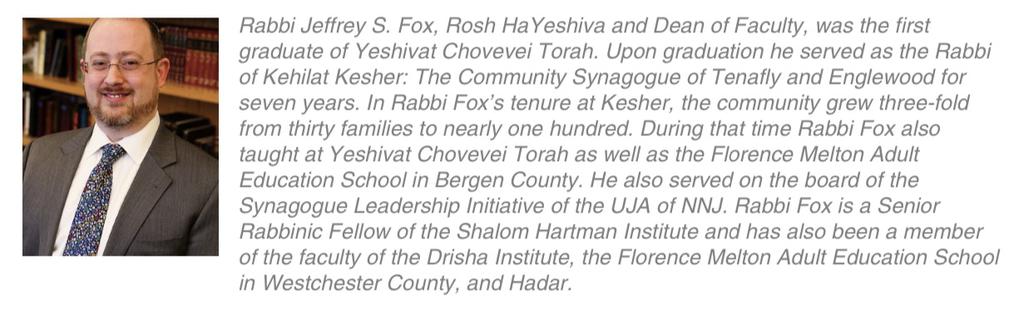
Rabbi Jeffrey Fox
Rosh HaYeshiva and Dean of Faculty
The question of the conversion of the Tribe of Levi, before it was asked by Ramban, was first asked by the Ba’alei ha-Tosafot on the page in Keritut. Let’s take a look at their formulation of the question:
דכתיב כי מולים היו כל העם. פירוש שמלו עצמם ביציאתם ממצרים. ואף על פי שאותן שהיו נימולים בימי אברהם לא מלו אותם ביציאת מצרים?
As it is written the entire nation was circumcised–This means that they circumcised themselves. And even though there were those who had been circumcising since the time of Avraham, they were not circumcised at the time of the exodus from Egypt.
If we take for granted that circumcision is an integral component to the conversion process how did the tribe of Levi become Jewish? Here is the answer that Tosafot offers to our question:
מ"מ מעיקרא כשמלו עצמן, מלו ליכנס בברית המקום וליבדל שאר אומות. וגם כי עתה טבלו.
Nonetheless, when they originally circumcised themselves, they did so with the intention of entering the covenant with the Omnipresent one and to separate themselves from the other nations. And also, they went to the Mikvah.
Tosafot asserts that when people circumcise their babies, there is a certain intention that is presumed to pertain. The physical act of removing the foreskin is done with the goal of separating the child from the surrounding community. In addition, there is an understanding that this is a covenantal behavior.
There is a subtle, but important, difference between Tosafot and Ramban. Ramban takes for granted that only a circumcision that is done within the context of a Torah Mitzvah can serve as a conversion circumcision. Tosafot broadens the possibility of what might be included in the category of conversion circumcision.
What about the following case? Imagine a young man graduating from a Yeshiva High School and preparing to go learn in Israel for the year who discovers that his birth mother is not Jewish. His family made a bris for him when he was eight days old and simply did not mention to the Mohel that the baby is not Halakhikally Jewish. The bris therefore took place in the standard fashion with all the appropriate ritual components and the bagels and lox!
Which of the physical rituals does he need? He will certainly have to attend the Mikvah to complete the clarification of his identity. However, what is required of him as it relates to the circumcision?According to Ramban, the ritual of circumcision that happened when he was eight days old was meaningless. Since he was not Jewish it was not a circumcision of Mitzvah (מילת מילה) it simply cannot serve as a conversion circumcision (מילת גרות).
However, according to Tosafot, the family had all the correct intentions when the bris was taking place. In fact, the father recited a beracha, “להכניסו לבריתו של אברהם אבינו –To bring him into the covenant of Abraham our forefather.” This is the intention that Tosafot demands for a circumcision to serve for conversion as well.
It turns out that this somewhat abstract debate between Tosafot and Ramban has some very significant implications for the real world. If the circumcision for conversion must be done with the intention of fulfilling a Mitzvah (Ramban), then our young man must undergo הטפת דם (the removal of a drop of symbolic blood). However, if the intention required is simply one of separating the child from the nations of the world (Tosafot), then this young man would not need anything done to that part of his body.
According to Tosafot’s approach this man is similar to a potential convert who has been circumcised but not yet immersed in the Mikvah (מל ולא טבל). What makes him different is that his circumcision was done at eight days old and his is now eighteen years old and needs to go to the Mikvah.
Within this framework, how should the Jewish community relate to this man? Should we treat him like a regular non-Jew? Would we let him eat non-Kosher food? What if he is the tenth man and someone is waiting to say kaddish–can he be counted in a minyan? At some level, he occupies a kind of in-between status. For synagogue ritual, presumably we would have to treat him as a non-Jews. For his personal, individual, embodied performance of Mitzvot, I would encourage him to still daven and keep kosher.
Rashba, in a different sugya, offers a compelling formulation that he uses to describe a similar phenomenon:
"אלא לאתויי גר שמל ולא טבל..." קשיא לי א"כ היינו גוי ואף על פי שמל, הרי הוא כערל דהו"ל כערבי מהול? וליתא, דשנאי הכא דמילתו לשם יהדות. ואף על פי שלא נגמר גירותו מ"מ כבר התחיל ונכנס קצת בדת יהודית שאינו צריך אלא טבילה.
Rather to include a convert who was circumcised but did not yet immerse… But this is a problem, because therefore [if he has not immersed] he is a non-Jew. And even though he was circumcised, he is considered an arel, for he is like a circumcised Arab. But it is not similar, for in our case his circumcision was for the sake of Judaism. And even though his conversion is not complete, nonetheless he has already started to slightly enter the Jewish religion, for he only lacks immersion.
Rashba says something that seems quite radical. It is possible to be “slightly Jewish.” A man who has been circumcised has begun the process enough to be considered almost Jewish. For Rashba it is possible for a person to occupy a third identity. This man is not yet fully Jewish, but he is also no longer a non-Jew. For what purposes is he considered Jewish? Next week we will look at another version of the idea that a person can occupy an intermediate place on the spectrum of Jewish identity.