25 Nisan 5777 | April 21, 2017
Parshat Shemini
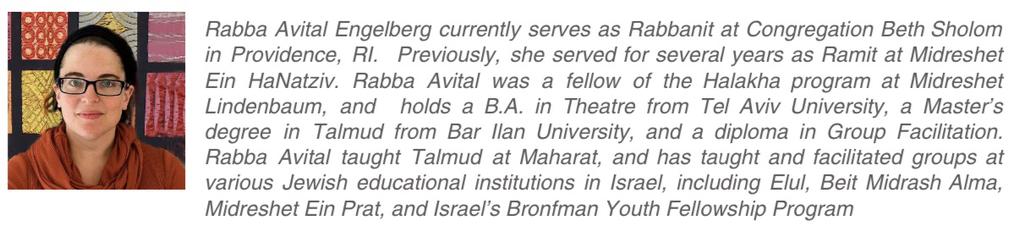
Rabba Avital Engelberg
Class of 2015
The Torah portion of Shmini is largely known for the story of the sin of Nadav & Avihu, Aaron’s sons, who brought a “strange fire” on the altar, on the day the Mishkan (Tabernacle) was dedicated, and were killed for it.
The story is even more interesting when examined in context of the parasha as a whole. This Torah portion deals with the minutiae of the holy work. Yet there is one moment, in spite of Moshe’ precise instructions, when Nadav and Avihu bring a “strange fire” and are punished for it.
The Torah portion continues with a desire to get back to “normal life”. This includes careful details from Moshe on how to cope (or better – how to not stop) and proceed with the Tabernacle’s dedication, and again, super detailed instructions regarding the way things should be done.
And then, in Chapter 10, verse 16, another event occurs, which could end up as “Aaron’s sons’ sin number two:
Moshe gives clears instructions how to proceed with the worship in the Tabernacle and the Kohanim's consumption of the chatat offering. Yet, Aaron and his remaining sons don’t eat the offering but rather, burn it, which angers Moshe:
וְאֵ֣ת ׀ שְׂעִ֣יר הַֽחַטָּ֗את דָּרֹ֥שׁ דָּרַ֛שׁ מֹשֶׁ֖ה וְהִנֵּ֣ה שֹׂרָ֑ף וַ֠יִּקְצֹ֠ף עַל־אֶלְעָזָ֤ר וְעַל־אִֽיתָמָר֙ בְּנֵ֣י אַהֲרֹ֔ן הַנּוֹתָרִ֖ם
16 And Moshe diligently inquired for the goat of the sin-offering, and, behold, it was burnt; and he was angry with Eleazar and with Ithamar, the sons of Aaron that were left…
Following Nadav and Avihu’s transgression, Moshe wants the rest of the dedication to go by peacefully. Therefore, he is upset with Aaron’s sons who seem to repeat the same mistake, and do what they were not commanded to do.
However, in this case, and contradictory to Nadav and Avihu’s sin, here Aaron responds, saying:
19 And Aaron spoke unto Moshe: 'Behold, this day have they offered their sin-offering and their burnt-offering before the LORD, and there have befallen me such things as these; and if I had eaten the sin-offering to-day, would it have been well-pleasing in the sight of the LORD?
Aaron explains why they acted contrary to the clear command they received from Moshe. What is Aaron’s explanation? Various commentators, Rashi among them, did well to explain it as a halachik dispute between Moshe and Aaron, whether it’s permissible for Aaron to eat the chatat offering in the state of “onan” (halachik status during the first day of a death of a relative, before the burial). Moshe claimed everything needs to continue, in spite of the recent deaths. Aaron claimed that everything related to this special day of Tabernacle dedication should proceed. However, the chatat offering of Rosh Hodesh, which is in dispute, should not be eaten as usual, stating therefore, that Moshe was wrong.
Other commentators explain the debate between Moshe and Aaron, not as a halachik discourse, but as a discourse which touches Aaron’s deep sorrow. Nechama Lebovitz described it best: “One who reads these verses as they were spoken, will not see in them a simple halachik back and forth… but rather, a justification, uttered out of his innermost feelings on that bitter day… for while Aaron accepted the special restriction (not to mourn) and the judgment, he was not commanded not demanded to be filled with joy. Therefore, his heart told him that he does not need to force himself in consuming the chatat offering… a symbol of the pure thought of the one bringing it and offering it. Therefore, he knew he should not be eating the offering which should be done with great joy”.
Whether this is a halachik or emotional debate, Moshe accepts Aaron’s words:
20 And when Moshe heard that, it was well-pleasing in his sight.
Everything calmed down. There was a halachik debate. Moshe was convinced. No one was hurt.
But this is a debate after the act. And when we look at it attentively, there is still a big question: there are two incidences in our parsha during which – as part of the dedication of the mishkan, and amongst exact instructions given by Moshe, something is done by the kohanim (the priests, sons of Aaron) contrary to what Moshe commanded them:
אֲשֶׁ֧ר לֹ֦א צִוָּ֖ה אֹתָֽם׃
Which He had not commanded them.
Maybe, we can even cautiously say, that in the case of Nadav and Avihu, there was a mistake. Rashbam explains that even though on all other days it was written that Aaron’s sons placed the fire on the altar, that day, it was not commanded nor did Moshe want it. For they were waiting for a heavenly fire, so it was not good to bring a “strange fire” because the whole purpose was to sanctify heaven’s name "so all will know that the fire did come from the Heaven…”
Namely, the Rashbam explains that what Nadav and Avihu did would have been right any other time, except the specific time of the dedication. They did not act contrary to instructions, but instead, perhaps did not comprehend the difference between the day of the dedication to any other time.
On the other hand, the second act has no mistake. Moshe spells out the law clearly, saying they must eat the chatat offering, yet Aaron and his sons act in complete contradiction to the command.
Yet, as opposed to this basic difference, the first time ends tragically with Aaron silent, unlike the second time when Aaron argues with Moshe and Moshe acquiesces. Hashem also seems to accept Aaron’s opinion, since there is no tragic ending.
So what’s the difference between the two cases?
Why was Nadav and Avihu’s “strange fire” etched into our awareness as a ‘look what happens when one does not follow G-d’s precise directions’ as opposed to the chatat case?
The simple answer is that in the second case, Aaron knew the law and understood that Moshe was wrong.
But I believe there is a deeper question here.
Aaron ruled on a halacha contrary to Moshe. Aaron experienced conflicting values (the commandment to eat chatat as opposed to how to behave as an “onan” – or alternatively, difficulty fulfilling the mitzvah of chatat while one is mourning close relative), and is acting – and ruling – accordingly.
Even though his family was just impacted due to the possibility of halachik freedom (which might have been from inappropriate causes, hence named “esh zara” – a strange – or foreign – fire), Aaron does not give up his need for freedom and a wider outlook of halacha. Even immediately after, he seemingly, takes a risk again, doing things “not according to the precise instructions”. But here, he backs his actions, explaining his halachik thought process to Moshe, and Moshe and G-d, accept his words and his ruling.
Usually we learn from parshat Shmini how to be aware and to not deviate from the accepted written law because : “look what happened to Nadav and Avihu”. But if we keep reading, and reach the second case of Aaron and his sons, we see this parsha is much more complicated. The parsha teaches us greater sophistication: yes, it’s true, one must behave by the rules, but there are situations where it’s likely that in spite of the rules and regulations, we should deviate from the halacha known thus far, in order to build a better and more just law.
When will we know, along the way, if we kindle a foreign fire or create a better path? That indeed is a good question.