


One of the most significant legal scholars in Jewish history is Rabbi Joseph Karo, known most famously as the 16th century author of the code of Jewish law (halacha) called the Shulchan Arukh. Those who divide the history of Jewish law into epochs will say that Karo signalled the end of an era called the period of Rishonim, which was populated by biblical commentators like Rashi and legal scholars like Rambam, and inaugurated the period of the Acharonim.
It is not clear if Karo knew that he was the transitional figure in the history of halacha. However, he was surely aware of two monumental events, both of which shaped his life's work: the invention of the printing press in 1450 by Johann Gutenberg in Germany and the expulsion of the Jews from Spain in 1492. The latter caused a great upheaval in the Jewish world and provided Karo with the impetus to compile, preserve, and summarize as much halachic "data" as possible. Karo wrote the Shulchan Aruch in a style that made it accessible to less learned Jews. However, it was the invention of the new technology of movable type that disseminated his work widely, fostered a degree of religious uniformity, and transformed Karo into the foremost halachic authority.
Karo was born in 1488 and died two days before Passover on the 13th of Nisan in 1575. He was only four years old when he and his family were expelled from Spain. After enduring a second expulsion (Portugal) and wandering from one city to another, the family finally settled in Turkey where Joseph Karo spent his formative years learning from his father and other great Talmudists of his day. At age 48 he migrated to Tzefat, Israel where he continued his studies and received the newly revived classical semicha, rabbinic ordination, from Rabbi Yakov Bei Rav.
Although the Shulchan Arukh is the book most commonly associated with Karo, he would likely consider his greatest achievement to have been the Beit Yosef. The Beit Yosef was commentary based on a halachic work written 200 years earlier, called the Tur, a code that divided Jewish law into four large categories (prayer and holidays; kashrut, conversion, mourning, family; marriage and divorce; and civil law). The Tur comprised only the laws that could be put into practice as opposed to the laws of sacrifices, for example, that depended on a Temple that no longer existed. The Beit Yosef collected and analyzed the Tur's sources, resolved contradictions, and updated the Tur with new sources that emerged during the intervening two centuries.
It is not clear if Karo knew that he was the transitional figure in the history of halacha. However, he was surely aware of two monumental events, both of which shaped his life's work: the invention of the printing press in 1450 by Johann Gutenberg in Germany and the expulsion of the Jews from Spain in 1492. The latter caused a great upheaval in the Jewish world and provided Karo with the impetus to compile, preserve, and summarize as much halachic "data" as possible. Karo wrote the Shulchan Aruch in a style that made it accessible to less learned Jews. However, it was the invention of the new technology of movable type that disseminated his work widely, fostered a degree of religious uniformity, and transformed Karo into the foremost halachic authority.
Karo was born in 1488 and died two days before Passover on the 13th of Nisan in 1575. He was only four years old when he and his family were expelled from Spain. After enduring a second expulsion (Portugal) and wandering from one city to another, the family finally settled in Turkey where Joseph Karo spent his formative years learning from his father and other great Talmudists of his day. At age 48 he migrated to Tzefat, Israel where he continued his studies and received the newly revived classical semicha, rabbinic ordination, from Rabbi Yakov Bei Rav.
Although the Shulchan Arukh is the book most commonly associated with Karo, he would likely consider his greatest achievement to have been the Beit Yosef. The Beit Yosef was commentary based on a halachic work written 200 years earlier, called the Tur, a code that divided Jewish law into four large categories (prayer and holidays; kashrut, conversion, mourning, family; marriage and divorce; and civil law). The Tur comprised only the laws that could be put into practice as opposed to the laws of sacrifices, for example, that depended on a Temple that no longer existed. The Beit Yosef collected and analyzed the Tur's sources, resolved contradictions, and updated the Tur with new sources that emerged during the intervening two centuries.
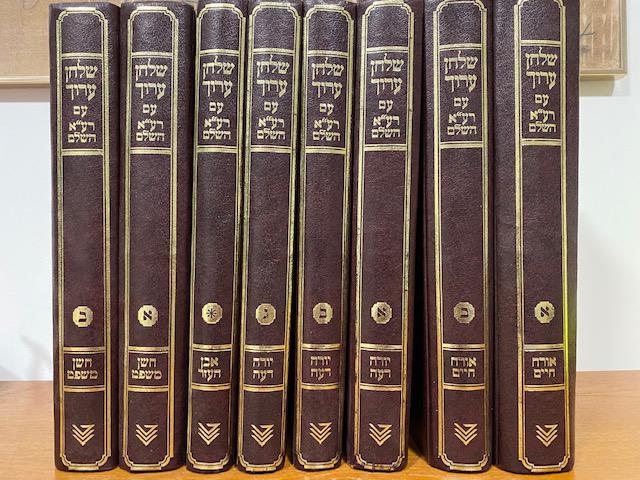
The Beit Yosef became so encyclopedic that Karo realized he needed to create a more accessible text for those who did not want to wade through a long series of sources from the mishna to Talmud through the legal scholars during the period of the Rishonim. He created the Shulchan Arukh, literally a set table where the laws were neatly organized and ready to be consumed. It followed the four-part division of the Tur and provided a definitive guidance on how to act. (See the example below about the Passover Seder which comes from the first of the four-part division of the Shulchan Arukh.)
מוזגין לו מיד כוס שני כדי שישאלו התינוקות למה שותים כוס שני קודם סעודה. ואם אין חכמה בבן, אביו מלמדו. אם אין לו בן, אשתו שואלתו. ואם לאו, הוא שואל את עצמו. ואפילו תלמידי חכמים שואלים זה לזה מה נשתנה וכו'
We pour for him the second cup, so that the children will ask why we drink the second cup before the meal. If the son has no wisdom, the father teaches him. If he has no son, his wife should ask him. If he does not even have a wife, he should ask himself. Even scholars should ask each other "Ma Nishtana," etc...
- The text quoted above is based on disparate, non-continuous sources in the Tractate Pesachim, some of the Mishnah and some from the Talmud. The Shulchan Arukh puts these diverse sources together, omits all the Talmud's elaborations and digressions, and creates a coherent set of simple instructions on how to act.
- Paraphrasing the Mishnah, the Shulchan Arukh teaches that we pour a second cup of wine so that the child asks a question: Why did you pour a second cup of wine (usually on Jewish holidays, one drinks only one cup before starting the meal)?
- The Shulchan Arukh says that if the son/child missed his cue and didn't ask about the second cup of wine, the father stops and teaches him that the Passover Seder is not any ordinary festival meal. There will be a whole set of strange things happening at the meal that don't take place at other festival meals, all of which are included at the seder in order to prompt questions that enable one to expand upon the story of the exodus from Egypt.
- Quoting the Talmud, the Shulchan Arukh continues and notes that if there are no children at the seder, then the seder leader's wife asks. And if the seder leader is alone, he should ask himself questions. And even if the seder is populated by people who presumably know all about the seder, they still should still ask questions, which take the form of the "Ma Nishtana."
Karo was a prodigious writer who penned other books of halacha and also books of Kabbalah. Still, his most famous contribution was the Shulchan Arukh which, although designed as a brief distillation of all of Jewish law, attracted generations of voluminous commentaries. The latter added the traditions of their communities and their times. With the proliferation of commentaries on the Shulchan Arukh, new codes had to be written in order to ascertain a final decision. This cycle of expansion and contraction in Jewish law is characteristic of Jewish legal history and continues until today.