Beshallach 2
From Torah Or
Translation and Commentary by Rabbi Gedalia Potash and William Schecter, MD
Friday, January 29, 2021 and January 13, 2022
Rabbi Potash began our session by observing that the Exodus from Egypt is a metaphor for our journey both as individuals and as a People. Although we weren’t personally enslaved, each of us goes through the same journey from where we were when we were born to where we can potentially be spiritually when we reach “120” (Moses lived to the age of 120. A common expression in modern Hebrew is Ad Meah VeEsrim=Until 120 meaning may you live to 120. Interestingly, it seems the maximum human life span is about 120 years based on the rate of the loss of telomeres at the end of the chromosomes).
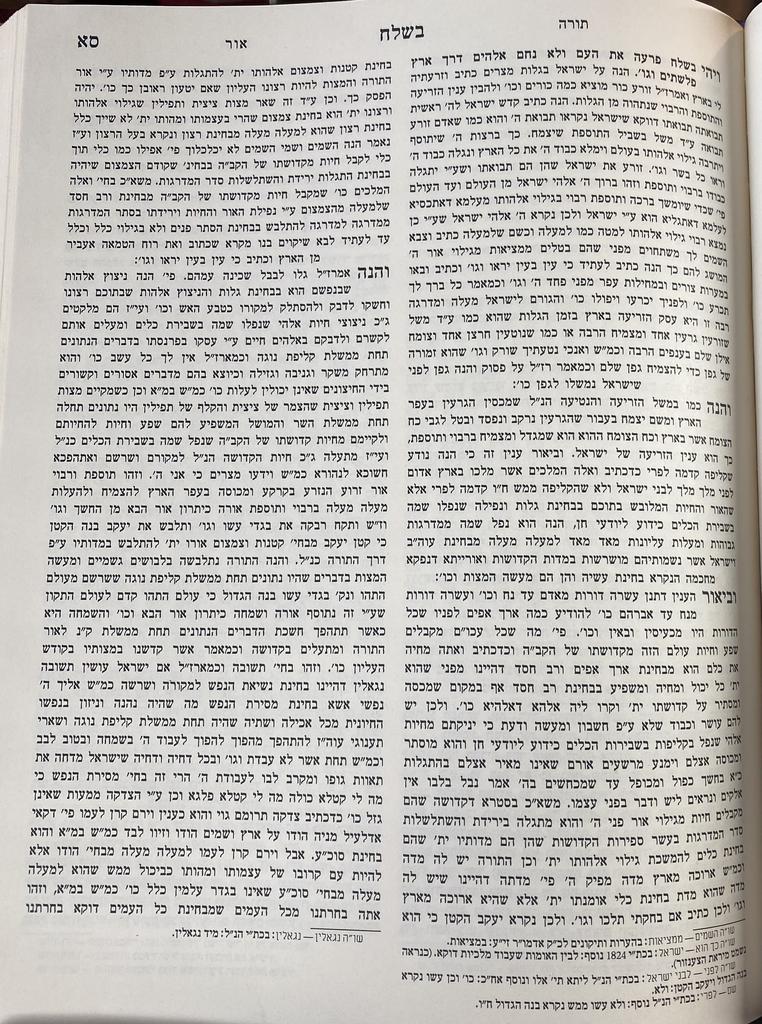
The Elter Rebbe begins his commentary by quoting the first line of our Parasha “Now when Pharaoh let the people go, God did not lead them by way of the land of the Philistines” (Exodus 13:17) The Elter Rebbe then quotes the Prophets concerning Israel’s Exile in Egypt: “I will sow her in the land as My own” (Hosea 2:25) and then follows with a quote from the Talmud: “And Rabbi Elazar said: The Holy One, Blessed be He, exiled Israel among the nations only so that converts would join them, as it is stated: “And I will sow her to Me in the land” (Hosea 2:25). Does a person sow a se’a of grain for any reason other than to bring in several kor of grain during the harvest? (Pesachim 87:b) The kor is a unit of measurement which is equivalent to about 30 se’as. So too, say the commentators on this sentence in the Talmud, the purpose of the Exile is to enable converts from the nations to join the Jewish people.
Comment: A surprising comment to me in that our People have traditionally discouraged converts.
The Elter Rebbe now states that these quotations are for the purpose of understanding the concept of planting, addition and multiplication that occurred as a result of the Exile. He then follows this statement with another from the Prophet Jeremiah “Israel was holy to the LORD, The first fruits of His harvest.” (Jeremiah2:3) Indeed, says the Elter Rebbe, Israel is called G-d’s harvest and He (G-d) is like a man who plants, by way of example, so that additional vegetation will sprout. The Elter Rebbe now does not use the analysis of the commentators, namely that the purpose of the Exile is to increase converts to the Jewish People. Rather, he says, G-d wishes to increase and multiply the revelation of His Divinity in the world so that the Glory of G-d will fill the entire world and ”the Glory of G-d will be revealed and seen by all flesh.” (Isaiah 40:5) By planting Israel (in Exile), they will be his harvest and through them His Glory (or Presence) will be revealed and multiplied and this is the meaning of “Blessed is the LORD, God of Israel, From eternity to eternity” (Psalm 106:48) The Elter Rebbe interprets this to mean that Israel is necessary for the blessing, the addition and multiplication to be drawn from the world of concealment to the world of revelation and therefore G-d is called the Lord G-d of Israel (the Divine Name is repeated). Through this the multiplication of G-d’s Divinity is found in the world below just as it is on high where “and the host of heaven prostrate themselves before You.” (Nehemiah 9:6) for they are nullified from reality by the revelation of the Divine Light presented to them so here it is written “For every eye shall behold The LORD’s return to Zion” (Isaiah 52:8) “And men shall enter caverns in the rock and hollows in the ground— before the terror of the LORD And His dread majesty, When He comes forth to overawe the earth.” (Isaiah 2:19) “And every knee shall bend to You” (Alenu Prayer concluding the Service) G-d is the One who did the planting in the earth at the time of the Exile and He is the One by way of example who plants one seed from which many plants sprout or who plants a pit (or a pine cone for example) from which an entire tree with many branches grows as it is written “I planted you with noble vines” (Jeremiah 2:21) who plant a twig of a grape vine from which a new entire grape vine grows. The Elter Rebbe then says that the Rabbis in the Talmud compared Israel to a grape vine (but I could find no reference to support this).
Rabbi Potash commented: Think of exile as a seed being planted in the ground. When you put a seed in the ground, it results in many more plants. We have been planted in exile; the result will be greater. There is a benefit and a harvest from being seeded in Exile. G-d puts us in this world because He loves us says Rabbi Potash. If you have a plant, you don’t want it to just be there but you want to nurture it so it grows. So too, we should think ourselves not as static beings but having the responsibility to grow and advance. The definition of love is more (Kabbalah) We want to expand our love.
What does it mean that G-d is the G-d of the Jewish People? He understands this that without the commitment of the Jewish People to reveal the concealed G-d, the rest of the world would not know Him. The Jewish People’s adoption of their responsibility to be like seeds that sprout and grow and increase until we get to a state at the time of the Messiah that we will see “eye to eye” the appreciation of G-dly essence to see the true reality of G-d rather than concealment. The Elter Rebbe quotes many sources to make this point. (see above)
The Elter Rebbe continues: And here by way of example the sowing and planting referred to above covers the seed with the dust of the earth from which a plant will sprout through the rotting of the shell of the seed which becomes nullified allowing the inner core of the seed through its own power combined with the elements in the soil to grow. Israel goes through a similar process after being planted (in Exile). The peel precedes (is external) to the fruit. The Elter Rebbe now compares the peel and the fruit to the other nations and Israel. He says: The kings ruled in the land of Edom prior to kings ruling over the Children of Israel. Not that peel really preceded the fruit (in importance), G-d forbid, but rather the light and the vitality invested within them in the attribute of Exile and the fall (of the energy and light) from the world of Atzilut with the breaking of the vessels, as is understood by those who know Kabbalah, from the greatest heights with the attribute of the World to Come, down to our world. And Israel, whose Souls are rooted in Holy Merits and the Torah produced from the Intellectual Attribute of Wisdom, is called the attribute of Asiyah (action and the name of our lowest world), that is the performance of Mitzvot.
Rabbi Potash explains the previous paragraph. He says: The Elter Rebbe tells us we should look at ourselves as seeds planted in the ground. Now he says that there is a very important step for this to happen. The seed itself has to be willing to let go of its corporal self, decay and disintegrate and unleash the hidden potential within it—to reveal its abstract potential and join with the minerals in the ground, to let go of our corporal being and tap into our abstract potential. If we hold on to our physicality, we will be unable to tap into the spirituality.
The Torah is describing the establishment of other kings and other nations. If we are the chosen people, why is there a delay in establishment of the Jewish People? The Elter Rebbe explains that sometimes that what comes before is a preparation for what comes after. The Elter Rebbe uses an analogy. We look at a fruit, the first thing you see is the peel. The essence of the fruit is what is growing inside the peel. The order does not necessarily dictate the priority.
All this ties in to the metaphor of Exile. Where are they in Exile? They are in Exile in the lands of other nations. It is like we are the seeds in the lands of other nations. The result of that is an expansion of what the Jewish People represent. How is it that the nations of the world, which seem to be secondary to what G-d’s ultimate goal is, dominate. The other nations are like the peel which facilitates the growth of the Jewish People. What facilitates the revealed growth is sometimes greater than the growth. So that the other nations of the world are at a lofty level, sometimes higher than the Jewish People. There is a partnership between the nations of the world, functioning as the peel, and the Jewish people as the seed.
The Elter Rebbe now goes on to explain the other nations preceding the establishment of the Jewish People. He says: There were ten generations between Adam and Noah and another ten generations between Noah and Abraham to inform us of how slow to anger G-d is. For all of these 20 generations angered G-d by worshiping idols, stars and constellations. All of these people received sustenance and vitality in this world from His Holiness as it is written “And you give life to them all” (Nehemiah 9:6) through His qualities of great love and slowness to anger. Meaning, because he is capable of everything, gives life and influences everything through his great love even in a place where His Holiness is hidden and concealed but they said “their G-d is not my G-d” And therefore they have wealth and honor not through on account of their actions and knowledge but because they have been suckled by the Divine Vitality which fell in the Klipot (the layers surrounding the Soul corresponding to the 10 Sefirot within the Vessels in the World of Atzilut) after the shattering of the vessels. His Holiness is hidden and concealed from them and prevents the evil ones from their light which does not enlighten them with revelation but a double darkness which darkens (conceals) G-d so the scoundrel denies the existence of G-d as things seem to be the way they are superficially.
Rabbi Potash explains: G-d is slow to anger and abundant in kindness. He did it out of His kindness but they didn’t really deserve it. There are two types of received kindness: earned kindness and unearned kindness. Rabbi Potash gives the example of a parent who gives the same supper to the well-behaved child and the rebellious child. The well-behaved child has earned the meal. The rebellious child receives the meal out of the kindness of the parent’s heart rather than the “deservedness” of the child. Sometimes our behavior is not appropriate but we still receive G-d’s Blessing out of the abundance of kindness. Even though the rebellious one may come and say Ah, you’re a loser. You worked so hard and I got the same thing as you. But at the end of the day, who has the more direct and loving relationship. The relationship of the rebellious one is called Elokah veElohayah (their G-d—not my G-d). Why are the wicked successful? Because G-d is so kind and generous, G-d will also give to the rebellious. That’s how it looks from the outside but from the inside, G-d is more pleased with the person who chooses Kiddushah. It’s true, it’s more rigorous, there are more rules, we have to earn the relationship but the ultimate final conclusion is that when you have an earned relationship it is a more intimate relationship
The Elter Rebbe continues: On the other hand, the Holy people (presumably the Jews) receive their vitality from the revelation of the light of the Face of G-d which reveals Itself if the descent and flowing down of the order of spiritual levels of the 10 Holy Sefirot which are His Merits having the attributes of drawing down the Divine Revelation. The Torah has such a merit for “Its measure is longer than the earth and broader than the sea”. (Job 11:9) ……Therefore it is written If you follow My laws and faithfully observe My commandments (Leviticus 26:3) Therefore Jacob is called the small one because he has the attribute of smallness and the contraction of His Divinity to be revealed through his merits by the light of the Torah and the commandments to be His Supernal Will. If Reuven would argue such and such and Shimon would argue such and such, eventually a judgement would be reached. Here the Elter Rebbe is using the Talmudic dialectic as a method of discerning the Divine Will. By way of example, the rest of the commandments of Tzitzit and Tefillin are a way of achieving revelation of His Divinity and His Will. And so, the Elter Rebbe goes on to explain that the Kings of Edom received sustenance and vitality without revelation of the concealed G-d. The Jewish People, through the performance of Mitzvot can reveal the Divine Presence.
Comment: What does the Elter Rebbe mean when he says “Reuven will make such and such a claim”? Reuven is not referring to Reuven the eldest son of Jacob. Rather, in Talmudic discourse, when discussing one person vis à vis a second, the first person is referred to as Reuven and the second as Shimon. So here, the Rabbi uses Reuven as a substitute for “a person”.
Rabbi Potash concluded: The Jewish People are called small because they make small steps towards elevated spirituality. Every Mitzvah in many ways is tedious and detailed. This tedium is part of the effort, to care about the details, each time we go out of our way to align ourselves with the details of the Mitzvot. Are we willing to put ourselves through the effort and the inconvenience in order to earn the relationship?