


Latin: Come now the end of my loves
The Hasidim explain this irony or paradox - ביטול היש we 'remove the self', our own needs, concerns, our 'self' so that we may encounter God fully.
This way of thinking parallels the way Isaac Luria describes God 'reducing' (tzimtzum) Godself at Creation to enable the universe to come into existence.
In a relationship, both sides have to make compromises and regular shifts to preserve the relationship.
How does the Amidah end? With שלום - whole-ness, fulfillment -- It flows from the Priestly Blessing that precedes it (when we repeat the Amidah)
What did our ancestors believe 'shalom' means in this context?
(1) ישא ה׳ פניו אליך, "May the Lord lift up His countenance upon you, etc." This means that in the event the deeds (sins) of the Israelites have erected some kind of barrier between them and G'd that G'd should lift this barrier and remove it. וישם לך שלום, "and may He grant you peace." The meaning of the word "peace" or "harmony" is the reverse of every kind of separation and fragmentation. Anyone examining the word carefully realises that the concept it represents is the foundation our world is built upon, the force which ensures that the "higher" world and our "lower" world can co-exist successfully. This is the mystical dimension of the words: "and they shall put My name upon the children of Israel," and the concluding words "and I will bless them."
Personal meditation - Not for sharing:
Let's take 2 minutes for writing -- What areas in our lives/families/communities do owe feel 'separation' and/or 'fragmentation'?
For sharing (optional) - Was it difficult to do this? What types of feelings did the writing bring up?
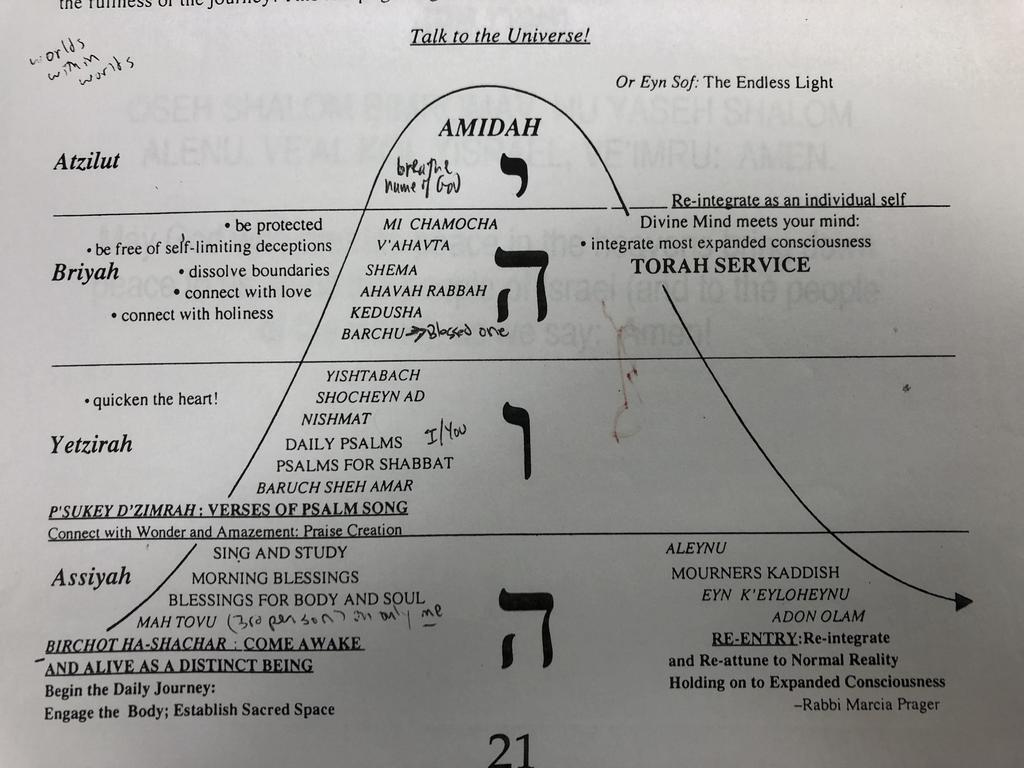
On Mondays, Thursdays, and Shabbat (and holidays), the 're-entry' part of prayer includes Torah reading, taking us back dow into the Shema section - into the mind - intellectual/learning/perspective...
Then, the closing prayer: Alenu, Ayn Kelohenu, Kaddish, Adon Olam
Back to the world of the body/self/self in community:
Alenu - It's up to us to initiate the praying! -- And we hope and pray for the Presence of God to be universal (back to the theme of wholeness)
Ayn Kelohenu - Also a "let's praise" moment
Mourner's Kaddish - Circle of Life, the living remember those who are gone, also bookends with calling to our ancestors in the Amidah
Adon Olam - God transcends the time, time that orders and structures our fundamental existence
How does a service end? How do we carry the inspiration forward?
2. Re-integration - how can the experience speak to life experience, and also mesh with/influence that experience?
3. Staying in touch with body/self and others during the service - prayer time in Jewish practice is not solitary or even always quiet -- SOAP BOX: This is a good thing! We have times of relative quiet and focus (Amidah, Kaddish, silent prayers) but prayer (and life) is not about avoiding distractions but rather being able to notice them while maintaining focus and rhythm - even possibly exploring the distraction to see what about it is distracting to us in the first place (could just be loud noise or commotion that is universally distracting, but even then - how do we judge sound? ) -- Checking in with our breathing, sitting and standing position, where is there tension in us.
4. Reviewing key themes, communal singing that brings us together
Leaving the space - Give the moment a chance to finish sinking in - if we feel need to move/rush/head out (for any reason other than schedule), take a moment to recognize that feeling and see what's happening inside us
Other ways to round out the experience:
- Sephardic custom - private prayer at the Ark
- Chat and check-in, often happens naturally
- Re-grounding, feel feet on the floor
- Take aways - mental review of any notes, memories, impressions from the prayers