19 Av 5777 | August 11, 2017
Parshat Ekev
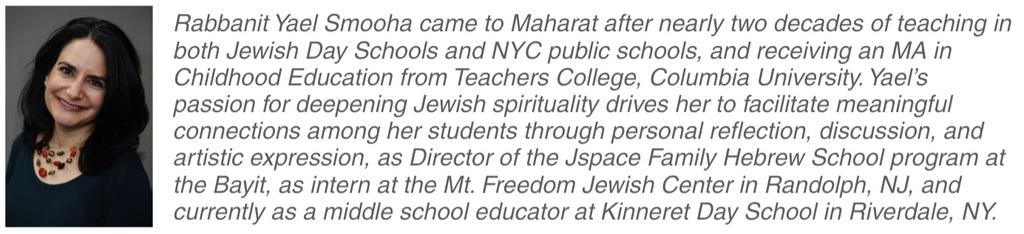
Rabbanit Yael Smooha
Class of 2021
In a number of ways, Parshat Ekev is a guide for navigating our relationship with God and ourselves.
In God’s account of his relationship with the Jewish people while they were traveling in the wilderness, God describes the ways in which he attended to their everyday physical needs by providing them with manna and clean clothing. He also describes the ways in which he made Israel suffer, testing their faith in him multiple times. However, God asks the Jewish people to consider their suffering as an essential part of their growth as a nation. He puts this suffering in the context of a parent-child relationship:
You shall know in your heart that just as a man disciplines his child so does Hashem your God discipline you.
Nachmanides comments on this verse that God chastises Israel for Israel’s good, just as a parent trains a child in their early years, so that eventually that child can reap the fruits of his training. Likewise, after years of trials in the wilderness, the Jewish people can enjoy and appreciate the pleasures that the land of Israel has to offer.
This idea of mussar, character development through discipline, is echoed in the book of Mishlei (Proverbs), ascribed to the authorship of King Solomon. I thought of the verse often quoted in the context of “Spare the rod, spoil the child”:
He who spares his rod hates his child, But he who loves him disciplines him while he is young.
Some commentators, like Rashi, understand the verse to be referring to the end result of the parent child relationship. In other words, a parent who does not take the time to discipline his child will eventually hate that child when that child grows up to have ill manners. Conversely, a parent who disciplines his child will come to have a loving relationship with that child as an adult.
Other commentators read the verse in the present tense: One who loves his child will have the foresight and take the time to train them properly, even punishing that child when necessary, so that that child will have the life skills to live a productive adult life.
In fact, earlier in the book of Proverbs, the author describes these parental chastisements as adornments that grace the head and neck of he who heeds them. (Proverbs 1: 8-9)
I have distinct memories of the times my parents corrected or pushed me in my childhood in ways I found frustrating, embarrassing, or challenging. For example, my father insisted on speaking to me exclusively in Hebrew. As a five year old new to the US, this was perfectly fine with me. But as I acquired more and more English, Hebrew quickly became my secondary language. My father, however, still insisted on not only speaking to me in Hebrew, but in my responding to him exclusively in Hebrew as well . When I ignored this rule, by initiating a conversation in English, his response would be: “ani lo meveen anglit!” (“I don’t understand English!”) I remember rolling my eyes as a six year old as he smirked, because we both knew he spoke English as well as any born American. Eventually, I realized that if I wanted to have conversations with my father, I had no choice but to play along with his little game. Today, I’m glad he was as persistent as he was, because I use the Hebrew skills he taught me as both an educator and a student of Torah. Today, his firm, consistent Hebrew-only policy at home is an “adornment” for my head, as Mishlei writes. The same holds true for the moment my mother explicitly taught me to say hello when I come home from school, and the time my father insisted that I be the one to call Kmart to find out if they had the yarn I wanted for my fourth grade knitting project.
My understanding is that each one of us can reflect on a childhood moment in which an adult - a parent teacher, rabbi, camp counselor - intervened to teach us something important that would serve us long into adulthood. At the time, those lessons were humbling and uncomfortable. Hopefully, if we absorb them, they eventually become like those saltwater pearls that were originally irritating grains of sand.
Yet although our brains are most malleable, and we are most impressionable as children, and can absorb so much learning as we grow, learning doesn’t stop when we hit adulthood. As humans, we have the capacity to be lifelong learners, and that learning takes place in many different arenas, including our character. I think the biggest challenge as adults is to continue to parent our selves, without the urgency of listening to a parent who we depend on for our basic needs.
The second passage of the Shema deals with exactly this. God promises favorable farming conditions for good behavior on our part. If we don’t behave, then God does not provide and eventually even the land we were promised will be taken away from us.
Our reality today does not match this passage in agricultural terms. For the most part, we do not make our livings off farms, and completely depend on rainfall the way the Jewish people did in Biblical times. However, the broader idea of our behavior affecting consequences in our relationships with God, ourselves and others still holds true. It is up to us to notice the natural patterns and consequences and become our own parents, our own loving disciplinarians. And when we get stuck, to seek out friends and mentors who can help us find those patterns.
May we be blessed with the awareness of the ways our behaviors affect positive and negative events in our lives, and the wisdom to create the structures and find the resources to support our growth.