21 Cheshvan 5778 | November 10, 2017
Parshat Chayei Sarah
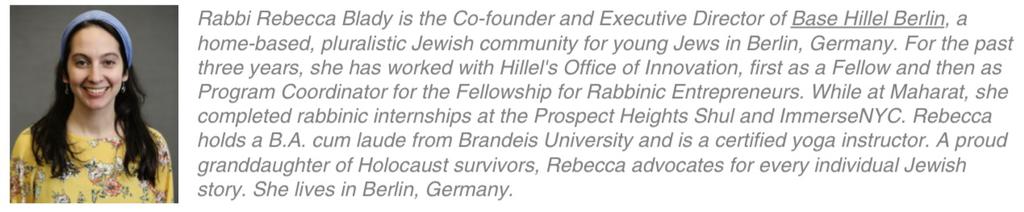
Rabbi Rebecca Blady
Class of 2019
It’s a moment of bereavement for Abraham. Sarah dies, and Abraham becomes distraught. We witness him picking himself up from his current location (likely Beer Sheva), traveling to Kiryat Arba and devoting time to mourn in a place that feels full of Sarah’s presence.
In this overwhelming moment, it also occurs to Abraham that in order to properly pay respects to his wife, to honor her life, her body and her soul, he must bury her. And in order to bury her, Abraham must go through the fascinating process of building a relationship with a man named Ephron the Hittite -- and sets an example for the Jewish people integrating into pluralistic societies in the process.
The verses in Genesis 23:3-4 tell us:
Then Abraham rose from beside his dead, and spoke to the Hittites, saying, “I am a resident foreigner among you; sell me a burial site among you, that I may remove my dead for burial.”
Why, in his very first interaction with the Hittites, the local population in the Land of Canaan, does Abraham introduce himself as a ger toshav, a “resident foreigner?” The very term is an oxymoron -- the words ger, translated as foreigner, and toshav, translated as reisdent, don’t make sense together. What has driven Abraham, in his moment of extreme sadness, to refer to himself as such as he enters into negotiations with members of other nations?
Rashi, commenting on these verses, offers two ideas for why this could be the case:
(א) גר ותושב אנכי עמכם. גֵּר מֵאֶרֶץ אַחֶרֶת וְנִתְיַשַּׁבְתִּי עִמָּכֶם. וּמִדְרַשׁ אַגָּדָה אִם תִּרְצוּ הֲרֵינִי גֵּר, וְאִם לָאו אֶהְיֶה תּוֹשָׁב וְאֶטְּלֶנָּה מִן הַדִּין, שֶׁאָמַר לִי הַקָּבָּ"ה לְזַרְעֲךָ אֶתֵּן אֶת הָאָרֶץ הַזֹּאת:
[Abraham said, “I am] a stranger having come from another land, but I have settled down amongst you.” A Midrashic explanation is: [Abraham said] “If you agree to sell me the land then I will regard myself as a stranger and will pay for it, but if not, I shall claim it as a settler and will take it as my legal right, because the Holy One, blessed be He, said to me, (12:7) "Unto thy seed I give this land".
In the former answer, Rashi presents a simple read of the text. Indeed, Abraham has moved to Canaan from another land and would like to settle; purchasing property to bury his dead would indicate a desire to remain permanently in the land, and out of respect to the locals, it would behoove Abraham to present himself this way.
In the latter answer, Rashi draws upon the Midrash to make a different claim about Abraham’s reality. It seems that Abraham uses the word ger to indicate a desire to enter into a productive relationship of commerce and the word toshav to indicate his own, personal, Divinely-inspired obligation to be there, regardless of what the locals think.
In my own analysis, I’d like to think that perhaps the word ger comes first because it represents a preferable course of action for Abraham. It’s building a relationship of mutual respect, fair trade, ethical business; it’s an entry point for Abraham to acknowledge and even empathize how strange it must be for the other nation to experience his presence. And perhaps the word toshav represents a dire need to adhere to his religious beliefs, to claim the land out of deference to G-d’s law (which is respected by the Hittites) on a permanent basis, particularly at a time of upheaval in his life. And yet -- through his staunch commitment to his faith, Abraham still makes clear that he prefers to purchase the land, showing a deeper commitment to live in the reality of the land, its peoples and its norms.
The late Rav Aharon Lichtenstein, commenting on the dual language of ger and toshav in our parsha, once said:
צריך אדם לשאת עמו את תחושת הגרות והזרות. עליו לדעת כי הגם שהשתלבותו בחיי המעשה, במציאות סובבת אותו, הכרחית היא כדי שיוכל להגיע לדרגות רוחניות גבוהות.
A person must carry with him the sensations of gerut (strangeness) and zarut (foreignness). It’s on them to know that their integration into a life of action and the physical reality surrounding them is necessary in order to reach higher spiritual levels.
Following the example of Abraham means integrating a constant feeling of foreignness along with our connection to our faith and our roots and our families, if for no reason other than to empathize with our peers and neighbors. Abraham acknowledges in an extremely straightforward manner that his presence could perhaps interrupt the way of life of the Hittite nation. His language tells us that there’s something that transcends family lines and inherited traditions. Learning from one’s society, trying to sense out the experience of the other, is a process that can help us attain a more powerful, more spiritual presence in the world.
Rambam, in Hilchot Issurei Bi’ah, outlines how every Jew who exited Egypt went through a process of gerut by participating in milah (circumcision - for men), tevillah (ritual immersion) and korban (sacrifice). Based on this model, we know that every Jew originally experienced the process of gerut -- a process that integrates settledness and rootedness in G-d’s tradition together with the state of feeling foreign. Maintaining a mentality of gerut is the charge we inherit from Abraham today.
’m thinking about how to integrate Abraham’s message into my own life as we wrap up a week in which many of us in the U.S. had the privilege of voting in the 2017 Elections. We are fortunate to live in a time when Jews can run for public office, succeed in business, maintain beautiful Jewish lives and infrastructure and generally feature prominently in American society. The truth is: For the most part, we as Jews no longer feel foreign in the safe haven that America has provided us. And yet, the Torah tells us, we must still allow ourselves to be gerei toshav, to feel slightly foreign as we live our regular lives. It’s a part of our civic duty: to open ourselves to a place of greater empathy and more compassionate citizenship.