28 Cheshvan 5778 | November 17, 2017
Parshat Toldot
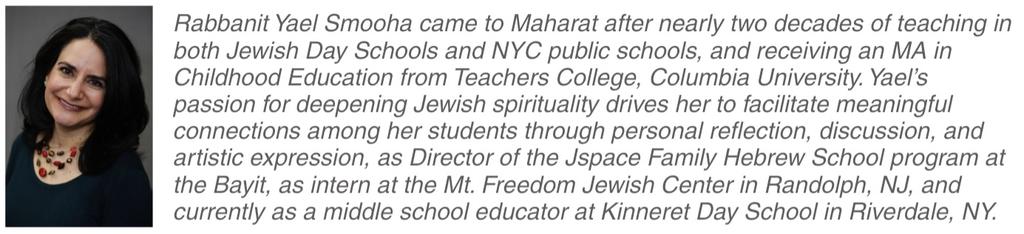
Rabbanit Yael Smooha
Class of 2021
Dedicated to the memory of my dear friend Koren Backstrand, a seeker of truth.
One of the Jewish children’s songs I was exposed to as a young adult went something like this:
That’s what you gotta do.
Tell, tell, tell the truth and feel much better.
Tell, tell, tell the truth,
That’s what you gotta do.
I want to be an emesdik Jew!
An emesdik Jew means an honest Jew. There’s no question that truthfulness is a Jewish value. We are told that אמת חותמו של הקב"ה - "the very signature of God is truth" (Shabbat 55a). God himself is synonymous with truth. We are also exhorted: מדבר שקר תרחק - "distance yourself from any matter of falsehood" (Exodus 23:7), which implies that not only should we avoid telling lies, but rather that we should avoid giving an impression that is false.
Yet, this week’s sedra tells a grand story of deception when Jacob deceives his own father Isaac at the request of his mother Rebecca. Isaac, who is old and blind, is ready to give his favored firstborn son Esav his most generous blessing. As Esav hunts for his father’s favorite food, Rebecca calls on her favorite son, Esav’s twin Jacob, to disguise himself as his brother in order to receive this most coveted blessing.
Jacob, whom the Torah describes as an איש תם יושב אוהלים, "an uncomplicated man who dwells in tents", acquiesces. He dons his brother’s clothes, and wears skins to duplicate his twin’s hairy arms. Inexperienced in the art of deception, Jacob has a few close calls with his encounter with Isaac. In one such moment, Isaac his father, exclaims: הקול קול יעקב והידים ידי עשו, “the voice is Yaakov’s, yet the arms are Esav’s.”
We are all born like Yaakov, raw and unfiltered. As children growing up in the safety of our homes we say what we think, and those around us are often charmed by our candidness and simplicity. Yet there are also moments as children when we are out in the world, that we open our mouths and say what we really think to the horror of the grownups who care about us. As we grow up, we are taught to don the protective layers of civilized behavior: be polite, take turns, and consider the other’s point of view.
The Torah is straightforward in explaining Isaac’s love for Esav: כי ציד בפיו, because he was a good hunter, or literally, he had game in his mouth (read: words!). Esav knew how to make his dad happy: he brought him the food he liked, and perhaps even said the things he knew would make his father proud as well. In short, Esav knew how to play the game (pun intended). Ironically, manipulation requires a certain degree of empathic skill. Only one who understands the other can truly manipulate. והידים ידי עשו, the arms are Esav’s. Indeed, Jacob’s arms, covered in skins, were doing what Esav did every day: they were pleasing his father, bringing fresh game, food his father loved.
Perhaps Rebecca was trying to teach her quiet, tent-dwelling son some life skills for going out into the world. When navigating an environment that you want to treat you favorably, one needs to don clothing (both literally and figuratively), and cater to the needs of those in power in order to ensure protection. Rebecca was doing what parents must do for their children - teach them how to share their snacks, be respectful to the teacher, wear nice clothes to their job interviews, and know their way into the hearts of those who have the capacity to bless them in one way or another.
The danger in growing up, however, is that if we take the game to an extreme, we risk losing touch with our inner selves, and only conduct our lives based on the whims and wants of the people around us. While we are out in the world winning over clients, and landing deals, are we also remembering to pause to consider our raw, inner feelings, and to give expression to our deepest selves in our most intimate relationships?
Ultimately, the outermost layers must be removed in order for true intimacy to take place. As adults, we long to be loved for our most raw, unfiltered selves as we were as children in our parents’ homes. Yet this requires skill and practice just as the field requires its strategies. If we are truly raw, and throw care to the wind, we may risk losing the intimacy we so crave, because our rawness may endanger the safety our partner or close friend desires. Instead we learn how to frame our language so that we can be both truthful and productive.
Indeed, God himself, whose signature may be Truth, has moments of diplomacy. When God reports to Avraham that Sarah laughs, he changes details in the story to keep the peace between husband and wife. We see this with Moshe’s brother Aharon as well, who in rabbinic literature is the icon of mediation. Aaron, who is dubbed אוהב שלום ורודף שלום, lover of peace and seeker (literally, “chaser”) of peace, is told to have twisted the truth a bit when seeking to resolve conflicts between members of a couple.
It’s a delicate dance. A tightrope walk between אמת, truth, and חסד, kindness. May we be blessed with the patience to see the other’s point of view, the courage to be ourselves, and the wisdom to express ourselves in a way that merges the two qualities to brings about שלום, peace.