5 Iyyar 5778 | April 20, 2018
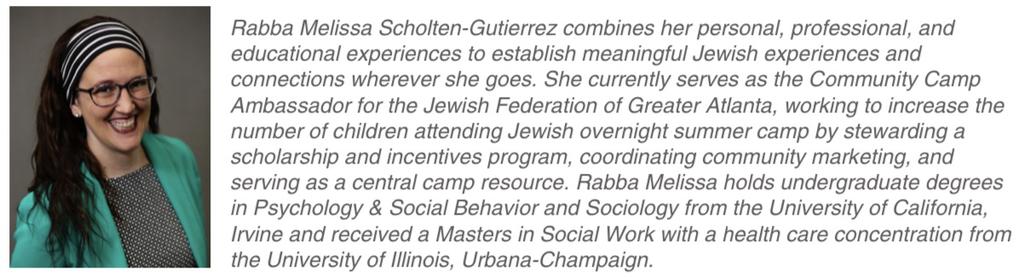
Rabba Melissa Scholten-Gutierrez
Class of 2018
The wounded healer is a paradigm that suggests that a healer’s own wounds can carry curative power for those with whom they work. This is not exclusive to therapists, it is also true of clergy, and I would suggest, people at large. We all have wounds, and the opportunity to heal others from them.
The Talmud Bavli in Sanhedrin 98a, brings a story of Mashiach interfacing with this very idea.
אמר ליה אימת אתי משיח אמר ליה זיל שייליה לדידיה והיכא יתיב אפיתחא דקרתא ומאי סימניה יתיב ביני עניי סובלי חלאים וכולן שרו ואסירי בחד זימנא איהו שרי חד ואסיר חד אמר דילמא מבעינא דלא איעכב
Rabbi Yehoshua ben Levi said to Elijah: When will the Messiah come? Elijah said to him: Go ask him. Rabbi Yehoshua ben Levi asked: And where is he sitting? Elijah said to him: At the entrance of the city of Rome. Rabbi Yehoshua ben Levi asked him: And what is his identifying sign by means of which I can recognize him? Elijah answered: He sits among the poor who suffer from illnesses. And all of them untie their bandages and tie them all at once, but the Messiah unties one bandage and ties one at a time. He says: Perhaps I will be needed to serve to bring about the redemption. Therefore, I will never tie more than one bandage, so that I will not be delayed.
Mashiach places himself amidst the others who are also suffering. He uses his wounds to hold his space there, and to provide comfort to those who are suffering outside the city.
In this week’s parsha, Tazria-Metzora, we can learn a lot about how to interact with those who are suffering outside of their community, chutz l’machaneh. While our parsha speaks primarily of those who have been afflicted with tzaraat, a condition for which there is no modern translation, it also includes women who are post-childbirth and men who have had a seminal emission, which are quite present in our modern lives.
Someone with presumed tzaraat, must go to a priest and have it examined and declared publicly. They are then sent out of the camp for seven days, as we read in Vayikra 13:46:
After being checked and found clean, they must bring a complex series of offerings and engage in a purifying ritual; the completion of which allows them to re-enter the community.
Tzaraat is most commonly translated as leprosy. While we know its not quite leprosy, we also know that it was a condition which caused people to be shunned from their community in part because of presumed contagiousness and fear - the same thing stigma which applies to “lepers” today. So, who are our modern lepers? Who are the people we are casting out from our society because of stigma and fear?
One such group is those with mental illness. To take the connection one step further, Chazal often question the causes of tzaraat, seeking a moral or spiritual failing to pin it on. So too do our communities do with mental illness. Not only are people with mental illness often quieted, shunned, and/or feared, they are judged as others try to understand what failing has caused their affliction. We blame the victim and separate from them at a time when they often need the most support.
In order to get adequate support and treatment, those with mental illness must approach a professional, be examined, and have a diagnosis declared. Sometimes, that person must go physically from the community in order to heal in a treatment center. Other times, that person is physically in the community but feels isolated and removed emotionally.
We must do better than our ancestors. We cannot shun those we do not understand. We must find ways to keep people connected to our community, even when they must physically separate in order to heal. We cannot use their illness against them or as an excuse to dissociate.
Rabbi Sara Berman suggests that the “ritual associated with purification [from tzaraat] can be viewed as a way to give people time to heal. People in the midst of severe clinical depression or any other mental illness should have a chance to separate from their responsibilities in order to focus solely on getting better. Once they begin to heal, they can slowly reintegrate into society and their normal activities. As they do this, they should be welcomed and celebrated by the community rather than avoided.”
Mashiach can only come once we act like Mashiach and start helping the people in our midst; when we embrace our role as wounded healers.