19 Iyyar 5778 | May 4, 2018
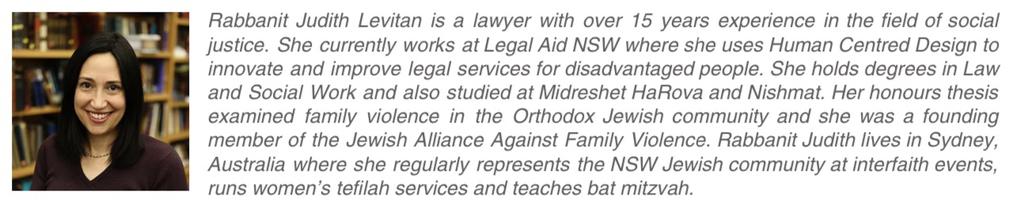
Rabbanit Judith Levitan
Advanced Kollel: Executive Ordination Track
Class of 2020
At the end of this week’s parsha the Torah addresses the issue of how to compensate a victim of an assault. The Torah identifies three acts of violence – assault resulting in death, damage to property, and personal injury - and the consequent punishment. The Torah’s approach is exemplified in the verse
A literal reading of the text suggests that retaliation against violence is justified. This understanding of the text clashes with our modern sensibilities and conceptions of how justice should be administered.
How can we make sense of a seemingly problematic text and how is it relevant to us today?
There are three approaches we can take:
1. Adopt the classic rabbinic interpretation that holds ‘eye for an eye’ means monetary compensation.
The Rabbis in the Gemara (Bava Kama 84a) are at pains to demonstrate the text cannot be understood literally. They maintain the underlying principle is that the perpetrator should pay monetary compensation to the victim for the loss suffered.
Rabbi Shimon Bar Yochai argues a literal interpretation of the law cannot be practically implemented – it is impossible to inflict the exact same injury on the perpetrator as that suffered by the victim. The school of Hezekiah asserts a literal interpretation of the text may result in a more unjust outcome where the punishment is harsher than originally intended –the process of maiming a person may result in complications leading to death.
Saadia Gaon, Ibn Ezra and Maimonides all bring similar arguments against a literal interpretation of the text and insist it refers to monetary compensation.
Modern commentators analyse the phrase עין תחת עין ‘eye for an eye’ by examining how the term 'תחת' is used in other places in the Tanach. In Genesis (22:13), Abraham offers the ram as a sacrifice in place of his son Isaac. 'ויעלהו לעולה תחת בנו'. Further on in Genesis (44:33), Judah argues with Joseph as vizier of Egypt. He begs to remain in Egypt in place of his brother Benjamin. “עתה ישב-נא עבדך תחת הנער.” These examples support the argument the phrase means ‘the value of an eye in place of an eye’ i.e. the offender should provide monetary compensation for the injury.
2. Reconcile the plain meaning of the text with the accepted traditional interpretation in the oral law.
If we accept that ‘eye for an eye’ refers to monetary compensation, then why is this not expressly stated in the Torah? There must be a reason why the Torah uses the language it does.
Perhaps the seemingly harsh language of the Torah is an echo of the victim’s roar of pain. It is a reminder that whatever compensation is provided, money remains an imperfect way of making up for the loss suffered. What is lost – the ability to see, to walk, to feel safe, to trust - can never be fully replaced. The victim’s experience and memory of the violent act can never be fully erased.
The language of the Torah represents the voice of the victim. The Rabbinic response of monetary compensation offers a way to vindicate the experience of the victim and, at the same time, provides some level of resolution so that both victim and perpetrator can move forward. We need the raw emotion of the written law, tempered with the logical and measured approach of the oral law. Together, these voices offer a paradigm to help the victim acknowledge the pain and then contain it, so they can shift their identity away from that of victim to survivor.
3. Place the text in its sociological and historical context. Identify the principles underpinning the laws that have contributed towards creating a civil society.
Whether or not we accept that monetary compensation is at the heart of the meaning of the verse ‘an eye for an eye’, we can still acknowledge the civilising aspects in the text. The Torah introduces the concept of an eye for an eye – not 100 eyes for one eye. The Torah favours a relationship between punishment and the crime that is measured and proportionate in the face of what could be unbridled revenge.
The law about compensation for damage to property (e.g. an animal) demonstrates the value the Torah places on human life ahead of personal property. The Torah distinguishes between the consequences of taking a human life and taking someone else’s property and then repeats this distinction: ומכה אדם יומת ומכה בהמה ישלמנו. Given the text is sparse to begin with, perhaps the repetition serves to emphasize the higher standard of care and the dire consequences for taking away a human life compared to taking away property.
The Torah law stands in stark contrast to ancient Babylonian Codes that came before it. For example, in the Code of Hammurabi (written at least 400 years before the Torah was given at Sinai) there is less of a distinction between the value of human life over property and less of a measured response to its loss. The Code provides the punishment for theft - taking property without consent - is death. The sentence could be commuted depending on the thief’s ability to repay 5–30 times the value of the stolen goods. The Torah concludes the section with the statement ‘You shall have one standard for stranger and citizen alike: for I am the Lord your God’. משפט אחד יהיה לכם כגר כאזרח יהיה כי אני ה' אלוקיכם. The laws of other ancient societies, such as the Code of Hammurabi, prescribed penalties for the offender that were dependent on the social standing of the victim. The offender paid less in compensation if they injured a slave as opposed to a free man.
The Torah presents a radical break from this approach with the concept of one law for all, irrespective of social or economic status. The injuries sustained by rich and poor are valued in the same way and the same sanctions apply to those who commit the crime. This idea is rooted in the belief that all humans are created in the divine image.
Following the exhortation to apply one law, the Torah reminds us אני ה' אלוקיכם, I am your (plural) God – the God of the stranger and citizen alike.
This divine effort to include those that sit on the margins of society offers a way to prevent the assault spoken of at the outset. People who feel alienated are less likely to have connections in the community or to be invested in the wellbeing of the community. They have nothing to lose from resorting to violence to get what they want. Violence can be an indicator of the breakdown within society between the citizen and the stranger. By seeking to include those that may feel alienated, the Torah offers a way to repair this breach. The laws at the end of this week’s parsha were game-changers for human civilisation at the time they were introduced. Thousands of years later, they continue to set a standard to which modern, civilised societies can aspire – a justice system that hears the voices of those impacted by violence and provides them with adequate compensation; a system where there is equality before the law and one standard for rich and poor, for people who are fully engaged and also for those on the margins.