Rosh Hashana 2018/5779
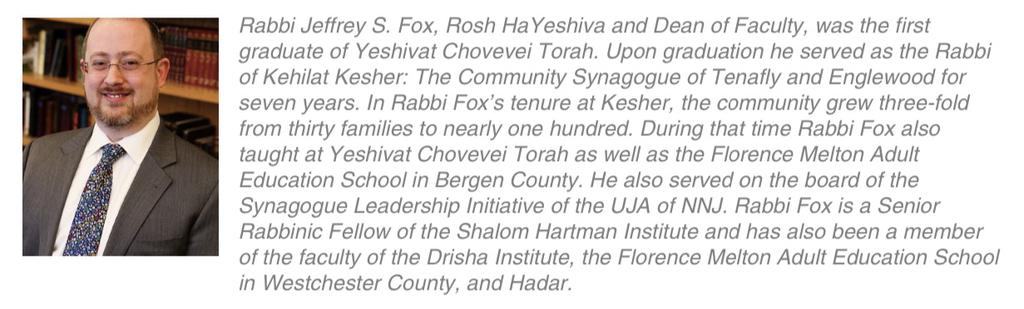
Rabbi Jeffrey Fox
Rosh HaYeshiva and Dean of Faculty
Introduction — On Clocks and Clouds
One of the greatest philosophers of science of the twentieth century was a man by the name of Dr. Karl Popper. He was born in Vienna in 1902 and had four Jewish grandparents, though his family converted to Lutheranism before he was born. He studied psychology, pure math, physics, and metaphysics. In an attempt to escape Austro-Hungary in the 30's, he began publishing and was given a university position in New Zealand. From there, he moved to London, where he taught formal logic and pure math. His writings and teachings were influential in every area of modern thought — truth, free will, quantum mechanics, evolution, Marxism, cosmological pluralism — to name just a few. He was friends with all the leading physicists of the day -- Einstein, Heisenberg, Bohr.
The question of human freedom and the ability of people to change were issues that animated much of his thought. He was terrified by the notion that all of existence was driven by a predetermined path, as though we were all functioning like the hands on the face of a clock, simply ticking through our lives and following a pre-ordained destiny.
For Popper, the universe was divided into clocks and clouds. Clocks represent regularity, predictability and the belief that we can take apart any problem and then put it back together. Clouds, on the other hand, are disorderly and unpredictable. They are gasses that are made up of properties that we cannot precisely define. His core claim was that scientists too often believe that they are working on a problem that is a clock when, in fact, most problems are actually clouds.
Popper was living at a time when people believed that with enough data they could predict with precision not only the paths of the planets and billiard balls, but also human behavior. The development of the social sciences was also moving in this direction. If only we could know all of the thoughts of one person we could predict exactly what they would do and when they would do it.
Scientists today make the same mistake because it is more comforting to imagine that the answers are out there and we just need to work harder to find them. Rabbis also make the same mistakes when we are dealing with human challenges in Halakha, Jewish Law. In fairness, there are some Halakhik issues that really are clocks. When someone calls me having used the dairy spoon for the chicken soup the answer can be provided like clockwork. However, when I am sitting in the hospital room with a family trying to decide whether or not to put in a feeding tube in their 96 year old grandmother who has not eaten anything in 24 hours, the answer is complex. That situation is a cloud, a nuanced reality that will reach a unique outcome every time.
The season of the yamim noraim is filled with challenges that the great thinkers of the past have sought to solve with clock-like precision. Rambam sketched the steps that are necessary for repentance, the exact sounds of the Shofar are debated at great length, and we are given a menu of foods to be eaten at the Rosh Hashana meals -- all in hope of ensuring a happy and healthy year. However, we all know people who went through the stages of teshuva, heard all the sounds of the Shofar, and ate all the “right” foods who were not blessed with a year of health or who were not really able to improve their bitter personalities. Life is a cloud, not a clock.
Each day of Rosh Hashana we blow the Shofar for 100 different blasts. The significance of the number 100 is veiled in mystery and is, I believe, one of the more cloudy aspects of Rosh Hashana. It is through competing midrashim and texts that we are able to arrive at a nuanced and complex — cloudy — understanding of the Shofar.
The Mother of Sisera
The Talmud (Rosh Hashana 33b) explains that there is a fundamental debate as to the exact sound of the terua. All agree that the tekia is a single strong, solid sound. However, the nature of the terua, the broken sound, is unclear. The gemara links this sound to different types of crying - יילול or גנח, which can best be translated as either whimpering or moaning. Our current practice reflects both views. What we today call the terua, the nine quick staccato beats, is a type of quick whimper; what we call the shevarim, the three mid-size notes, is a slower moaning sound. The gemara seems to take for granted that the Shofar is linked to crying.
The Rabbis proved this through reference to a woman of the Bible about whom we know very little. One of the enemies of the Israelites was a general by the name of Sisera. He fought against Devorah the Prophetess. After her victory Devorah wrote a beautiful song of thanks to God. In this shira she refers to the mother of Sisera waiting by the window anticipating the return of her son from battle. She is peering out past the lattice and, in the words of the Navi:
וַתְּיַבֵּ֛ב אֵ֥ם סִֽיסְרָ֖א
And the mother of Sisera cried
The word used in this verse for crying, ותיבב, can also describe the sounds of the Shofar. The mother of Sisera became one of the classic sources for the cries of the Shofar — both the terua and the shevarim.
Rabbeinu Chananel (d. 1053 Kairouan, Tunisia) at the very end of Masechet Rosh Hashana says that he has an ancient tradition that not only did the mother of Sisera cry, but that she cried 100 times. For Rabbeinu Chananel (and the Aruch, ערך ערב quoted in Tos. 33b) and those who follow his approach, each and every time the Shofar is blasted we are reminded of the tears of the mother of the evil general Sisera.
The mother of the sworn enemy of Israel became the model upon which the sounds of the Shofar are based. Sisera was clearly understood to be an evil person and yet the anxious tears of his mother have deep meaning. What does this mean for us today? How do we relate to the mothers of our sworn enemies? Do we seek to incorporate them into our tefilot? Are we able to internalize the message that the mother of even the general coming to attack and kill us deserves our compassion?
Sara for Yitzchak
Another tradition ties the blasts of the Shofar to Sara's cries for Yitzchak. The Midrash (Pirkei d'Rebbi Eliezer, 31:2) tells us that the evil angel Samael was very upset that Avraham passed the test of the binding of Yitzchak. As Avraham and Yitzchak were on the way down from the mountain Samael went to Sara. He said to her, “So did you hear what happened?” The Midrash continues:
לקח אישך הזקן לנער יצחק והקריבו לעולה, והנער בוכה ומייליל שלא יכול להנצל, מיד התחילה בוכה ומייללת, בכתה שלש בכיות כנגד שלש תקיעות, שלש יללות כנגד שלש יבבות, ופרחה נשמתה ומתה.
Your elderly husband took Isaac and slaughtered him on an altar. Immediately Sara began to cry and moan. [She cried] three times like the three tekiot, and her soul departed and she died.
According to this Midrash, Sara died upon hearing this terrible news from the angel. She thought that her husband had actually slaughtered her beloved son. She was so overwhelmed that she could no longer live. Even in the pshat of the story as told in Chumash, the family is never truly able to come back together after the Akeida. The next time we hear of them together is when Avraham (without Yitzchak) comes to mourn Sara’s passing. The connections among them have been torn asunder by this traumatic experience.
There are other versions of the Midrash in which Sara instead of crying only three times, actually cries 100 times (See Rav Kasher, Torah Shleima, Chayye Sara, n.17). Now the Shofar has been shifted from the tears of the mother of our enemy to the tears of our mother Sara -- with an ironic twist. The mother of Sisera cried for her son who she believed was alive and would eventually return home, but who had already died. Sara Imeinu cried for her son who she believed was dead and would never come home, but who was still alive and well.
The cries of Sara in this powerful Midrash represent the cries of anyone who has ever faced a challenge within their family. How did we respond? Were we able to bring our family together in the face of diversity?
It is not uncommon for families to unravel as the result of trauma — the sudden loss of a parent, a bitter divorce, the tragic (God forbid) loss of a child. There are people of great strength who are able to persevere, but many struggle to find their way back to equilibrium. For them, the Shofar is a plea -- please God give me the strength to hold my family together at this most difficult time. And for everyone, the Shofar, in this model, represents our deepest held hope for Shalom Bayit, for peace in our homes.
The Laboring Woman
A third source given for the one hundred sounds can be found in a fascinating Midrash dealing with the question of why a woman after giving birth brings certain sacrifices. The Midrash is bothered by the fact that a woman is required to bring a sin offering after this experience and explains that in her pain she may have sworn never to have children again.
In her screaming out in pain we are told:
מֵאָה פּוּעוֹת הִיא פּוֹעָה כְּשֶׁהִיא יוֹשֶׁבֶת עַל הַמַּשְׁבֵּר, תִּשְׁעִים וָתֵשַׁע לְמִיתָה, וְאַחַת לְחַיִּים.
The woman cried out one hundred times when she is sitting on the birth stool — 99 are tears of pain (death) and one is the cry of life.
These 100 cries are also modeled for us by the Shofar. These are a very different kind of tears. The tears of an expecting mother and father are filled with hope for a healthy child and a bright future. They are tears associated with the fears of the unknown, but also tears filed with prayers that the baby that is about to be born know a life of peace, health, fulfillment, joy, torah, mitzvot, family.
Now our Shofar cloud is taking some shape. We have the mother of Sisera, our mother Sara and a mother in labor. Our cloud clearly has some shared themes — the tears of a mother; and, at the same time, is forcing us to think in wildly different directions. It also has competing themes — is it the universalistic ethical method of compassion for all mankind or the particularistic message of people within my family? _ Is it the Shofar of social justice, the Shofar of shalom bayit, or perhaps the Shofar of hope? In the end, the answer is that it is the Shofar of all of the above; because the Shofar is a cloud and not a clock.
We are living at a time when people are looking for fast answers. We demand immediate access to information; our expectation is that with the click of a button we can find the answers to our questions. In the age of the internet there is a grave danger that we will begin to see clocks everywhere. The Shofar reminds us that we live in a world of clouds as well as clocks. We must learn to make room for the clouds in the world -- to see the world as a place filled with meaning moving in many directions. May we all be blessed with a cloudy year.