


(כ) וַתֹּ֨אמֶר נׇעֳמִ֜י לְכַלָּתָ֗הּ בָּר֥וּךְ הוּא֙ לַה' אֲשֶׁר֙ לֹא־עָזַ֣ב חַסְדּ֔וֹ אֶת־הַחַיִּ֖ים וְאֶת־הַמֵּתִ֑ים וַתֹּ֧אמֶר לָ֣הּ נׇעֳמִ֗י קָר֥וֹב לָ֙נוּ֙ הָאִ֔ישׁ מִֽגֹּאֲלֵ֖נוּ הֽוּא׃
(20) Naomi said to her daughter-in-law, “Blessed be he of the LORD, who has not failed in His kindness to the living or to the dead! For,” Naomi explained to her daughter-in-law, “the man is related to us; he is one of our redeeming kinsmen.”
READING (A) Blessed is he to the Lord, who has not abandoned his kindness with the living and with the dead. the LORD is the referent, and the subject of עזב.
READING (B): Blessed to the Lord is he who has not abandoned his kindness with the living and with the dead. BOAZ is the referent. and the subject of עזב.
See also: P. Jouon, Ruth: Commentaire Philogique et Exegetique (Rome, 1953), 63;
E. Campbell, Anchor Bible: Ruth (New York, 1975), 106,
J. M. Sasson, Ruth: A New Translation with a Philological Commentary and a Formalist-Folklorist Interpretation (Sheffield, 1979.), 60;
Y. Zakovitz, מקרא וישראל: רות עם מבוא ופירוש (Jerusalem, 1990), 83
From Marjo Christina Annette Korpel, The Structure of the Book of Ruth, 2001:
p. 130, n. 20
Dunn, Fewel 1993, 157 multivalence
Linafelt 1999, 41-42 multivalence
Some see Boaz as the referent: Rebera 1985, 317-27; followed by Hubbard 1988, 186; Gow 1992 59-60; Bush 1996, 134-36
(13) I will be a father to him, and he shall be a son to Me, but I will never withdraw My favor from him as I withdrew it from your predecessor.
Reading A takes "the Lord" to be the antecedent (and implied subject) of the relative clause, whereas reading B makes "he," i.e. Boaz, the antecedent.
*Prof. Richard Steiner (in an oral communication) argued that חסד should be taken as the subject of the verb עזב, as in II Sam 7:15, חסדי לא יסור ממנו ("My kindness shall not depart from him"), since עזב את ("to leave," "to abandon") is a synonym of סר מן (qal; "to depart from"), not הסיר מן (hif'il; "to remove from"). In that case, את would be the direct object marker, indicating החיים והמתים as the (compound) object, yielding the translation, "Blessed is he to the Lord, whose kindness has not left the living or the dead."...
Reading B, like reading A, can be modified slightly to accommodate R. Steiner's analysis:
<ST: e.g., Blessed to the Lord is he whose kindness has not left the living or the dead."
Main clause: blesses Boaz for his generosity
Relative clause praises the Lord, "invoking one of the thirteen divine attributes of mercy, נוצר חסד ("preserver of kindness"; Ex 34:7)," implicitly attributing the generosity to divine providence.
The negative formulation, לא עזב instead of אשר נוצר ("who has preserved"), reflects a reversal of Naomi's feeling in ch. 1 that God has caused her to suffer.
Main clause: blesses Boaz for his generosity
Relative clause: praises Boaz, stipulating the reason for the blessing.
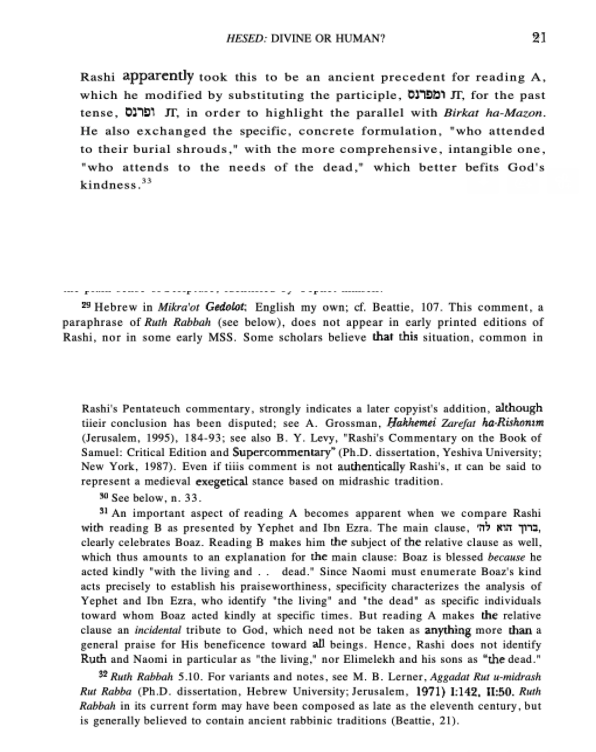
(י) וַתֹּאמֶר נָעֳמִי לְכַלָּתָהּ בָּרוּךְ הוּא לַה' אֲשֶׁר לֹא עָזַב חַסְדּוֹ אֶת הַחַיִּים (רות ב, כ), שֶׁזָּן וּפִרְנֵס אֶת הַחַיִּים. וְאֶת הַמֵּתִים, שֶׁנִּטְפַּל בְּתַכְרִיכֵיהוֹן.
Composed: Talmudic Israel/Babylon, c.700 - c.950 CE?
(10) "And Naomi said unto her daughter-in-law: 'Blessed be he of Hashem, who has not left off His kindness to the living and to the dead.' (Ruth 2:20)": that is the feeding and support of "the living". "And the dead" that is being attentive to their shrouds.
Inconclusive.
The text seems to have a particular referent in mind, but this could plausibly be understood as either Boaz or God; both fit and both are problematic.
In support of Boaz: attending to shrouds seems like a human activity.
counter: if "the dead" are Elimelech, Mahlon, and Chilion, is it likely he would have prepared their shrouds, in the land of Moab?
counter: in this passage, God is said to tend to the dead (see below)
In support of God: M. Cohen sees the feeding and support of the living as a divine activity.
counter: I do not think this is clear from the text; I think he is influenced by Birkat haMazon.
Note: see the fuller citation of this passage below. Regardless of the intended subject of these actions, the midrash could support an understanding of deliberate ambiguity.
תרגום רס"ג רות ב' כ'
יכון מבארכא ללה אלד'י לם יכ'ל פצ'לה מן אלחיה ואלמותי
Saadia Gaon (882-942)
"Blessed is he to the Lord, W/who has not withheld his kindness from the living and from the dead."
retains the ambiguity
פירוש יפת בן עלי על רות
(Text is from M. Cohen, see his n. 5)
קולהא אשר לא עזב חסדו יחתמל אנהא תשיר בה אלי אללה תעלי ויחתמל אנהא תשיר בה אלי בעז פהו ידל אל בעז קד פעל חסד ואמת מע אלימלך ובניו והם אלמתים.
Yefet ben 'Ali on Ruth (10th century; Translation is from M. Cohen)
Her saying אשר לא עזב חסדו - it is possible that it refers to God, may He be exalted; or it may refer to Boaz, [in which case] this indicates that Boaz had performed חסד ואמת <see Cohen, n. 4> toward Elimelekh and his sons, who are the מתים.
and her saying את החיים ("with the living")--refers to herself and to Ruth.
M. Cohen translates Yefet's translation of the verse as follows, with footnote 3:
And נעמי said to her daughter-in-law: May he be blessed by the Master of the World, who has not abandoned his kindness with the living and the dead..."
<f.n. 3>: Although this English translation looks like reading A, Yephet's Arabic, like the Hebrew, is actually ambiguous (a feature that cannot be reproduced in English). See below, p. 22.
See Cohen, <f.n. 4> on Yefet's introduction of the term אמת in his collocation חסד ואמת. He cites E.Z. Melamed, in referring to the rabbinic use of this hendiadys in the sense of "חסד של אמת", presumably remarking on Yefet's use of the idiom specifically in his identification of the kindness to "the dead".
YEFET, additional interpretation
But it is said also [by others] that it [i.e., את החיים] refers to Elimelekh and his sons, and its meaning is לא עזב חסדו ואמתו ("He has not abandoned his kindness and faithfulness") to them while they were חיים ("living") and [now] when they are מתים ("dead"), with the meaning that he performed חסד ("kindness") with Naomi for the sake of th מתים ("dead").
Cohen (p. 16 and f.n. 15) suggests that Yefet records this problematic alternative reading because it accommodates the continuity of לא עזב; he notes that his student suggested that this reading suits the chronological sequence.
He finds the reading problematic (pp. 15-16) because it takes את החיים ואת המתים in the sense of "during their lifetime and in their death," which in Biblical Hebrew should be expressed as בחייהם ובמותם, as in 2Sam 1:23. He also explores whether Qoh 9:3 could be used in support of this alternative reading in Yefet, but concludes that it cannot.
<f.n. 6>: If God is the subject of the relative clause, it is reasonable to take את החיים ואת המתים as a reference to all people, living or dead, rather than to Elimelekh's family (see below, n. 31). God's kindness, unlike that of Boaz, is not limited to specific individuals or acts, which is perhaps why Yephet does not elaborate on his first reading.
ST: It would be possible to understand the reference generally for Reading B, with Boaz as the subject of the relative clause. But clearly, Yephet does not read this way. <Tiferet Adler noted, 9 Dec 2022, that attributing general kindness to Boaz could be associated with his fulfillment of agricultural Torah laws for caring for the poor>
Summary of M. Cohen (p. 14):
Yephet provides a rationale for our Reading B, with Boaz as the subject; he needs to posit a prior חסד, because he sees לא עזב as indicating a prior action that is continued. Contrast NJPS "has not failed." ... "was not discontinued" (p. 15.
<f.n. 7> In Yephet's language, "her saying אשר לא עזב חסדו... indicates (Ar. ידל) that Boaz had performed חסד ואמת with Elimelech and his sons." It is clear that this inference is based solely on the phrase אשר לא עזב חסדו and not the words את המתים, because he subsequently analyzes החיים, which precedes המתים in our verse. Cf. the Hebrew translation of Yephet (cited below), which rearranges the commentary. see <f.n. 8> on the Arabic.
ST: in Reading A, God's ongoing חסד - God always extends kindness to all beings - does not seem very well-suited to the context, if taken as a general statement.
In <f.n. 31>, Cohen states that for READING A / Rashi, no specificity is needed, because the relative clause is an "incidental tribute to God".
I am thinking in the following direction: "Blessed is Boaz before God, for [in providing us with food through Boaz], He continued/did not leave off His kindness..."
Or even, as possibly hinted in some of Cohen's discussion: Blessed is Boaz before God, Who [counter to my perception and laments in ch. 1] has not [actually] abandoned his characteristic/eternal kindness..."
Cohen, <f.n. 20>: The Hebrew בועז עשה חסד ("Boaz performed kindness") is simple perfect, not pluperfect ("Boaz had performed kindness"); cf. Ibn Ezra's formulation, בועז עשה חסד בתחילה, cited below. Yephet's Arabic בועז קד פעל חסד seems to indicate the pluperfect, although the prefix קד can be construed otherwise; see W. Wright, A Grammar of the Arabic Language (New York, 1967), II:3-5.
תרגום של יפת לעברית, מהמאה ה-12
(see Cohen, f.n. 16)
ואמר אשר לא עזב חסדו - ישוב אל ה' ית״ש או ישוב אל בועז. ואמר את החיים - ישוב אל נעמי ואל רות.
ואמר את המתים - וזה יודיע כי בועז עשה חסד ואמת עם אלימלך ובניו, והם המתים, במענה כי הוא עשה חסד עם נעמי בעבור המתים.
12th century Hebrew translation of Yefet's commentary (See M. Cohen, f.n. 16 on the earlier misattribution of this commentary).
And it says, "who has not abandoned his kindness" - this refers either to God, may his name be blessed, or it may refer to Boaz.
And it says, "with the living" - this refers to Naomi and Ruth.
And it says, "and with the dead" - this indicates that Boaz performed "kindness and truth" with Elimelekh and his sons, and they are "the dead," with the meaning that he performed kindness with Naomi for the sake of the dead.
modified Yefet:
תרגום של יפת לעברית, מהמאה ה-12
(see Cohen, f.n. 16)
ואמר אשר לא עזב חסדו - ישוב אל ה' ית״ש או ישוב אל בועז. ואמר את החיים - ישוב אל נעמי ואל רות.
ואמר את המתים - וזה יודיע כי בועז עשה חסד ואמת עם אלימלך ובניו, והם המתים, במענה כי הוא עשה חסד עם נעמי בעבור המתים.
YEFET's ARABIC
קולהא אשר לא עזב חסדו יחתמל אנהא תשיר בה אלי אללה תעלי ויחתמל אנהא תשיר בה אלי בעז פהו ידל אל בעז קד פעל חסד ואמת מע אלימלך ובניו והם אלמתים.
Her saying אשר לא עזב חסדו - it is possible that it refers to God, may He be exalted; or it may refer to Boaz, [in which case] this indicates that Boaz had performed חסד ואמת <see Cohen, n. 4> toward Elimelekh and his sons, who are the מתים.
and her saying את החיים ("with the living")--refers to herself and to Ruth.
(א) ברוך ה' אשר לא עזב חסדו. לאות כי עשה חסד בתחילה עם אלימלך ועם בניו כי שופט היה.
(ב) החיים. נעמי ורות.
מגואלנו הוא. אין הגאולה יבום רק הוא דרך אחרת.
(1089 - 1164); Translation of M. Cohen
Blessed is [he to] God, who has not abandoned his kindness"--this is evidence that he had performed kindness beforehand toward Elimelekh and his sons, for he was a chieftain.***
"..." the living"--Naomi and Ruth.
M. Cohen comments on Yephet's influence on Ibn Ezra (in f.n. 21, he cites Schorstein, 5; Beattie, 37); he notes (p. 18-19) that Ibn Ezra reflects Yephet's Arabic rendering of Reading B more faithfully than the Hebrew translation of Yephet's commentary does, because it is clearly in the past. But he departs from Yefet in citing only this Reading-- Boaz as the antecedent and subject. And he only cites the first explanation of Reading B-- past kindness to Elimelech and sons, rather than present & past.
Cohen notes: Yefet's equivocation might have related to the fact that the Bible does not cite prior kindness of Boaz to Elimelech and sons; Ibn Ezra is fine with this, relying on rabbinic tradition.
<f.n. 22> M. Cohen notes the "laconic incipit" 'ברוך ה, omitting the "the crucial words הוא ל" , "which would imply that God is the subject of the relative clause", as in the Peshitta below. "But this is clearly not Ibn Ezra's view, as indicated on his commentary on this verse. It is likely. that the laconic incipit is the result of a copyists error".
*** See b. Bava Batra 91a: Boaz = Ivzan (Judg 12:8); cf. Ibn Ezra Ruth 2:1, at first mention of Boaz (see Cohen, <f.n. 27>)
(1) With the living and with the deceased. That he feeds and sustains the living, and occupies himself with the needs of the deceased.
*The “needs of the deceased” refers to the kindness displayed by Bo’az to Elimelech and his sons. (Ibn Ezra) Alternatively, the “needs of the deceased” refers to the willingness of Bo’az to perform a levirate marriage and will thus do kindness to the memory of her deceased husband. (Alshich)
M. Cohen:
This comment, a paraphrase of Ruth Rabbah (see below), does not appear in early printed editions of Rashi, nor in some early MSS. Some scholars believe that this situation, common in Rashi's Pentateuch commentary, strongly indicates a later copyist's addition, although this conclusion has been disputed...
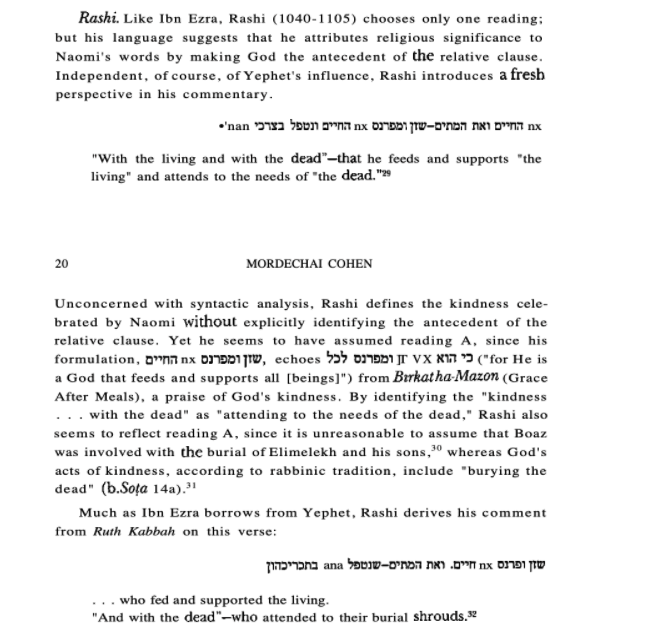

(י) וַתֹּאמֶר נָעֳמִי לְכַלָּתָהּ בָּרוּךְ הוּא לַה' אֲשֶׁר לֹא עָזַב חַסְדּוֹ אֶת הַחַיִּים (רות ב, כ), שֶׁזָּן וּפִרְנֵס אֶת הַחַיִּים. וְאֶת הַמֵּתִים, שֶׁנִּטְפַּל בְּתַכְרִיכֵיהוֹן.
(10) "And Naomi said unto her daughter-in-law: 'Blessed be he of Hashem, who has not left off His kindness to the living and to the dead.' (Ruth 2:20)": that is the feeding and support of "the living". "And the dead" that is being attentive to their shrouds. "
Rashi apparently took this [Midrash Ruth Rabba] to be an ancient precedent for reading A, which he modified by substituting the participle, מפרנס, for the past tense, פרנס, in order to highlight the parallel with Birkat ha-Mazon. He also exchanged the specific, concrete formulation, "who attended to their burial shrouds," with the more comprehensive, intangible one, "who attends to the needs of the dead," which better befits God's kindness.33
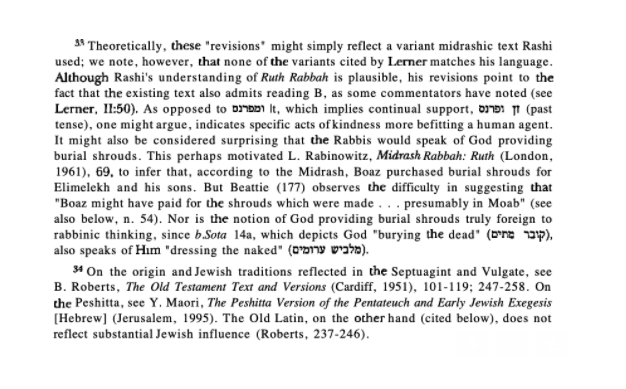
As opposed to ומפרנס which implies continual support, זן ופרנס (past tense), one might argue, indicates specific acts of kindness more befitting a human agent. It might also be considered surprising that the Rabbis would speak of God providing burial shrouds. This perhaps motivated L. Rabinowitz, Midrash Rabbah: Ruth (London, 1961), 69, to infer that, according to the Midrash, Boaz purchased burial shrouds for Elimelekh and his sons.
But Beattie (177) observes the difficulty in suggesting that "Boaz might have paid for die shrouds which were made . . . presumably in Moab" (see also below, n. 54). Nor is the notion of God providing burial shrouds truly foreign to rabbinic thinking, since b.Sota 14a, which depicts God "burying the dead" (קובר מתים), also speaks of Him "dressing the naked" (מלביש ערומים)
(א) בָּרוּךְ אַתָּה ה' אֱלֹקֵינוּ מֶלֶךְ הָעוֹלָם הַזָּן אֶת הָעוֹלָם כֻּלּוֹ בְּטוּבוֹ בְּחֵן בְּחֶסֶד וּבְרַחֲמִים, הוּא נֹתֵן לֶחֶם לְכָל־בָּשָׂר כִּי לְעוֹלָם חַסְדּוֹ וּבְטוּבוֹ הַגָּדוֹל תָּמִיד לֹא חָסַר לָנוּ וְאַל יֶחְסַר לָנוּ מָזוֹן (תָּמִיד) לְעוֹלָם וָעֶד בַּעֲבוּר שְׁמוֹ הַגָּדוֹל כִּי הוּא אֵל זָן וּמְפַרְנֵס לַכֹּל וּמֵטִיב לַכֹּל וּמֵכִין מָזוֹן לְכָל־בְּרִיּוֹתָיו אֲשֶׁר בָּרָא בָּרוּךְ אַתָּה ה' הַזָּן אֶת הַכֹּל.
(1) Blessed art thou, O Lord our God, King of the universe, who feedest the whole world with thy goodness, with grace, with lovingkindness and tender mercy; thou givest food to all flesh, for thy lovingkindness endureth for ever. Through thy great goodness food hath never failed us: O may it not fail us for ever and ever for thy great name's sake, since thou nourishest and sustainest all beings and doest good unto all, and providest food for all thy creatures whom thou hast created. Blessed art thou, O Lord, who givest food unto all.
הַקָּדוֹשׁ בָּרוּךְ הוּא קָבַר מֵתִים דִּכְתִיב וַיִּקְבֹּר אוֹתוֹ בַּגַּי
the Holy One, Blessed be He, buried the dead, as it is written: “And he was buried in the valley in the land of Moab” (Deuteronomy 34:6)
וְאָמַר רַבִּי חָמָא בְּרַבִּי חֲנִינָא מַאי דִּכְתִיב אַחֲרֵי ה׳ אֱלֹקֵיכֶם תֵּלֵכוּ וְכִי אֶפְשָׁר לוֹ לְאָדָם לְהַלֵּךְ אַחַר שְׁכִינָה וַהֲלֹא כְּבָר נֶאֱמַר כִּי ה׳ אֱלֹקֶיךָ אֵשׁ אוֹכְלָה הוּא אֶלָּא לְהַלֵּךְ אַחַר מִדּוֹתָיו שֶׁל הַקָּדוֹשׁ בָּרוּךְ הוּא מָה הוּא מַלְבִּישׁ עֲרוּמִּים דִּכְתִיב וַיַּעַשׂ ה׳ אֱלֹקִים לְאָדָם וּלְאִשְׁתּוֹ כׇּתְנוֹת עוֹר וַיַּלְבִּשֵׁם אַף אַתָּה הַלְבֵּשׁ עֲרוּמִּים הַקָּדוֹשׁ בָּרוּךְ הוּא בִּיקֵּר חוֹלִים דִּכְתִיב וַיֵּרָא אֵלָיו ה׳ בְּאֵלֹנֵי מַמְרֵא אַף אַתָּה בַּקֵּר חוֹלִים הַקָּדוֹשׁ בָּרוּךְ הוּא נִיחֵם אֲבֵלִים דִּכְתִיב וַיְהִי אַחֲרֵי מוֹת אַבְרָהָם וַיְבָרֶךְ אֱלֹקִים אֶת יִצְחָק בְּנוֹ אַף אַתָּה נַחֵם אֲבֵלִים הַקָּדוֹשׁ בָּרוּךְ הוּא קָבַר מֵתִים דִּכְתִיב וַיִּקְבֹּר אוֹתוֹ בַּגַּי אַף אַתָּה קְבוֹר מֵתִים
He explains: Rather, the meaning is that one should follow the attributes of the Holy One, Blessed be He. He provides several examples. Just as He clothes the naked, as it is written: “And the Lord God made for Adam and for his wife garments of skin, and clothed them” (Genesis 3:21), so too, should you clothe the naked. Just as the Holy One, Blessed be He, visits the sick, as it is written with regard to God’s appearing to Abraham following his circumcision: “And the Lord appeared unto him by the terebinths of Mamre” (Genesis 18:1), so too, should you visit the sick. Just as the Holy One, Blessed be He, consoles mourners, as it is written: “And it came to pass after the death of Abraham, that God blessed Isaac his son” (Genesis 25:11), so too, should you console mourners. Just as the Holy One, Blessed be He, buried the dead, as it is written: “And he was buried in the valley in the land of Moab” (Deuteronomy 34:6), so too, should you bury the dead.
(מח) (כ) וַתֹּאמֶר וכדין אמרית נָעֳמִי נשמתא לְכַלָּתָהּ ליצרא טבא בָּרוּךְ הוּא לַה' בריך שמיה דה' אֲשֶׁר לֹא עָזַב חַסְדּוֹ אֶת הַחַיִּים דלא שביק חסדא מחייא וְאֶת הַמֵּתִים ועתיד לאחייא מתיא.
...
Author: Judah David Eisenstein
Composed: c.400 - c.1200 CE
Otzar Midrashim (“Anthology of Midrashim”) is an encyclopedic work listing and describing midrashim compiled by Julius Eisenstein in 1915. It includes the full text of some of the shorter midrashim.
Zohar - Midrash Hane'elam on Ruth
Thus said Naomi (the Soul) to her daughter-in-law (the Desire-for-Good): Blessed is he to the Lord! Blessed is the name of the Lord who does not withdraw His loving-kindness from the living, and is destined to resurrect the dead.
(א) ותאמר נעמי לכלתה, תחלה נתנה לו ברכה אשר לא עזב חסדו את החיים כי הבינה שעשה זאת לפרנס עי"כ בכבוד את נעמי ורות שהם חיים והם ממשפחתו, ואת המתים כי הבינה ג"כ שיעשה חסד עם המתים ע"י יבום שבזה יעשה טובה לנפש המת,
ופרשה דבריה נגד מ"ש אשר לא עזב חסדו את החיים כי קרוב לנו האיש, וע"כ עושה חסד עם קרוביו החיים, ונגד מ"ש עם המתים אמרה מגואלנו הוא, והגואל צריך הוא ליבם שבזה יגאל נפש המת לבל ימחה שמו מישראל, ואמרה מגואלנו הוא כי יש עוד גואל והוא אחד מהם:
...
Rabbi Meir Leibush ben Yehiel Michel Wisser (Malbim).
Composed: Warsaw (c.1844 - c.1874 CE)
"Naomi said to her daughter-in-law" - She began by blessing him [with the words] "who has not abandoned his kindness with the living", because she understood that what he had done was in order to honourably provide for Naomi and Ruth, who were living and of his kin, "and for the dead," since she also understood that he would show kindness to the dead by performing the levirate rituals, which do good for the soul of the dead.
Septuagint Ruth 2:20
εὐλογητός ἐστιν τῷ κυρίῳ ὅτι οὐκ ἐγκατέλιπεν τὸ ἔλεος αὐτοῦ μετὰ τῶν ζώντων καὶ μετὰ τῶν τεθνηκότων
Septuagint Ruth 2:20
"Blessed is he to the Lord, because he has not abandoned [lit. left behind] his mercy with the living and with the dead.
Vulgata - Liber Ruth II:xx
Benedictus sit a Domino quoniam eandem gratiam quam præbuerat vivis servavit et mortuis
Vulgate (4th century)
"May he be blessed by the Lord, because the same grace which he had shown to the living he preserved also to the dead."
ܣܦܪܐ ܕܪܥܘܬ ܡܘܐܒܝܬܐ
בריך הו מריא דלא אעבר חסדא מן חיא ומן מתיא.
Peshitta (2nd century?)
"Blessed is the Lord, who has not removed His kindness from the living and from the dead."
Vetus Latina - Ruth II:xx
Benedictus est dominus qui non derelinquid misericordiam suam cum uibis et cum mortuis
Old Latin (approx. 4th Century)
"Blessed is the Lord, who has not abandoned his kindness with the living and with the dead."
SYNTAX: ambiguous
CONTEXT:
immediate: Reading B: Boaz has just done the kindness.
broad: Reading A: Jouon-- the book is about Divine Providence; contrast and development from ch. 1 (1:13, 20-21)-- reversal.
לא עזב:
if עזב implies continuity, then perhaps better with Reading A as peshat, since God provides continuous kindness.
for Reading B: posit an undocumented past kindness by Boaz to (the) dead, and preferably, specifically Elimelekh and sons (so, Ibn Ezra).
- Jouon objects: not only unattested, but there was surely no prior kindness to Ruth?
- Cohen: Ruth can be considered indirect beneficiary, as part of the family.
alternatively, posit a different meaning of עזב, such as "has not failed".
המתים:
Glueck: חסד to dead is only by human beings.
See Ruth 1:8, below
(ST: potential challenge posed by נוצר חסד לאלפים? )
(ח) וַתֹּ֤אמֶר נׇעֳמִי֙ לִשְׁתֵּ֣י כַלֹּתֶ֔יהָ לֵ֣כְנָה שֹּׁ֔בְנָה אִשָּׁ֖ה לְבֵ֣ית אִמָּ֑הּ (יעשה) [יַ֣עַשׂ] ה' עִמָּכֶם֙ חֶ֔סֶד כַּאֲשֶׁ֧ר עֲשִׂיתֶ֛ם עִם־הַמֵּתִ֖ים וְעִמָּדִֽי׃
(יד) יַעַשׂ ה' עִמָּכֶם חֶסֶד, רַבִּי חֲנִינָא בַּר אָדָא אָמַר, יַעֲשֶׂה כְּתִיב, כַּאֲשֶׁר עֲשִׂיתֶם עִם הַמֵּתִים, שֶׁנִּטְפַּלְתֶּם בְּתַכְרִיכֵיהוֹן, וְעִמָּדִי, שֶׁוִתְּרוּ לָהּ כְּתֻבּוֹתֵיהֶן.
אָמַר רַבִּי זְעֵירָא, מְגִלָּה זוֹ אֵין בָּהּ לֹא טֻמְאָה, וְלֹא טָהֳרָה, וְלֹא אִסּוּר, וְלֹא הֶתֵּר, וְלָמָּה נִכְתְּבָה לְלַמֶּדְךָ כַּמָּה שָׂכָר טוֹב לְגוֹמְלֵי חֲסָדִים.
(14) "God will deal kindly with you (Ruth 1:8)" . Rabbi Chanina son of Ada says, "He will deal (ya'aseh)" is what is written (k'tiv), "as you dealt with the dead" when you were occupied with their shrouds, "and with me" when they renounced their ketubot. Rabbi Zeira says: "This book [of Ruth] does not have anything in it concerned with impurity or purity nor what is forbidden and what is permitted. So why is it written? To teach us the greatness of the reward for acts of lovingkindness."
54 Ruth Rabbah also highlights this parallel, since the gloss on 2:20 (cited above, p. 20) echoes a similar one on 1:8, which reads: עִם הַמֵּתִים, שֶׁנִּטְפַּלְתֶּם בְּתַכְרִיכֵיהוֹן, . -("... with the dead-that you tended to their bunal shrouds."וְעִמָּדִי, שֶׁוִתְּרוּ לָהּ כְּתֻבּוֹתֵיהֶן "and with me-that they absolved her of their marriage settlement" [Ruth Rabbah, 2:14; Lerner, 1:68].)
But rather than drawing Glueck's conclusion, the Midrash can be said to demonstrate a connection between divine and human kindness. Naomi later praises God as He "who attended to ... burial shrouds," precisely the actions performed by her daughters-in-law, indicating that their behavior reflected a divine quality. (Claiming, instead, that Ruth Rabbah on 2:20 credits Boaz with purchasing burial shrouds for Elimelekh and his sons [see above, n. 33] leads to a contradiction between these two midrashic sources.)
ST: but i think both midrashim can go either way.
NOTE THAT RUTH RABBAH 5: 10 is also about "to demonstrate a connection between divine and human kindness."
p. 130, n. 20
Dunn, Fewel 1993, 157: "multivalence"--the reader might take either God or Boaz or both of them as the subject of the blessing.
[ST: this is an inaccurate representation-- it is unlikely that they take God as the "subject" of the blessing (and unclear what that might mean), but rather as the referent of the relative clause and pronoun, and perhaps the subject of עזב (if the subject is not presumed to be חסד), as Korpel understands correctly in the rest of the footnote.
and so Linafelt 1999, 41-42.
Some see Boaz as the antecedent of the relative clause. So, Rebera 1985, 317-27; followed by Hubbard 1988, 186; Gow 1992 59-60; Bush 1996, 134-36.
Korpel rejects this on two grounds:
(1) Boaz has not yet done anything for the dead; in ch. 2 he "does not yet know that he is expected to act as a redeemer (cf. 3:9bC 12-13) nor does Ruth at this point know it (cf. 2:20bC). Consequently he has done nothing as yet for the dead.
Naomi's statement in v.20aC-D would have been incomprehensible if Boaz were the subject. Logically Naomi would have stated v. 20bC first if she had meant Boaz in vv. 20aC-D.
ST: his caring for Ruth and Naomi is a kindness to the dead
(2) Gen 24:27, and also Ezra 9:9, Neh 9:17 show that it is God who must be the subject of עזב חסד; Gen 24 is "hinted at several times earlier in Chapter 2 of the Book of Ruth". (Campbell 1975, 106: Wünch 1998, 195-96; Sakenfeld 1999, 45-46; Smelik 2000, 95). When human beings are the subject of עזב חסד it is their loyalty to God, not to human beings that is at stake (Jonah 2:8; cf. Job 6:14). See also גאל ||עזב Isa 62:12.
ST: Gen 24: מקרה actually could support the deliberate ambiguity, in my opinion; divine usage-- if it is imitatio dei here, then that supports deliberate ambiguity
(27) and said, “Blessed be the LORD, the God of my master Abraham, who has not withheld His steadfast faithfulness from my master. For I have been guided on my errand by the LORD, to the house of my master’s kinsmen.”
M. Cohen: CAUSAL EXPLANATION
See LXX:
"Not surprisingly, the Septuagint supplies the causal particle, ὅτι, to clarify the function of the relative clause, yielding: "Blessed are you to die Lord, because you have wrought this mercy.""
Although it lacks the phrase אשר לא עזב חסדו, its basic structure is identical to that of Ruth 2:20 and it is unambiguous, since die subject of the relative clause must agree with the verb עשיתם and can only be אשר be ,. .58 Given the formulaic nature of biblical benedictions, it is reasonable to assume that the אשר clause functions identically in both verses, i.e., to justify die choice of the recipient of the benediction, ל X ברוך, which yields reading B in Ruth 2:20.
(י) וַיֹּ֗אמֶר בְּרוּכָ֨ה אַ֤תְּ לַֽה' בִּתִּ֔י הֵיטַ֛בְתְּ חַסְדֵּ֥ךְ הָאַחֲר֖וֹן מִן־הָרִאשׁ֑וֹן לְבִלְתִּי־לֶ֗כֶת אַֽחֲרֵי֙ הַבַּ֣חוּרִ֔ים אִם־דַּ֖ל וְאִם־עָשִֽׁיר׃
(ה) וַיִּשְׁלַ֤ח דָּוִד֙ מַלְאָכִ֔ים אֶל־אַנְשֵׁ֖י יָבֵ֣ישׁ גִּלְעָ֑ד וַיֹּ֣אמֶר אֲלֵיהֶ֗ם בְּרֻכִ֤ים אַתֶּם֙ לַֽה' אֲשֶׁ֨ר עֲשִׂיתֶ֜ם הַחֶ֣סֶד הַזֶּ֗ה עִם־אֲדֹֽנֵיכֶם֙ עִם־שָׁא֔וּל וַֽתִּקְבְּר֖וּ אֹתֽוֹ׃
Maker of heaven and earth.
“Blessed be Abram of God Most High,
Creator of heaven and earth.
Yet even this argument is not decisive, since Naomi may have wished specifically to employ the negative formulation אשר לא עזב, which cannot be expressed in an appositive phrase. Perhaps she intended to reflect a reversal in her initial belief that God had forsaken her.63 Or, perhaps, she wished to invoke the words of Abraham's servant, ins TfVx 711113 '3VTK •?& maxi non aw X^ im nmax. And even if the parallel in Gen 24:27 was not actually on her mind, it is conceivable that the phrase non aw xV had, by her time, become a formulaic praise of God, which would remain unchanged despite being used in different contexts and syntactic constructions.
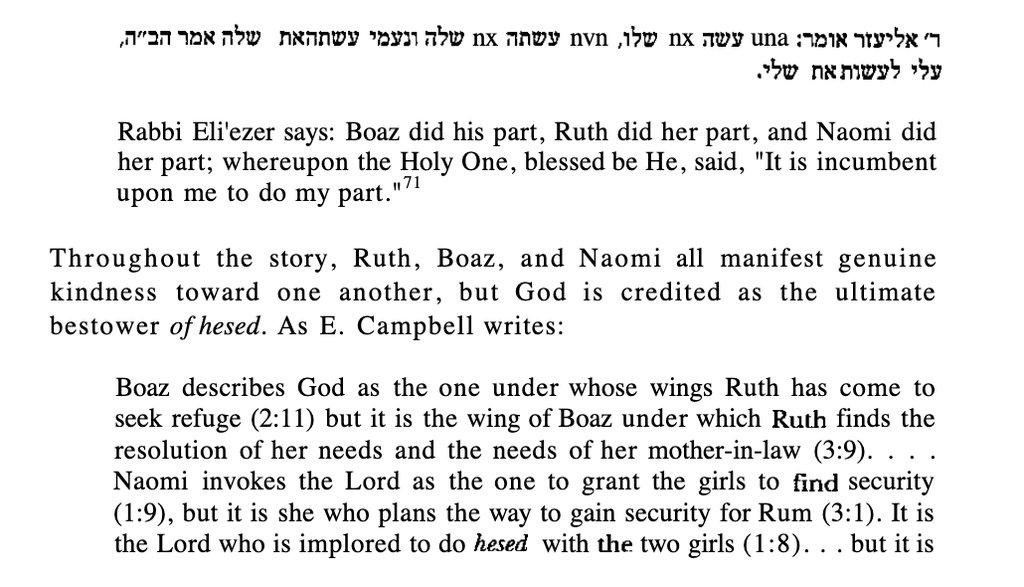
(ז) וּבֹעַז עָלָה הַשַּׁעַר וַיֵּשֶׁב שָׁם וְהִנֵּה הַגֹּאֵל עֹבֵר אֲשֶׁר דִּבֶּר בֹּעַז (רות ד, א), מָה לַאֲחוֹרֵי תַּרְעָא הֲוָה קָאֵים, אָמַר רַבִּי שְׁמוּאֵל בַּר נַחְמָן, אֲפִלּוּ הָיָה בְּסוֹף הָעוֹלָם הֱטִיסוֹ הַקָּדוֹשׁ בָּרוּךְ הוּא וֶהֱבִיאוֹ לְשָׁם, כְּדֵי שֶׁלֹא יְהֵא אוֹתוֹ צַדִּיק יוֹשֵׁב וּמִצְטַעֵר מִתּוֹךְ יִשּׁוּבוֹ. אָמַר רַבִּי בֶּרֶכְיָה, כָּךְ דָּרְשׁוּ שְׁנֵי גְדוֹלֵי עוֹלָם, רַבִּי אֱלִיעֶזֶר וְרַבִּי יְהוֹשֻׁעַ, רַבִּי אֱלִיעֶזֶר אוֹמֵר בֹּעַז עָשָׂה אֶת שֶׁלּוֹ, וְרוּת עָשְׂתָה אֶת שֶׁלָּהּ, וְנָעֳמִי עָשְׂתָה אֶת שֶׁלָּהּ, אָמַר הַקָּדוֹשׁ בָּרוּךְ הוּא, אַף אֲנִי אֶעֱשֶׂה אֶת שֶׁלִּי. וַיֹּאמֶר סוּרָה שְׁבָה פֹּה פְּלֹנִי אַלְמֹנִי, רַבִּי יְהוֹשֻׁעַ אוֹמֵר פְּלוֹנִי אַלְמוֹנִי שְׁמוֹ, רַבִּי שְׁמוּאֵל בַּר נַחְמָן אָמַר אִלֵּם הָיָה מִדִּבְרֵי תוֹרָה, אָמַר הָרִאשׁוֹנִים לֹא מֵתוּ אֶלָּא עַל יְדֵי שֶׁנָּטְלוּ אוֹתָן, וַאֲנִי הוֹלֵךְ לִטְלָהּ, חָס לִי לִטְלָהּ, לֵית אֲנָא מְעַרְבֵּב זַרְעֲיָיתִי, אֵינִי מְעָרֵב פְּסֹלֶת בְּבָנַי, וְלֹא הָיָה יוֹדֵעַ שֶׁכְּבָר נִתְחַדְּשָׁה הֲלָכָה עַמּוֹנִי וְלֹא עַמּוֹנִית מוֹאָבִי וְלֹא מוֹאָבִית.
(7) "Meanwhile, Boaz had gone to the gate and sat down there. And now the redeemer whom Boaz had mentioned passed by. He called, “Come over and sit down here, So-and-so!” And he came over and sat down (Ruth 4:1)": so was he waiting behind there and then he appeared? Rabbi Samuel the son of Nachman said: "Even if he was at the ends of the earth, the Holy One, blessed be He, would have flown him and brought him there so that a righteous man would not be upset sitting there". Rabbi Berachya: "So expounded the two great men of the world, Rabbi Eliezer and Rabbi Joshua: Rabbi Eliezer said: "Boaz made his thing and Ruth did her thing, and Naomi did her thing, and the Holy One, blessed be He said: "So I will do my thing". And he said "Hey, so and so, go there". Rabbi Joshua said: his name was Ploni Almoni ("so and so")". Rabbi Samuel the son of Nachman said that he was ignorant of the words of the Torah. He said: "the first ones did not die but rather because they took her and I am going to go and take her? I certainly am not going to take her. I will not pollute my seed and I am not going to create unfitness for my children". And he did not know that the halakhah had been changed "Ammonite and not Ammonitess; Moabite and not Moabitess".
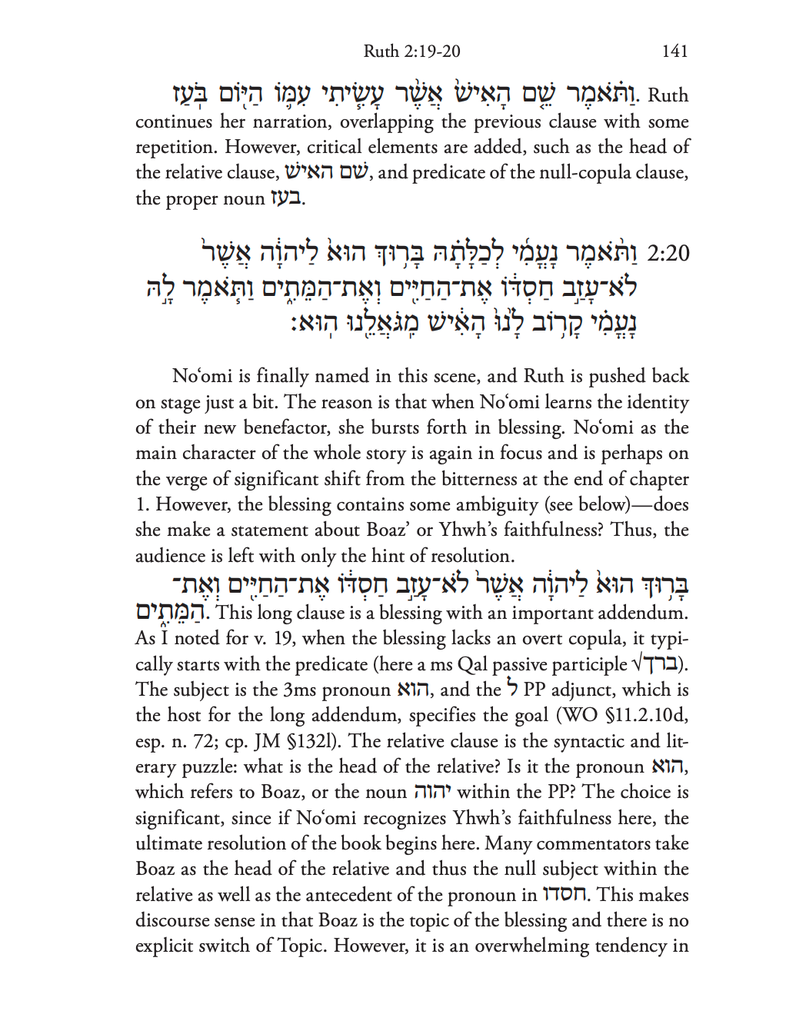
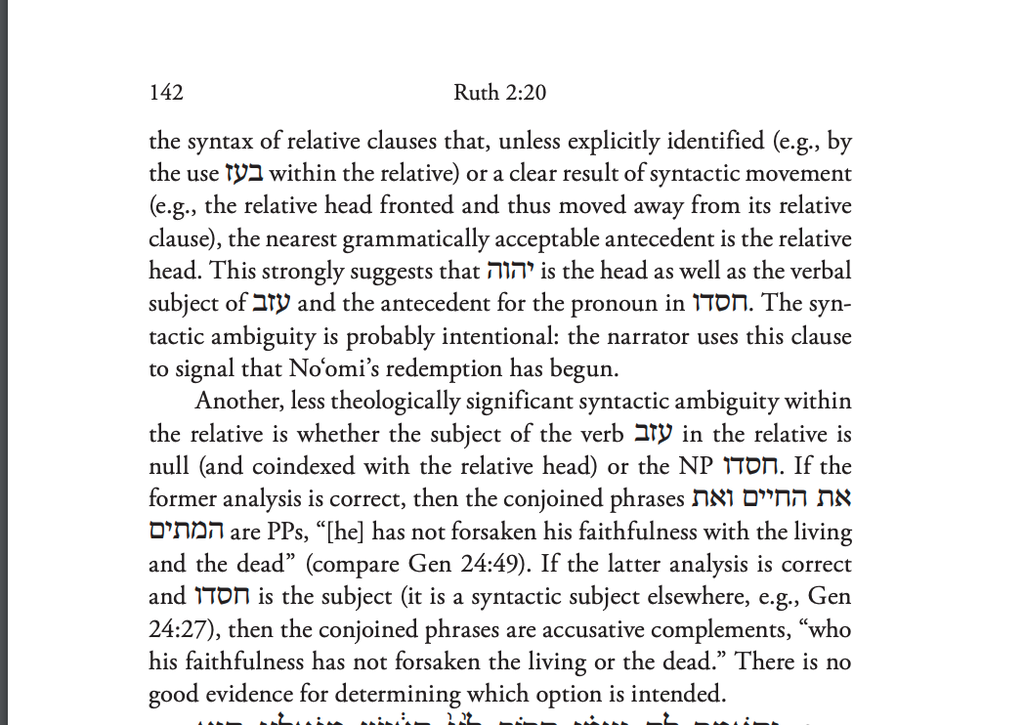
No‘omi is finally named in this scene, and Ruth is pushed back on stage just a bit. The reason is that when No‘omi learns the identity of their new benefactor, she bursts forth in blessing. No‘omi as the main character of the whole story is again in focus and is perhaps on the verge of significant shift from the bitterness at the end of chapter 1. However, the blessing contains some ambiguity (see below)—does she make a statement about Boaz’ or Yhwh’s faithfulness? Thus, the audience is left with only the hint of resolution. ּבָ ר֥ ּוְך הּוא֙ לַ יהוָ֔ה אֲ ׁשֶ ר֙ ל ֹא־עָ זַ ֣ב חַ סְ ּד֔ ֹו אֶ ת־הַ חַ ּיִ ֖ים וְאֶ ת־ יםִ ֑ תֵ מַ ּה .This long clause is a blessing with an important addendum. As I noted for v. 19, when the blessing lacks an overt copula, it typically starts with the predicate (here a ms Qal passive participle √ברך .( The subject is the 3ms pronoun הוא ,and the ל PP adjunct, which is the host for the long addendum, specifies the goal (WO §11.2.10d, esp. n. 72; cp. JM §132l). The relative clause is the syntactic and literary puzzle: what is the head of the relative? Is it the pronoun הוא , which refers to Boaz, or the noun יהוה within the PP? The choice is significant, since if No‘omi recognizes Yhwh’s faithfulness here, the ultimate resolution of the book begins here. Many commentators take Boaz as the head of the relative and thus the null subject within the relative as well as the antecedent of the pronoun in חסדו .This makes discourse sense in that Boaz is the topic of the blessing and there is no explicit switch of Topic. However, it is an overwhelming tendency in Ruth 2:19-20 141 2:20 the syntax of relative clauses that, unless explicitly identified (e.g., by the use בעז within the relative) or a clear result of syntactic movement (e.g., the relative head fronted and thus moved away from its relative clause), the nearest grammatically acceptable antecedent is the relative head. This strongly suggests that יהוה is the head as well as the verbal subject of עזב and the antecedent for the pronoun in חסדו .The syntactic ambiguity is probably intentional: the narrator uses this clause to signal that No‘omi’s redemption has begun. Another, less theologically significant syntactic ambiguity within the relative is whether the subject of the verb עזב in the relative is null (and coindexed with the relative head) or the NP חסדו .If the former analysis is correct, then the conjoined phrases ואת החיים את המתים are PPs, “[he] has not forsaken his faithfulness with the living and the dead” (compare Gen 24:49). If the latter analysis is correct and חסדו is the subject (it is a syntactic subject elsewhere, e.g., Gen 24:27), then the conjoined phrases are accusative complements, “who his faithfulness has not forsaken the living or the dead.” There is no good evidence for determining which option is intended.
(א) ותאמר נעמי וכו'. ראוי לשים לב א' האם עד כה לא ידענו כי רות היתה כלתה. ב' אומרו אשר לא עזב חסדו למה שיבחו על העדר עזיבת חסד ולא אמר דרך חיוב לומר ברוך הוא לה' אשר עשה חסד עם החיים ועם כו'. ג' אמרו עם החיים כו' כי הלא אחת היא נעמי ואיך אמרה החיים ל' רבים. ד' או' ואת המתים כי מה להם למתים עם זה והרי נתפרדה חבילתם ומה גם כי נשואי מואביות היו והיו כלא היו ואדרב' מה להם מאד מנשואיהן וכמאמ' על פסוק כי מר לי מאד מכם. ה' אומרו ותאמר לה נעמי באמצע דבריה כי הלא גם עד כה נעמי היא המדברת. ו' אומ' קרוב לנו האיש כי הלא אם לנעמי הוא קרוב לרות אפי' אינו ספק קרוב לה וא"כ איפה קרוב לי היה ראוי יאמר. ז' כי בכלל אומרו מגואלנו הוא נשמע כי קרוב הוא ולמה נאמר. ח' כי לא גואל הוא רק לאלימלך ובניו ואיך יאמר מגואלנו הוא שחוזר אל נעמי ורות: (ב) אמנם הנה כתבנו למעלה כי ענין רות עם בועז היה מעין ייבום כי רוח מחלון היתה מקשקשת במעהא כנלמד מחכמי האמת וזהו כתבנו שכיוון בועז באומרו אשר עשית את חמותך אחרי מות אישך כלומר את אשר היא חמותך אחרי מות אישך כי גם אחרי מות אישה עדיין רוח מחלון בקרבה. ונבא אל הענין והוא כי גם לא נעלם דבר זה מנעמי ככתוב למעלה וזה מאמר הכתוב ותאמר נעמי לכלתה כלומר לאשר היא עדיין כלתה שהוא מפאת רוח מחלון אשר בקרבה ברוך הוא לה' אשר לא עזב כו' והוא כי הנה ידענו מרז"ל אשר דברו על חיוב עשות איש בעד רעהו אמרו מית רחמך פרוק מית בריה דרחמך טעין ולכן עחה דמיתו מרחמוהי אלימלך ובניו מהראוי היה לפרוק וחסדיו יעזוב ומה גם כי לא נין ולא נכד נשאר להם כ"א רות אשר נשאה בגיות כי היא לא אשתו ומחלון לא אישה שהיה לו לעזוב על כן אמרה ראוי להחזיק לו טובה אשר לא עזב חסדו כי מית רחמיך פרוק והיה לי לעזו' ופרוק חסדו וזה אל החיים ואל המתים והחיים קרא אל נעמי ורוח מחלון שעודנן חי ברות כאמור ואת המתים הוא נפש מחלון הבלתי נשאר ואביו ואחיו והנה בזה כבר גמרה כוונת תשובתה אך להיות כי רות לא ידעה בדבר הזה כי מבית אביה לא למדה מהרוח דמקשקש במעהא ומה גם שנשואיה בגיות היו ע"כ הוצרכה אמירה שנית להודיעה עיקר הדבר וזהו ותאמר לה נעמי קרוב לנו האיש לומר דעי איכה כי גם לי גם לך קרוב האיש כי גם עמך יש לו קורבת והכנה על רוח מחלון שבקרבה שע"י כן גם קרוב לרות הוא על הרוח ההיא הנכללת בה ולא יעלה על רוחך כי על אשר היטיב עמך אני אומרת כ"א גם לקחת לו לאשה להשקיט הרוח שבקרבך כי הלא מגואלנו הוא כי גם לך הוא גואל כי ע"י רוח מחלון נקרא גואל גם לך ליקרא גואלנו על בחינת רוח זה כמו על בחינת חלק רוח המת לגאול את השדה ואם כן גם למען השקיט רוח המקשקש בך קרוב יקרא לעשות מעין ייבום:
...
Commentary of R' Moshe Alshikh on Ruth.
Composed: Venice (c.1542 - c.1592 CE)