


Kristallnacht (The Night of the Broken Glass) took place on November 9th and 10th 1938. Let's first review what happened that night, through a contemporary short film and survivors' memories.
As you watch the video, think about the following:
a. What changed for the Jews of Germany after Kristallnacht?
b. How did the attitude of Germans change toward the Jews?
Afterwards, we will take a look at how the American media reported on Kristallnacht, the reaction of the American government and what the ultimate significance of Kristallnacht was the Jews of Europe.
The events of Kristallnacht were widely reported in the American media. Here are a few examples:
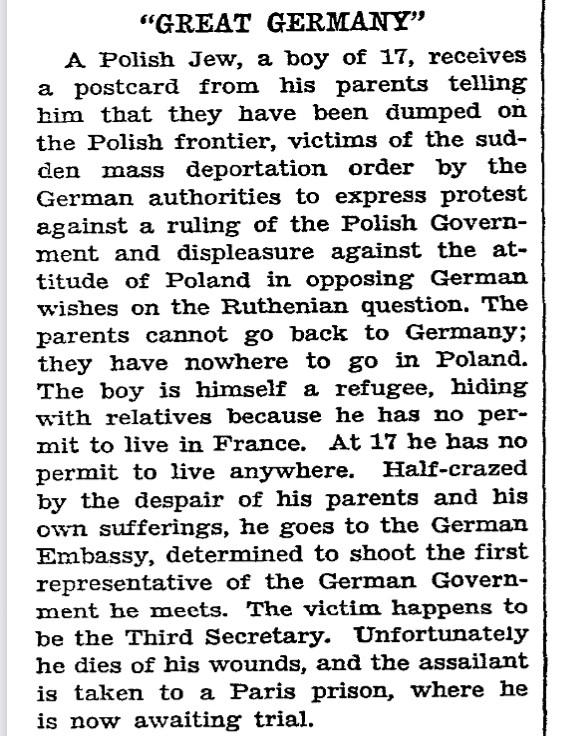
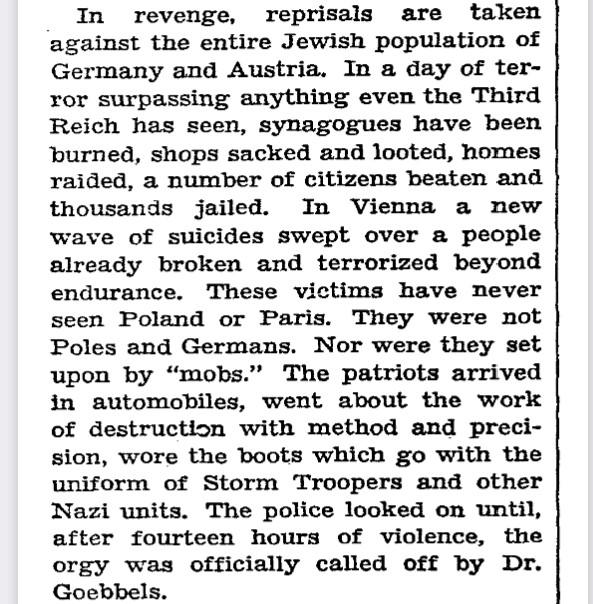
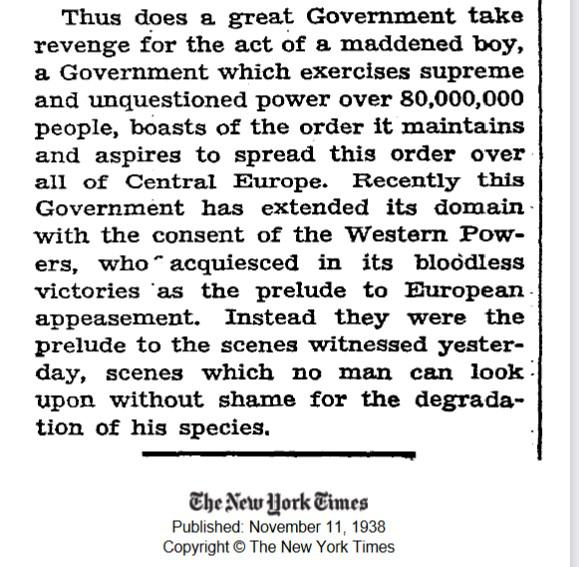
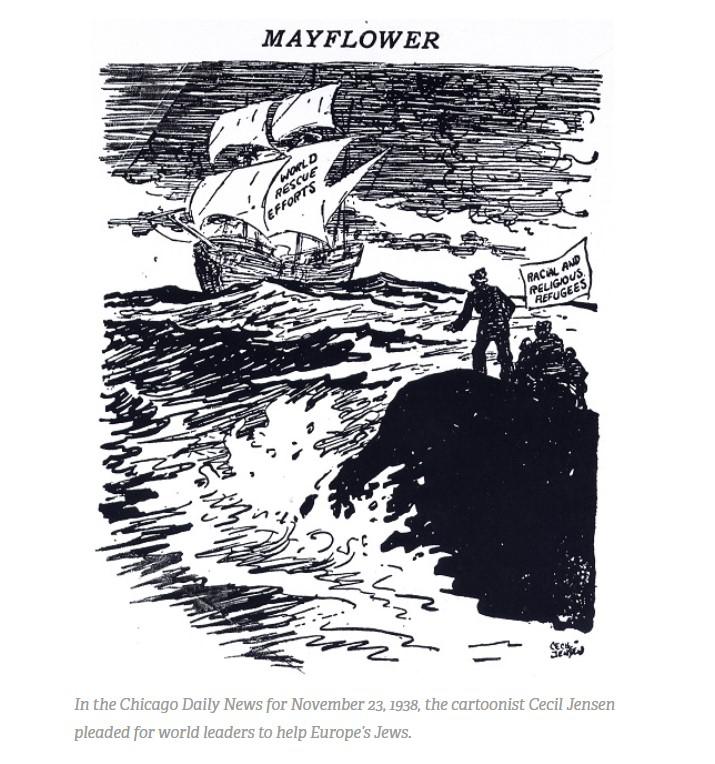
The events of Kristallnacht, then, were widely known. The U.S. government took some action. Why then, was there so little done to help German Jews?
Despite the outrage against the violence in Germany, there was not much support for lifting or modifying immigration restrictions. Since the beginning of the Great Depression in 1929, Americans had been worried about unemployment and the economy and coping with labor unrest. They had been unwilling to confront racism in their own country and fearful of being drawn into foreign conflicts in which they felt their country had no interest. All these matters seemed much more important than the problem of stateless Jews in Europe. Although many were willing to accept a few famous writers, artists, and scientists who happened to be Jews, they were not willing to let in thousands of other Jews.
Few Americans were violently antisemitic, but many felt that Jews should be “kept in their place.” Enforcement of the nation’s immigration laws reflected these views. The United States could legally admit 27,000 immigrants from Germany each year. Yet in 1934, the State Department had allowed only about 5,000 to enter the country. Approximately 6,000 were permitted to enter in 1935 and less than 11,000 in 1936.
In February 1939, Senator Robert Wagner of New York and Representative Edith Nourse Rogers of Massachusetts sponsored a bill based on a popular British program. Between 1938 and 1939, the British admitted 10,000 unaccompanied Jewish children from “Greater Germany” as part of a program known as the Kindertransport (children’s transport). Wagner and Rogers wanted Congress to temporarily admit 20,000 Jewish children until it was safe for them to return home. The first 10,000 would arrive in 1939 and the remaining 10,000 in 1940. Most of these children were too young to work, so they would not take away jobs from Americans. Furthermore, their stay would not cost taxpayers a penny because various Jewish groups had agreed to assume financial responsibility for the children.
Yet the bill encountered strong opposition. In January 1939, Gallup, a polling organization, began asking Americans the following question: “It has been proposed to bring to this country 10,000 refugee children from Germany—most of them Jewish—to be taken care of in American homes. Should the government permit these children to come in?”
In response, 61% said that the government should not permit the children to come into the country, 30% said that the children should be permitted to come, and 9% said that they had no opinion.
In the summer of 1940, after World War II had begun and the Germans were bombing British cities, the US Congress did vote to accept thousands of British children, mostly non-Jewish, into the country.
How does the situation after Kristallnacht compare to the refugee issues we face today?