Parashat Noah
From Torah Ohr
By Rabbi Shneur Zalman of Liadi
Translation and Commentary by Rabbi Gedalia Potash and William Schecter, MD
October 9, 2021
This draft has neither been edited nor approved by Rabbi Potash
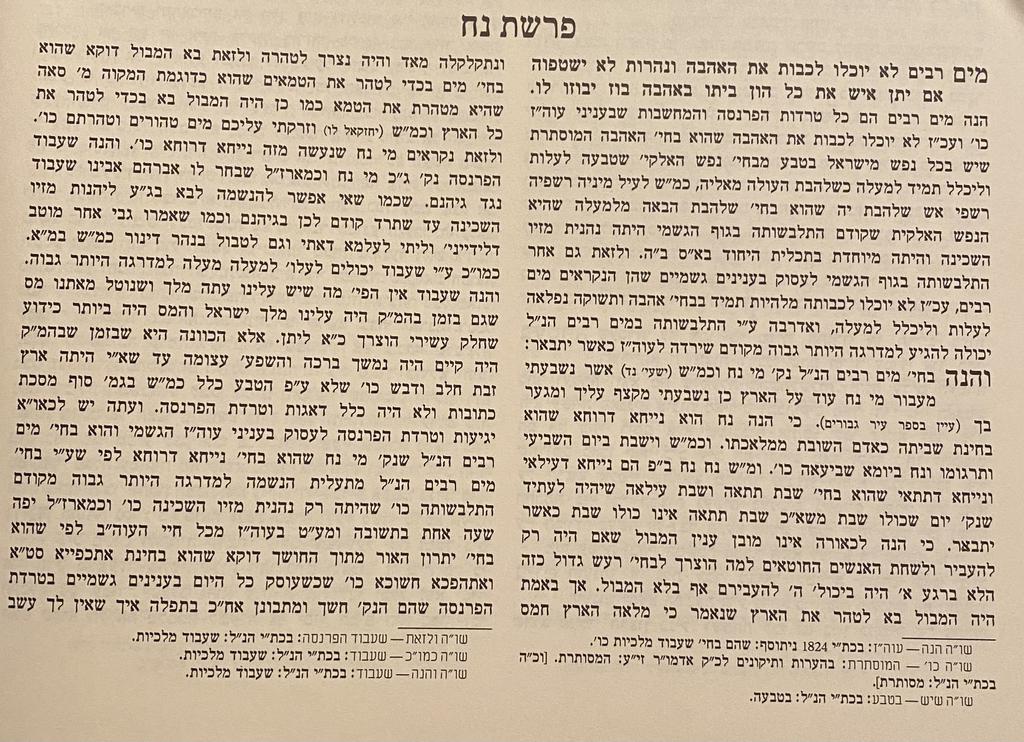
The Elter Rebbe begins his commentary by quoting a passage in the Song of Songs referring to flood waters: “Vast floods cannot quench love, nor rivers drown it. If a man offered all his wealth for love, he would be laughed to scorn” (Song of Songs 8:7) The flood waters (great waters) referred to in this passage, the Elter Rebbe says, are the worries and concerns of making a living and the thoughts of worldly issues. And all of these worries (the flood waters) cannot extinguish the love that is the hidden love within each soul of Israel by its very nature. For the nature of the G-dly Soul is to ascend towards the Heavens, back to its Source, as the flame that ascends from the sacrificial alter.
The Elter Rebbe then quotes from the verse preceding the one quoted above: “Love is as fierce as death, Passion as mighty as Sheol (similar to Hades). Its darts are darts of fire, a blazing flame”. (Song of Songs 8:6) The flame descending from above is the G-dly soul, which, prior to its investment in the material body, enjoyed the G-dly splendor and was united with the Eternal Light of G-d.
After investment of the G-dly soul in the corporeal body, it busies itself with the material concerns of the world, which are called “the great waters”. With all of this, the great waters (worldly issues) cannot extinguish the eternal love and wonderful desire to ascend back to its source. On the contrary, through its investment in the great waters (worldly affairs) referred to above, the soul can reach a spiritual level even higher than prior to its descent to our world as will be explained.
The Elter Rebbe then goes on to quote Isaiah who refers to the Flood Waters as the Waters of Noah: “As I swore that the waters of Noah nevermore would flood the Earth so I swear that I will not be angry with you or rebuke you (referring to Jerusalem and presumably the Jewish People)”. (Isaiah 54:9)
The Elter Rebbe then continues that Noah is נייחא דרוחא (a tranquil spirit), a man resting after his work, as it is written “and you shall rest on the 7th day” (Genesis 2:2).
The Elter Rabbi suggested that the great flood waters did not serve just to destroy the world of sinners for if so, there were a lot of easier ways to do it. Rather, the flood waters served to purify the world which was “filled with lawlessness” (Genesis 6:13) The Elter Rebbe then compared the Flood Waters to a purifying Mikveh.
Comment by Rabbi Potash: Here the Elter Rebbe is referring to the raging flood waters as the waters of Noah (by quoting the passage from Isaiah. The word Noah actually means pleasure, rest, or tranquility. Is this a paradox? How can the raging Flood Waters also be Waters of Tranquility? Rabbi Potash opined that even though superficially, the experience may seem like overwhelming flood waters (the daily problems of life), if we persist and “go with the flow”, we can reach a state of tranquility. Rabbi Potash used the metaphor of surfing. If you don’t know how to surf, you can wipe out and even drown. On the other hand, a skilled surfer can harness the power of the wave and convert it into an elevating experience. I related the experience of my son Sam who was surfacing off Ocean Beach in San Francisco and was “tubed” by the wave. As he was flying through the tube, the dawn sun light hit the foam of the wave causing a mini rainbow. It seems that, at that moment, Sam caught a transient glimpse of the “Divine Light”. Rabbi Potash then concluded our session by saying that worldly obstacles and challenges can be defined by how we react to it. We can either be elevated or overwhelmed by them—as in surfing.
Comment: One final point, several years ago I was studying with Rabbi Potash’s father. He made an interesting observation by quoting the first sentence in the second Aliyah of Parashat Noah: “ויאמר ה׳ לנח בא אתה וכל בתיך אל התבה – And the L-rd said to Noah: Come you and all of your House to the Ark”. The word “התבה“ has two meanings. The first is “the Ark”. But התבה—HaTaivah also means the Word. So, says Rabbi Potash Senior, “Come to the Ark” is G-d’s way of telling Noah, and all of us, to come to the Torah, our Ark in which we can take refuge and ride out the raging waters of the challenges and concerns of daily life.