.Commentary on Shmini Atzeret
From Likutei Torah
By Rabbi Shneur Zalman of Liadi
Translation and Commentary by Rabbi Gedalia Potash and William Schecter, MD
Wednesday September 29, 2021
This draft has neither been edited nor approved by Rabbi Potash
The Holiday of Shmini Atzeret occurs on the first day after the completion of the 7-day celebration of Sukkot. The Elter Rebbe quotes the Torah saying on the 8th day there will be a pause for a second Holiday. The first two days of Sukkot are a Holiday in the Diaspora (only the first day in Israel) and the remaining five days, called Chol HaMoed are not quite holidays but also not completely secular. We are commanded to be joyous during this time.
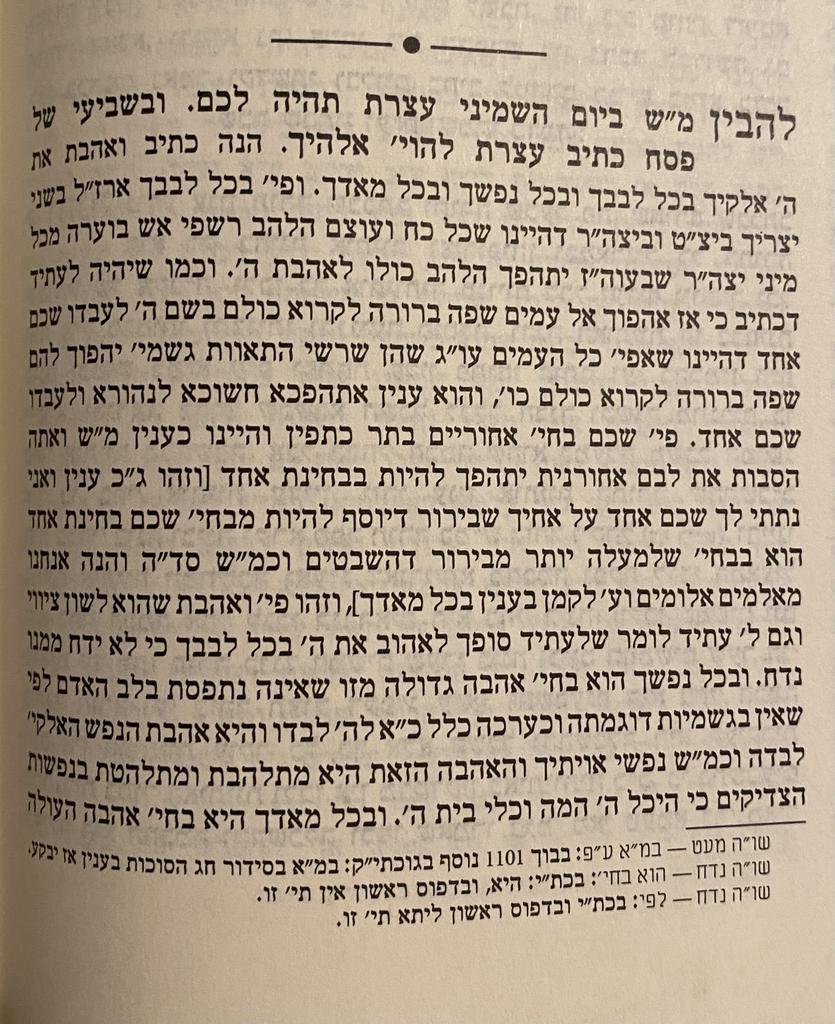
The precise commandment for Shmini Atzeret is that there should be a Pause (for a Holiday) for YOU (plural—that is the Israelites)
“בַּיּוֹם֙ הַשְּׁמִינִ֔י עֲצֶ֖רֶת תִּהְיֶ֣ה לָכֶ֑ם כָּל־מְלֶ֥אכֶת עֲבֹדָ֖ה לֹ֥א תַעֲשֽׂוּ׃
On the eighth day you shall hold a solemn gathering;(. you shall not work at your occupations.” (Numbers 29:35).
During the Passover Holiday the first day and the last day are Holidays. The Elter Rebbe quotes the Biblical passage with this commandment:
שֵׁ֥שֶׁת יָמִ֖ים תֹּאכַ֣ל מַצּ֑וֹת וּבַיּ֣וֹם הַשְּׁבִיעִ֗י עֲצֶ֙רֶת֙ לַיהוָ֣ה אֱלֹהֶ֔יךָ לֹ֥א תַעֲשֶׂ֖ה מְלָאכָֽה”
After eating unleavened bread six days, you shall hold a solemn gathering”. for the LORD your God on the seventh day: you shall do no work.”
Notice that the Atzeret (the Pause for a Holiday at the end of Passover) is for G-d whereas the Pause for the Holiday of Shmini Atzeret after Sukkot is for the Jewish People. The Elter Rebbe then asks why is this so? The remainder of this Drash is his attempt to answer this question. In other words, why is the Holiday at the end of Pesach for G-d and the Holiday at the end of Sukkot for the Jewish People?
The Elter Rebbe says It is written
וְאָ֣הַבְתָּ֔ אֵ֖ת יְהוָ֣ה אֱלֹהֶ֑יךָ בְּכָל־C וּבְכָל־נַפְשְׁךָ֖ וּבְכָל־מְאֹדֶֽךָ׃
“And you shall love the L-rd your G-d with all your heart and with all your Soul and with all your might.” (Deuteronomy 6:5)
The Rabbis of the Talmud interpreted the expression “with all your heart” to mean that one should love G-d with the two Yetzers (Inclinations of Souls) in the heart—the Yetzer HaTov (the G-dly Soul) and the Yetzer HaRa (the Animal Soul)—meaning that all the strength of the fire of the Yetzer Ha Ra burning in this world, will be transformed to the Love of G-d.
Comment: In Chassidic thought, the heart is considered to have two chambers. The right chamber is the seat of the G-dly Soul (the Yetzer HaTov) and the left chamber is the seat of the Animal Soul (the Yetzer HaRa). If we forgive the Elter Rebbe for his somewhat fuzzy 18th century cardiac anatomy and follow his argument, we are instructed to love G-d with all our heart—both the animal (physical) elements and the G-dly (spiritual elements). Elsewhere in his commentaries, we have previously learned that the Elter Rebbe asked why “your heart” is written לְבָבְךָ֥ and not לבך, the usual correct way to write your heart. In other words, in the Biblical passage the letter ב is written twice. The Elter Rebbe responds to his own question by saying that the letter is doubled to indicate both the left and right chambers, meaning that one should love G-d with both the animal and spiritual elements within the heart.
Regarding the future, it is written
אֶחָֽד כִּֽי־אָ֛ז אֶהְפֹּ֥ךְ אֶל־עַמִּ֖ים שָׂפָ֣ה בְרוּרָ֑ה לִקְרֹ֤א כֻלָּם֙ בְּשֵׁ֣ם יְהֹוָ֔ה לְעׇבְד֖וֹ שְׁכֶ֥ם
“For then I will make the peoples pure of speech,
So that they all invoke the LORD by name
And serve Him with one accord. to serve Him shoulder to shoulder” (Zephaniah 3:9)
meaning that even all the multilingual idolatrous nations, which are the root of the passionate physical desires, will transform to one clear language to call them all to serve G-d as one and this is transformation of darkness to light and service to G-d shoulder to shoulder.
The meaning of Shechem (שכם-shoulder) is the area behind the two shoulders (כתפיים-Katefaim), meaning, as it is written, which” You have turned their hearts backward.” (Kings I 18:37) and transformed them (both shoulders or by extension the Yetzer HaTov and the Yetzer HaRa) into One entity. …. And this is the meaning of “and you shall love” which is both the imperative and future tenses and also as if to say your future is to love G-d with all your heart because nothing will be rejected.
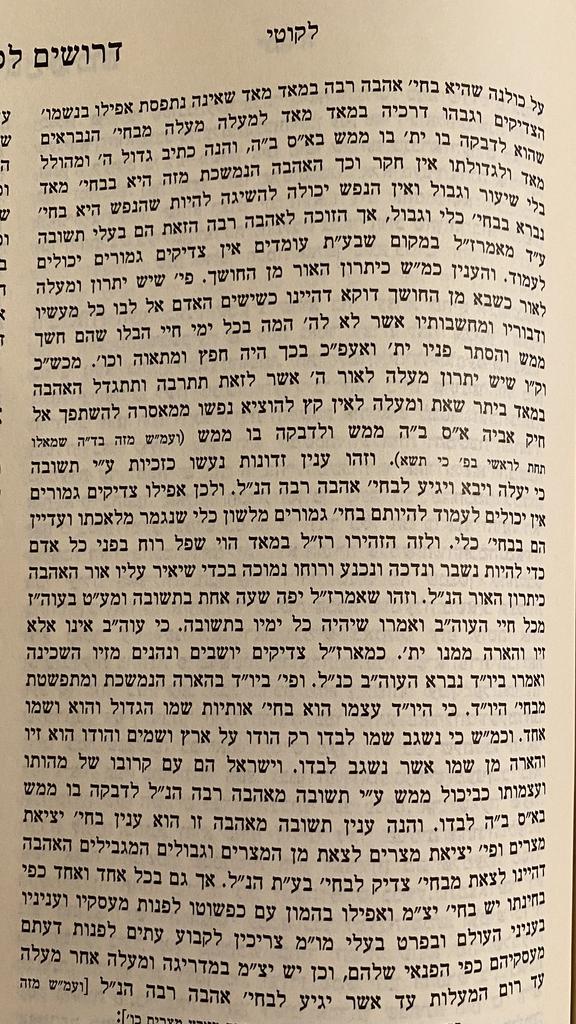
And “all your Soul” represents the Great Love which is not contained in the heart of man because there is no physical similarity or comparison at all except to G-d Himself and this is the love of the G-dly Soul alone. As is written, my Soul yearns for you and this love burns in the heart of the Tsadikim because the they are vessels in the Chamber of G-d.
And “with all your might” refers to the Love that ascends above all of us which is the attribute of the great abundant love which is not contained even in the physicality of the Tsadikim and its paths are infinitely higher than the G-d’s creations. This abundant Love cleaves to G-d in the Eternal Light. As it is written:
גָּ֘ד֤וֹל יְהֹוָ֣ה וּמְהֻלָּ֣ל מְאֹ֑ד וְ֝לִגְדֻלָּת֗וֹ אֵ֣ין חֵֽקֶר׃
Great is the LORD and much acclaimed;
His greatness cannot be fathomed. (Psalm 145:3)
and this love is drawn down without measure, without limitations, but those who merit this great love are the Baalei Tshuvah (Baalei Tshuvah—people who repent and return to the Service of G-d). By way of analogy, the Rabbis said that Tsadikim Gmurim (Complete Tsadikim) are unable to stand in the place where Baalei Tshuvah stand.
As it is written as “As light is superior to darkness” (Ecclesiastes 2:13) meaning that there is a superiority to light that comes from the darkness. The darkness is a metaphor for man's actions, words and thoughts which are not for G-d. They (these actions, words and thoughts) that he had throughout his life are futile and meaningless. They represent true darkness and the concealment of G-d’s Countenance which he nevertheless desires to reveal. And a fortiori there is greater merit to the Divine Light (compared to the Light coming from man) which will increase and infinitely expand the Love, extracting man’s Soul from the confines of its imprisonment and to pour it into the breast of its Father, the Eternal Light, and to truly cleave to G-d. Willful transgressions become merits through Repentance (Tshuvah) because they will ascend, come and arrive to the attribute of the Great Love referred to above.
Comment: The Elter Rebbe uses the phrase “יעלה, יבא ויגיע” meaning ascend go and arrive. The word יגיע (yagiah) actually has two meanings. The first is arrive and the second is to exert oneself. The Elter Rebbe comments elsewhere that arrival at a higher spiritual plane requires great exertion and self-motivation. Hence, the double entendre in the word יגיע (yagiah).
Therefore, even Tsadikim Gmurim (complete Tsadikim), are unable to reach the level of Baalei Tshuvah precisely because they are complete--that is, they have fixed boundaries. The Elter Rebbe then compares Tsadikim to vessels which even when their work is complete still have the attributes of a vessel.
Comment: What is the Elter Rebbe talking about? Rabbi Potash explains. The Tsadik Gamur, according to the Elter Rebbe, is a person who either lacks an Animal Soul or perhaps has an atretic one. In other words, the Tsadik Gamur never struggles with his Yetzer HaRa because he is born without one. The Elter Rebbe compares him to a vessel similar to the vessels used in the Service in the Holy Temple when it existed. When the Service involving the vessel is complete, it still remains a vessel with walls and a base—in other words it has fixed material boundaries. Most Tsadikim will dwell in the World of Briah and only a few are of such merit as to dwell in the World of Atzilut according to Chasidic Thought. However, the Ba’al Tshuvah (singular form of Baalei Tshuvah), that is the person who returns to the Service of G-d, continually struggles to suppress and transform his Yetzer HaRa and this great struggle and exertion gives him the merit to arrive at a spiritual plane far higher than the Tsadik Gamur can hope to attain, because, although he is righteous, he was born that way and did not achieve the attribute of righteousness with struggle.
Therefore, the Rabbis cautioned “be exceeding humble spirit” (Pirkei Avot 4:4) before each man in order to be broken, depressed, and surrendered with a low spirit so that the Light of Love will shine upon you like the Superior Light as discussed above. The Rabbis also said “more precious is one hour in repentance and good deeds in this world, than all the life of the world to come” (Pirkei Avot 4:17). and they said that man “should spend all his days in Repentance” (Masechet Shabbat 153:a) because the World to Come is none other than the Divine Light. As the Rabbis said “Tsadikim sit and enjoy the splendor of the Shechinah (the Divine Presence) (Masechet Brachot 17;a:12) and they said that the World to come was created by the letter yud (the first letter of the Tetragrammaton) as discussed above. Meaning that with the yud the Light is drawn down and disseminated with from the attribute of yud because the letter yud itself has the attribute of the letters of G-d’s Great Name and G-d and His Name are One. And as it is written “His name, His alone, is sublime;
His Glory covers is upon the Earth and the Heavens” (Psalm 148:13) and His Glory is the splendor and light emanating from His Name which alone is sublime. Israel is the People close to Him (Psalm 148:14), close to His Essence, as if truly through Repentance, with great love, as discussed above, Israel cleaves to the Divine Eternal Light. And the purpose of the Repentance (Tshuvah) with great love is the Exodus from Egypt, meaning, in a spiritual sense, the Exodus from limitations and boundaries which limit Love meaning the Exodus from the attribute of the Tsadik (which by his or her very nature is confined to boundaries) to the attribute of the Ba'al Tshuvah (who is free from material shackles) as discussed above. But each of us, with varying degrees according to our nature, has within us the attribute of the Exodus from Egypt. Even the simple mass of people has the ability to turn away from business affairs and the affairs of the world. Businessmen in particular must fix specific times to turn their attention away from their affairs, each according to their available free time, in order to leave "Egypt" and spiritually ascend step by step until reaching the spiritual apex which is the Great Love referred to above.
Comment: So, the Elter Rebbe answers the question posed at the beginning of his commentary. On the seventh day of Passover, which we celebrate during the month of Nissan, we pause for a Holiday for G-d because during the Exodus from Egypt, G-d did all the work. The Children of Israel were provided with manna and water and meat (quail) during their forty-year sojourn in the desert. On the other hand, during the month of Elul (the month preceding Rosh Hashanah-the first day of the month of Tishrei) and during the first 10 days of Tishrei (the Days of Awe) until Yom Kippur we are working and striving to achieve Tshuvah (Repentance) and the Great Love for G-d referred to above. So, at the end of the joyous Holiday of Sukkot, we have a pause, an extra Holiday—Shmini Atzeret—for us—in recognition of all of our exertions.