Pl
Parashat Nitzavim
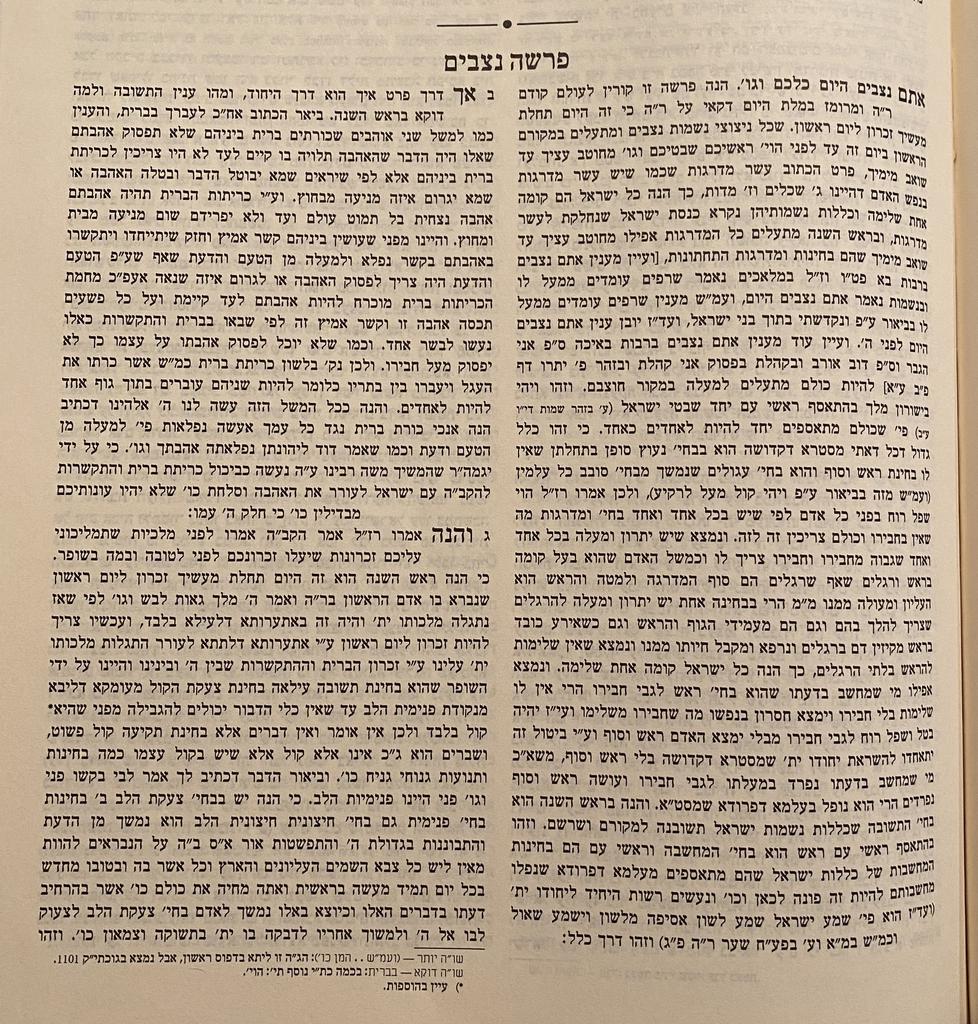
from Likutei Torah
By Rabbi Shneur Zalman of Liadi
Friday, September 3, 2021
Translation and Commentary by Rabbi Gedalia Potash and William Schecter, MD
This draft has neither been edited nor approved by Rabbi Potash
Parashat Nitzavim contain the remarks of Moses, transmitting the Word of G-d to the Community of Israel on the last day of his life prior to the entrance of the Children of Israel into the Land of Canaan under the leadership of Joshua. We are approaching the end of the book Deuteronomy which itself is a 30 day speech by Moses to the Children of Israel summarizing the Torah. Parashat Nitzavim is read every year on the Shabat preceding Rosh HaShana.
The Elter Rebbe begins his commentary by quoting the first passage of this week’s Torah portion: “You stand this day, all of you, before the L-RD your God—your tribal heads, your elders and your officials, all the men of Israel” (Deuteronomy 29:9), “this day” refers to Rosh HaShana because this is the day of the beginning of Your work (the creation of the world), a remembrance of the first day (of creation). All the sparks of the Souls (of Israel) are standing and ascending to their Source of origin before G-d on "this day" , the leaders of your tribes, etc. from your hewer of wood to your drawer of water (Deuteronomy 29:10).
There are 10 levels (or classes of the People) similar to the 10 levels in the Soul of man, meaning the 7 intellectual attributes (Wisdom Understanding and Knowledge) and the 7 emotional attributes (discipline, loving kindness, etc.). All of Israel is standing erect as one complete entity including all their Souls and is called the Knesset Yisroel (the Assembly of Israel) which is separated into 10 different levels. On Rosh HaShana all of the levels rise, even the Hewer of Wood and the Drawer of Water—which are the lowest levels—so that all of them ascend on high to the Divine Source from which they are hewn. “There will be in Yeshurun a King who assembles all the leaders of the tribes of the People” (Deuteronomy 33:5), means that they all assemble together to be united as one.
Comment: The question arises as to who exactly is the King in Jeshurun. The Ramban says that there are two possible explanations. The first: The King is G-d. This is the most likely explanation he says. The second is that the word King refers to Moses because the Pasuk preceding the quotation is “When Moses commanded us the Torah, a heritage of the congregation of Jacob” (Deuteronomy 33:4). The Ramban is referring to a dispute between Rashi (who argues that the King refers to G-d) and Ibn Ezra (who argues that the King refers to Moses). In our discussion of this Pasuk, Rabbi Potash also explained that the name Jeshurun (ישורון) is a poetic Biblical term referring to the Children of Israel. The Hebrew root of the word (ישר) means straight, honest or with integrity).
The interpretation of the Pasuk quoted above, in the opinion of the Elter Rebbe, is that that all the souls of the Congregation of Israel, stripped of their material trappings, are gathered together as one entity, each on an equal footing with the other.
Because this is the great principle that all who come from the “Sitra diKiddushah” (the side of Holiness) have the attribute of having the end “stuck” in the beginning so that there is no beginning or end. It has the attribute of circles drawn from the Sovaiv Kol Haolamim (encircling all the worlds).
Commentary: The Chassidic concept of סובב כל העולמים (Sovaiv Kol Haolamim - encircling all the worlds) refers to The Divine Eternal Light (G-d) encircling all the worlds (including our own—the world of Asiyah) as a power from without. In addition G-d fills all the Worlds from within.
Therefore, the Rabbis of the Talmud said” Let each man be humble before his fellows” (Pirkei Avot 4:4) for within each of us there are levels not present in others and we all need each other. There is found within each of us greater merit and virtue than in others and we need each other. For example, a person has a head and feet. The feet are lower than the head which is the highest and the most excellent (Intellectually). But the feet have one merit and attribute – that is the feet are required to walk and support the body and the head.
Now the Elter Rebbe employs a metaphor based on 18th and 19th century medical practice—phlebotomy—that is “bleeding” a patient to remove evil humors causing disease. He says: And when a headache occurs, if one “bleeds” the feet (that is removes blood from the extremities), the person is cured and receives vitality from the treatment, and therefore the head is incomplete without the feet.
Comment: Although the Elter Rebbe is employing an analogy based on an incorrect assumption, that is bleeding a patient leads to cure, if we ignore the fallacy, we can appreciate the point that although the feet are below the head, each complements the other. Historical Note: Blood letting no doubt killed many patients. George Washington, the 67-year-old former President, went for a ride to survey his domain in a heavy rain. He went to dinner in his wet clothes so as not to be late. Two days later he was desperately ill, short of breath. Various theories regarding the cause of death, ranging from pneumonia to upper airway obstruction caused by various inflammatory conditions of the glottis and its surroundings have been postulated. What is clear is that his physicians removed approximately 40% of his blood volume in an effort to cure him, a standard practice at the time. The bloodletting certainly hastened his death if it did not, in fact, cause it.
Referring to the analogies above, the Elter Rebbe says: So too, all of Israel stands as one entity before G-d. And it is found that even someone who considers himself as “a head” in comparison to his fellows is incomplete without them and his Soul will have a missing element which his fellows can complete. Through this he will be nullified and humble with regard to his fellows so that there will be no beginning nor end and through this nullification they will unite with His unity (G-d’s unity) from the Side of Holiness without head or end. If this is the case, whoever considers himself separate from his fellows in terms of the level of his attributes and behaves as if there is a separate head and an end, he falls into the world of separation which is derived from the Sitra Achra (the other side, a synonym for the Animal Soul or the Yetzer HaRa—the evil inclination).
Rosh HaShana has the attribute of Teshuva (Teshuva has a double meaning: repentance and return {to G-d}). Meaning that the entire corpus of the Souls of Israel will return to their Source and Root. This is what is meant by the phrase “the gathering of the heads (leaders) of the People—the head has the attribute of Thought. The Heads (leaders) of the People represent the thoughts of the entire Community of Israel which are gathering from the world of separation to which their thoughts fell to be brought together and be made into a domain (dwelling place) of the ONE, blessed be He and this is the general principle.
But how is the path of the individual the path of Unity? How does the issue of Teshuva relate and why on Rosh HaShana? The Torah in our Portion this week goes on to say “you pass over into the Covenant”. By way of analogy, two lovers enter into a covenant between them that their love will be eternal. If their love was in fact eternal, they would not need a covenant between them unless they feared that perhaps the love would be nullified or perhaps some external force would serve as an impediment to their love. And through the covenant their love would be eternal, without ever collapsing. No internal or external force could separate them. Meaning that because they are making a brave and powerful connection between them which will unite and bind them in their love with a wonderous tie above reason and knowledge. Even though reason and knowledge might require a halt to the love and cause a hatred between them, even so, because of the covenant their love would exist for eternity covering up all transgressions. This brave connection, resulting from the covenant and communication, was as if they were made of one flesh.
And just as one (the lover) could not end one’s love by oneself, so the beloved could not end the love. Therefore, it is called a covenant as it is written “and they divided the calf and passed between the two divided parts": as if to say both of them would be passing within one body to be several (separate).
Comment: The paragraph above refers to Genesis 15:10, known as the Covenant between the Parts (ברית בין הביתרים), in which G-d promises Abraham that his children will inherit the land between the Wadi of Egypt in the west and the Euphrates River in the East.
And here as in this entire parable that the L-rd our G-d made for us as it is written “Here I make a covenant with all of your People and I will perform wonders” (Exodus 34:10) meaning: above reason and knowledge; just as David said to Jonathan “Your love was wonderful to me….”) (II Samuel 1:26) For through the 13 attributes of G-d (Exodus 34:6), Moses metaphorically drew down the covenant and communication between G-d and the People of Israel to awaken the love and forgiveness within Him so that your transgressions would not separate you from Him because His People is a Part of G-d.
Comment: The complete quotation re: the 13 attributes of G-d is as follows:
יַּעֲבֹ֨ר יְהוָ֥ה ׀ עַל־פָּנָיו֮ וַיִּקְרָא֒ יְהוָ֣ה ׀ יְהוָ֔ה אֵ֥ל רַח֖וּם וְחַנּ֑וּן אֶ֥רֶךְ אַפַּ֖יִם וְרַב־חֶ֥סֶד וֶאֱמֶֽת ׀
The LORD passed before him “and the Lord proclaimed: The Lord! a God compassionate,” etc.; cf. Num. 14.17–18.and proclaimed: “The LORD! the LORD! a God compassionate and gracious, slow to anger, abounding in kindness and faithfulness,
נֹצֵ֥ר חֶ֙סֶד֙ לָאֲלָפִ֔ים נֹשֵׂ֥א עָוֺ֛ן וָפֶ֖שַׁע וְחַטָּאָ֑ה וְנַקֵּה֙ לֹ֣א יְנַקֶּ֔ה פֹּקֵ֣ד ׀ עֲוֺ֣ן אָב֗וֹת עַל־בָּנִים֙ וְעַל־בְּנֵ֣י בָנִ֔ים עַל־שִׁלֵּשִׁ֖ים וְעַל־רִבֵּעִֽים׃
extending kindness to the thousandth generation, forgiving iniquity, transgression, and sin; yet He does not remit all punishment, but visits the iniquity of parents upon children and children’s children, upon the third and fourth generations.”
This passage refers to the second ascent of Moses up Mount Sinai after the Sin of the Golden Calf. Moses carved the Ten Commandments into the second set of Tablets after which the L-rd proclaimed His attributes to Moses. This is particularly relevant to Rosh HaShanah, the Days of Awe and Yom Kippur because Moses descended from Mount Sinai with the Second Set of Tablets on Yom Kippur and indicated that G-d had forgiven the Children of Israel for the Sin of the Golden Calf. So, on Yom Kippur we rely on the Attribute of Divine Forgiveness as we seek to repent for our past failings and reach a higher spiritual and moral plane in the year to come.