Ki Titzei
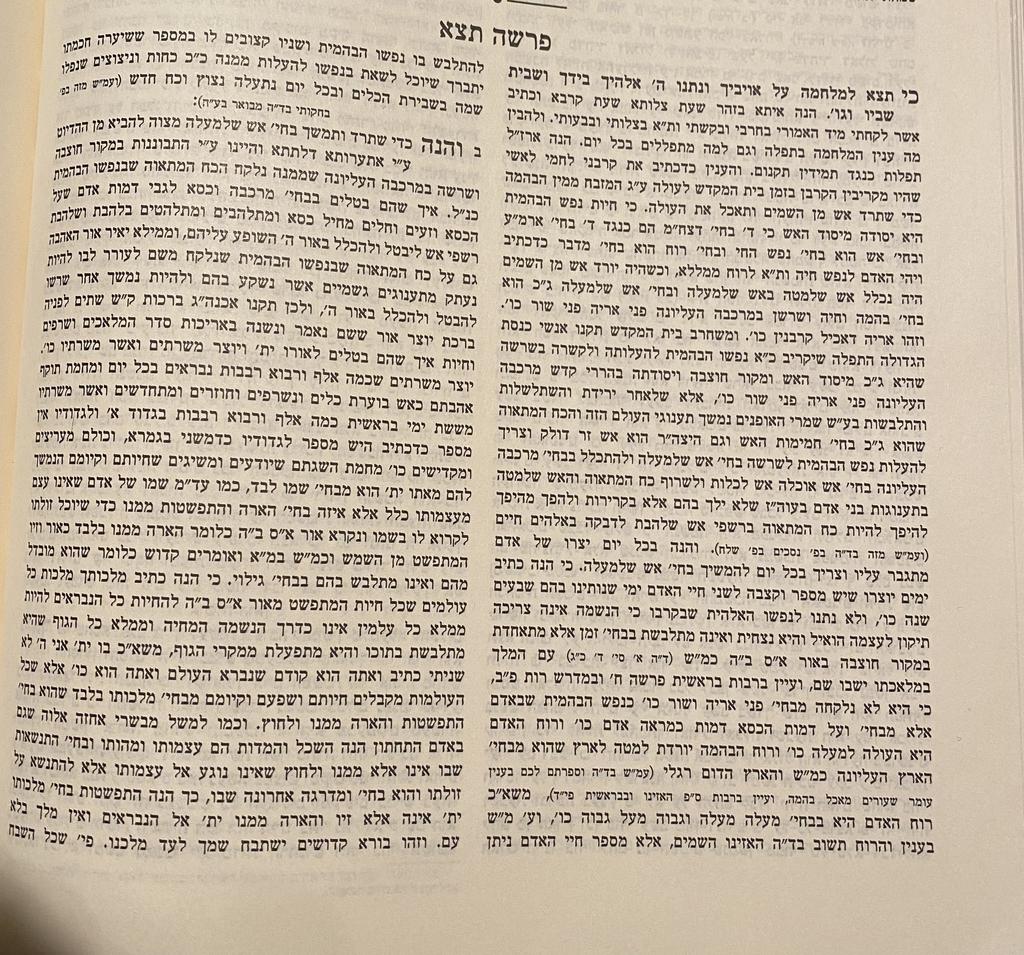
from Likutei Torah by Rabbi Shneur Zalman of Liadi
August 20, 2021
This draft has neither been edited nor approved by Rabbi Potash
The Elter Rebbe begins his commentary by quoting the first Pasuk of the Parasha:
כי תצא למלחמה על אויביך (You shall go out to war upon your enemies) (Deuteronomy 21:10) Rabbi Potash then noted by way of introduction that as the Soul descends from the Heavenly Realm to the physical realm we are “going out to battle” according to the Baal Shem Tov. The battle is between the spiritual and the physical. When you go out to battle on your enemy. You are above the enemy and he is outside of you. But, what happens when the enemy is within you? ושבית שׁביו וגו׳ You shall capture the captives. You shall bring the enemy within under your control.
The Elter Rebbe then points out that in the Zohar it says that “the time of prayer is the time of battle” ( שעת צלותא שׁעת קרבא ).
Comment: The word in Aramaic for prayer, צלותא , is very similar to the word in Arabic for prayer, صلاة . the צ in Aramaic (ts) has an (s) sound in Arabic, ص .
The Elter Rebbe then quotes the Pasuk אשר לקחתי מיד האמורי בחרבי ובקשתי (which I took from the Emori2 with my sword and my bow) (Genesis 48:22). Onkelos1 translates “my sword” and “my bow” as “my prayer” and “my heartfelt request” strengthening the argument that “the time of prayer is a time of battle”.
Comment: The word ובקשתי (ubekeshti) in Hebrew meaning “with my bow (קשת=Keshet) can also be read as uvevakashati, meaning and with my request. This is how both Onkelos and the Elter Rebbe make the connection between bow and prayer.
The Elter Rebbe then asks what is the relationship between prayer and battle and why do we have to pray every day. The Rabbis in the Talmud said that the daily prayers replace the daily offerings which occurred for 1200-1500 years (in the time period between the entrance of the Children of Israel into Eretz Yisroel until the destruction of the Second Temple). The Rabbis then instituted daily prayer as a “replacement” for the daily sacrifices.
The daily sacrifices are a process of converting matter into energy. The animal, one sheep sacrificed daily in the morning and another sheep every evening, is being consumed by fire on the alter and converted into energy. (Deuteronomy 28:2) The concept is that a fire descends from the Heavens above and consumes the offering. This process releases the divine energy trapped within matter and connects it with the Divine Energy from above.
The animal life force is in fact the key element of fire. How so? The Elter Rebbe then compares the four elements of the universe (Fire, wind, water and earth {dust} –abbreviated ארמ״ע ) with the four categories of creation (inanimate, vegetation, animal and human—abbreviated דצח״מ ) . Fire, he says, corresponds to the animal life force. Wind corresponds to the human through the attribute of speech. To strengthen this argument, the Elter Rebbe again quotes Onkelos who translate the word wind (רוח ) as murmuring (ממללא ).
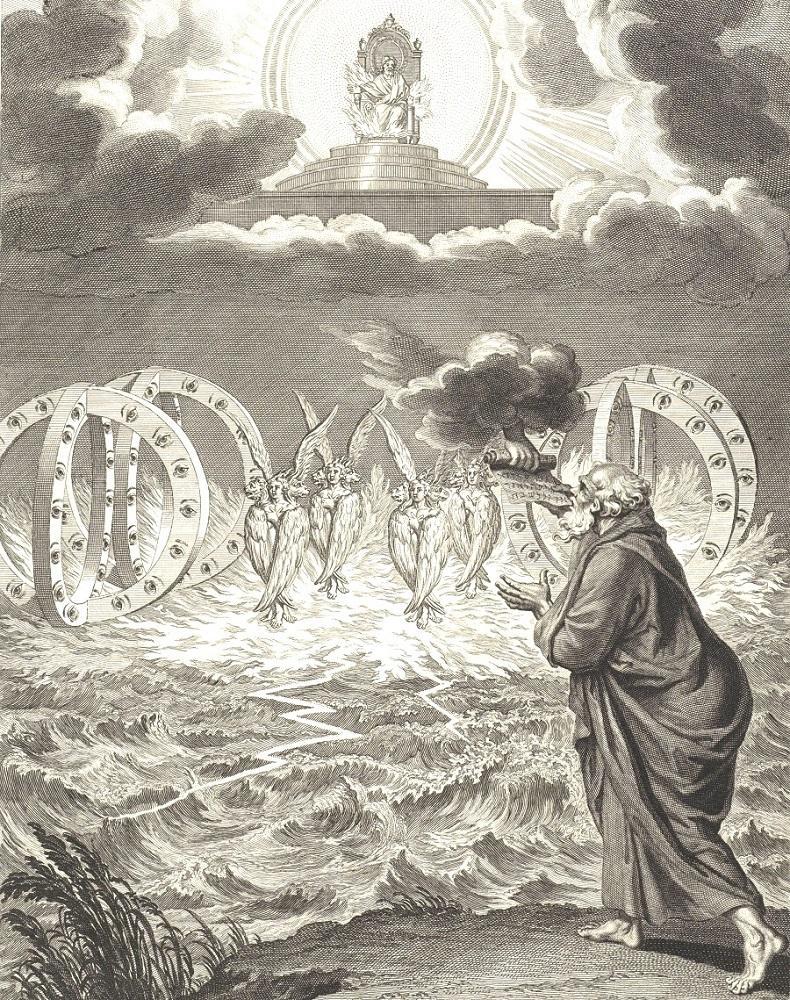
When the fire descends and consumes the animal sacrifice, the Heavenly fire encompasses the fire from below and converts both domesticated and wild beasts into energy. The Elter Rebbe then compares these two types of beasts to the face of the Ox and the Lion on the four faced creatures below the Throne in Ezekiel’s vision3 (Ezekiel 1:26) The other two faces are a human and an eagle. According to Chassidic interpretation of Kabbalah, the Divine Soul is transmitted to earth via the human face and the Animal Soul via the face of the Ox.
The Elter Rebbe the points out that the Animal Soul (that is the Yetzer HaRa, the “evil inclination”) is like an all consuming fire that drives man to pursue earthly pleasures. The idea, through sacrifice is to convert the animal soul to energy and allow it to ascend to its Heavenly source in the world of Asiyah in which dwell the Ofanim (see reference 3).
Of course, after the destruction of the Holy Temple, sacrificial offerings were not possible. However, the channeling of the Yetzer HaRa in a positive direction is not necessarily a physical but can be a spiritual process. Returning to the Pasuk, the enemy within you (i.e., the Yetzer HaRa) is captured, channeled and refined so that it can be elevated and perform the function for which we were placed on earth, to convert darkness to light. So, through prayer, the subjugation of the Yetzer HaRa leads to elevation of its energy in a positive direction. Our discussion ended here.
Reference:
- Onkelos was a descendent of a Roman Emperor who converted to Judaism and translated the entire Torah to Aramaic with a commentary.
- Emori: One of the Canaanite tribes living in Eretz Yisroel before the arrival of the Children of Israel after their forty-year desert sojourn
- To understand what the Rebbe is discussing, we have to study the Vision of Ezekiel as outlined in Ezekiel I. This is a problematic text and has been viewed by some Jewish scholars as “dangerous” and has led to many mystical interpretations including the one being discussed by the Elter Rebbe. Ezekiel saw what appeared to be “a radiant storm approaching from the north”. As the cloud comes nearer, Ezekiel is able to discern four “creatures” (חיות). Each creature has four faces, each pointing to its respective point on the compass, each has four wings, a single rigid leg and a foot ending in a calf’s hoof. Underneath the wings, Ezekiel sees human like hands. The four faces that he saw were a human face in front, a lion face to the right, the face on an ox to the left and an eagle in back.
After describing the “creatures”, the text then describes the wheels next to each creature. Although the Elter Rebbe interprets the Ofanim as Angels in the Lower World of Assiya, the word ofen in Hebrew means wheel (hence the noun in modern Hebrew, Ofanaim, two wheels, meaning bicycle). There were four Ofanim, each wheel consisted of a wheel within a wheel.
Above the heads of the creatures was a form-an expanse (רקיע) with an awe inspiring gleam as of crystal spread out above their heads. One pair of wings was spread out touching the wing of the adjacent “creature”. The other pair of wings covered the body. The flapping above the wings created a huge tumult, like the sound of mighty waters or a marching army.
Then, above the “expanse” above the heads of the creatures was the semblance of a throne and on top of the throne was a human form. Then suddenly, Ezekiel realizes that he is seeing G-d and prostates himself.
Ezekiel’s Vision, Bernard Picart, 1693-1783, Rijksmuseu.nls