15 Elul 5778 | July 27, 2018
Parshat Va’etchanan - Shabbat Nachamu
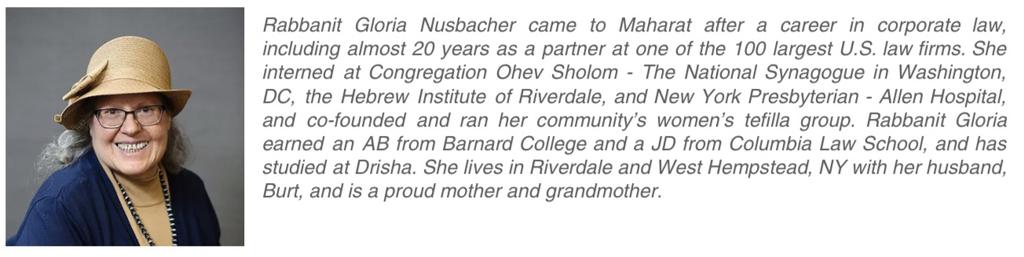
Rabbanit Gloria Nusbacher
Class of 2020
My heart goes out to Moshe at the beginning of this week’s parsha --
I begged, pleaded, with God at that time.
It is a cry of anguish. Moshe Rabbenu, who faithfully led Bnai Yisrael, who argued with God on their behalf, had one dream that he longed to fulfill -- to enter the Land of Canaan. But God rejected his request, saying:
רַב־לָ֔ךְ אַל־תּ֗וֹסֶף דַּבֵּ֥ר אֵלַ֛י ע֖וֹד בַּדָּבָ֥ר הַזֶּֽה׃
Enough! Don’t speak to me of this matter again!
The most God will do is to allow Moshe to go up the mountain and see the Land.
Why does God reject Moshe’s pleading? Has he committed a sin that is so great that God refuses to change God’s mind in the face of Moshe’s poignant plea? The Torah in several places describes Moshe’s sin as related to his actions at Mei Meriva - when Moshe struck the rock (see, for example, Bamidbar 20:12 and 27:14; Devarim 32:50-52). The commentaries try to identify the particular sin that led to such a severe punishment, but there is no consensus of exactly what Moshe did wrong.
Others have suggested an alternative explanation -- that by the end of Sefer Bamidbar Moshe has shown himself to have become an ineffective leader. Rav Mosheh Lichtenstein characterizes this failure of leadership as manifesting itself in a variety of ways -- Moshe’s anger and frustration at the people, and his inability to motivate them, communicate with them, or transmit his values to them. He notes that the psukim (referred to above) stating that Moshe will not enter the Land because of Mei Meriva all refer to Moshe’s failure “to sanctify” God -- since Moshe can no longer cause the people to believe in God, and thus to sanctify God’s name, he can no longer serve as their leader. (Lichtenstein, Moses: Envoy of God, Envoy of his People, pages 188-191.)
But even if Moshe could no longer lead the people, why couldn’t he enter the Land as a private individual? Moshe’s plea as described at the beginning of our parsha is not to continue as a leader, but merely to cross over and see the land on the other side of the Jordan (Devarim 3:25).
The Midrash provides an enlightening perspective. When Moshe pleads to enter the Land as an ordinary person, God gives him a taste of what that would look like. Moshe and Yehoshua together enter the Ohel Moed. The pillar of cloud comes down between them and God speaks to Yehoshua. When the cloud lifts, Moshe asks Yehoshua “What did God say?” and Yehoshua responds “When God spoke to you, did I know what was said to you?” At that moment Moshe realizes that his envy of Yehoshua as leader of the people was so strong he could not bear to live under those conditions. (Devarim Rabba 9:9)
I believe this midrash is teaching an important lesson about succession in leadership. Not all former leaders share the intensity of emotion attributed to Moshe in this midrash. We regularly see US Presidents transition to private citizens, albeit with a level of celebrity, and it is not uncommon for departing CEOs to continue to sit on the board of their companies. Nevertheless, a 2010 report by The Conference Board warns that there are dangers to retaining a former CEO on the board. If the former CEO is willing to step back from active leadership of the company and participate at the level of other non-employee directors, such service may be beneficial. However, the report found that maintaining such a limited role is often difficult, and that former CEOs frequently try to continue to have significant involvement with the business, which can be detrimental to the company. Similarly, the Harvard Business Review reported on a roundtable discussion in which several current and former CEOs discussed CEO succession. They all agreed that it is important for the departing CEO to move aside to let the successor take over, and that in most instances having the former CEO on the board proved to be a terrible disservice to the new CEO.
We can see a similar dynamic in the realm of family. A frequently-expressed concern by parents is that their own parents, the children’s grandparents, are overstepping boundaries. This may occur when grandparents undermine the parents’ child rearing decisions, such as refusing to follow “house rules” regarding sweets, TV, bedtime, discipline, or similar issues, or when the parents and grandparents have different values, such as disagreements over religion. In these cases it is often better for the grandparents to take a step back, and let the parents set the rules and values for their children, even if the grandparents believe they are in the right. Failure to do so could lead to family conflict, which could be harmful to the children.
Is there any consolation for the leader who needs to step back in order to let the next generation have its turn at leadership? Our midrash suggests there is. Once Moshe had accepted that he needed to die, God placated him by saying “Just as in this world you led My children, in the future I will lead them through you.” While a leader who is unable to let go and continues to intervene is likely to create resentment and strife, a leader who is able to cede authority to the next generation is more likely to have a level of continued influence.