6 Elul 5778 | August 17, 2018
Parshat Shoftim
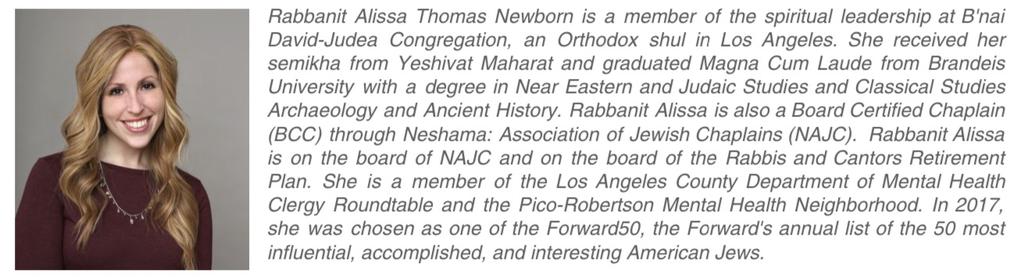
Rabbanit Alissa Thomas Newborn
Class of 2016
It’s a murder mystery. Someone was killed and found dead in a field, נופל בשדה, but we don’t know who the victim is. What do we do?
Your elders and judges shall go out and measure the distance from the body to the neighboring towns.
Our parsha teaches that the first response to our murder mystery is to make measurements. But why?
Rashi explains that measuring here is logical. Measurements must be taken in order to figure out which city is closest to the body, and thus which city will perform the atonement ritual for the death. For Rashi, the act of measuring is crucial for the next steps in closure and mourning.
But Daat Zekeinim offers a markedly different purpose for our measuring that takes us deeper than Rashi’s argument of proximity. Daat Zekeinim explains that the act of measuring draws attention from the surrounding cities, which results in regular citizens and relatives of the deceased helping to identify the victim. כל זה צוה הקב"ה לעשות כדי שיצא קול לנרצח, "God commanded this measuring in order that ‘a voice should go out’ publicizing the murder of an unidentified person," ומתוך כך יבואו עדים ויעידו שהוא מת, "and because of this, witnesses will come who will identify him and testify he is dead," ולא תשב אשתו עגונה, "so that his wife will not be an agunah".
For Daat Zekeinim, the purpose of God’s command in our parsha, ומדדו, "they will measure," is to identify the victim in order to save his wife from her own form of death: from being an agunah, a chained wife. For if her husband disappeared and was never found, dead or alive, she would be an agunah. And so, the measurements serve as קול לנרצח, "a voice for the murdered", calling the townspeople to identify the murder victim for his wife’s sake.
This teaching movingly asserts the cause of agunot-- a cause that must be empathized with, heard, and, God-willing, solved in our time. It is perhaps the halachic concern of our generation.
But today, I want us to focus not on the specifics of the agunah crisis, but instead on the middah, the character trait that our verse and Daat Zekeinim’s explanation of it are challenging us to cultivate. In doing so, Beezrat Hashem, we can ultimately respond to the agunah crisis and many more needs in our community with renewed koach.
It is the middah of doing everything in our power למדוד, 'to measure up'. ‘Measuring up’ here becomes not a literal measuring of land, as in the pshat of our verse, but instead a spiritual practice. What does this look like?
With Daat Zekeinim’s explanation, we can begin to form a definition of what it means to measure up. First, it means limiting additional pain. Someone has already been killed and it is our job to limit the pain, sorrow, and consequences his wife and family will suffer. Second, it means protecting and supporting those who are vulnerable. Measuring inspires the surrounding townspeople and the relatives of the victim to step up and be the voice of the murdered person when he cannot speak for himself. And third, it means seeking out justice with hope. When a person begins to measure, he or she does so out of faith and hope that the community will help and that justice will be fulfilled. This requires belief in the goodness of others and in God’s Torah as we pursue justice.
Limit pain. Support the vulnerable. Have faith in the pursuit of justice. These aspects which compose the trait of ‘measuring up’ transcend the context of our murder mystery and leave us with the command to embody them. It it hard to be someone who measures up, but if we don’t, we will not know comfort, protection, or justice.
During Elul, we begin to cultivate the middot we want to embody in the coming year. Our context is, God-willing, not as extreme as a murder mystery, but we are nevertheless still challenged to better limit pain, protect the vulnerable, and seek out justice with hope.
I encourage us to think of how we can better live this middah of measuring up in our own lives right now. It may mean holding our loved one’s hand when he or she experiences loss or disappointment, lessening the pain. It may mean working diligently to help someone in need, without any reward. Or it may mean, in the midst of tragedy and unknown, continuing to pray for God’s goodness and justice in this world.
May our fulfillment of the mitzvah of ומדדו, 'they will measure' not only bring about the end of the agunah crisis, but also give us the ability to bring relief, support, and justice to any person who lives in pain.