Kislev 5779 | December 2018
Chanukah
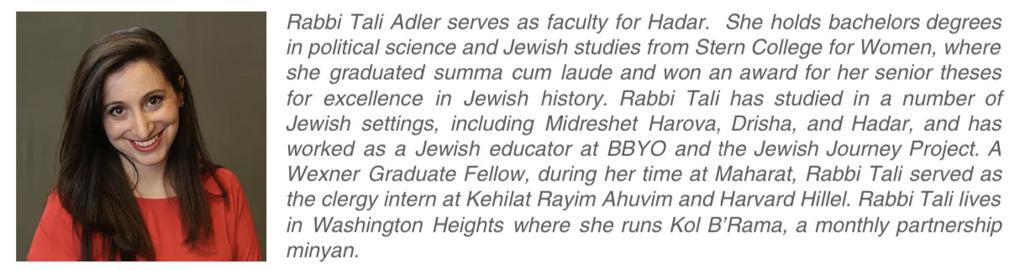
Rabbi Tali Adler
Class of 2018
It feels, this Hanukkah, like there is not enough light.
While the days grow shorter and the nights grow longer, it feels, sometimes, like hope is seeping away along with the daylight. There are moments when it feels like order is collapsing around us. There are days—or more accurately, perhaps, nights—when it feels the the world we thought we knew is devolving, leaving something unrecognizable in its stead. And in the midst of this feeling there are moments, perhaps, when the story of Hanukkah, the story of miraculous victory, of a tiny cask of oil that burns longer than it should, giving hope to a people, feels too far away.
The rabbis, though, tell another Hanukkah story, one that feels more appropriate for those moments of darkness. In this story the heroes are not warriors or priests, but a man alone in the dark.
The story arises from a question: How is it that so many other cultures have holidays so similar to Hanukkah, holidays that occur around midwinter and involve light and fire? In answering the question, our rabbis tell a story that situates the origins of Hanukkah not in the second temple period, but in a much more ancient story, one that takes place during the very first winter of the world.
The Talmud Bavli in Avodah Zarah, page 8a, relates that during the first winter, Adam, the first man, grew afraid. He saw the nights getting longer and the days, gradually, getting shorter.
With no knowledge of the cycles of the world or the nature of seasons, Adam reached the obvious conclusion: The world was being destroyed because of his sins. The days would continue the to get shorter and eventually there would be no light le at all. Eventually, he calculated, he would be le alone in a world of eternal darkness, a world that had returned to a state of pre-creation and primordial chaos. Terrified, Adam fasted and prayed for eight days, hoping to avert the world’s destruction.
On the ninth day, however, something changed. On the ninth day, the day aer the winter solstice, the day was slightly longer than it had been the day before. As Adam watched, waiting and hoping, the days continued to grow longer, and the nights shorter. Adam realized, at this point, that what he had assumed was a punishment for his sins was actually nature—the way of the world. In celebration, Adam marked the next eight days as yamim tovim.
The following year, we are told, Adam celebrated for sixteen days: the eight days he had fasted during the first year when he thought the world was being destroyed as well, as the eight days he celebrated when he realized the world and the light would endure. The Talmud ends the story by saying that, though Adam established the holiday for the sake of heaven, other cultures adapted it for idolatry.
The link to Hanukkah feels obvious. Hanukkah, like Adam’s first holiday, is eight days long and celebrated at midwinter. Furthermore, like the eight days following the solstice, the eight days Adam celebrated during the first winter, during which the light grew slightly stronger each day, on each day of Hanukkah, we celebrate by adding an additional light to an all-too dark world.
But in mapping Hanukkah onto the story of Adam’s primordial winter holiday, we are faced with a question: Why do we celebrate eight days of Hanukkah and not sixteen? What happened to the additional eight days of the holiday, the eight days before the winter solstice that Adam celebrated in subsequent years? Why do we only mark the growth of light, similar to the days aer the solstice, and not the days of decreasing light during the eight days before?
A baraita recorded in Talmud Bavli, Shabbat 21b records different traditions about how to kindle lights on Hanukkah. The baraita states:
בֵּית שַׁמַּאי אוֹמְרִים: יוֹם רִאשׁוֹן מַדְלִיק שְׁמֹנָה, מִכָּאן וְאֵילָךְ פּוֹחֵת וְהוֹלֵךְ. וּבֵית הִלֵּל אוֹמְרִים: יוֹם רִאשׁוֹן מַדְלִיק אַחַת, מִכָּאן וְאֵילָךְ מוֹסִיף וְהוֹלֵךְ.
Beit Shammai says: On the first day, eight lights are lit, and thereafter, they are gradually reduced; Beit Hillel says: On the first day one is lit and thereafter they are progressively increased.
Beit Hillel and Beit Shammai’s opinions, of course, are meant to be read as exclusive options: there are eight nights of Hanukkah, and one either kindles the lights progressively, starting with a single light and adding each night, until there are eight, as Beit Hillel states; or one kindles them in the opposite direction, starting with eight and kindling one less each night, until on the last night one is le with only a single light. However, if we juxtapose the baraita with our story about Adam and the primordial winter holiday, Beit Hillel and Beit Shammai’s opinions take on additional meaning. Beit Shammai’s method, in which we kindle fewer lights each night of the holiday, mirrors the eight days before the solstice, the eight days during which the nights grow longer and the days grow shorter, the eight days which Adam transformed from days of fasting and prayer to days of celebration. Beit Hillel’s method, on the other hand, in which we kindle an additional light each night, reminds the reader of the eight days after the winter solstice: eight days in which the light grows longer and stronger, eight days during which Adam realized the world would survive after all.
As usual in halakhah, we observe Beit Hillel’s opinion. We light Hanukkah candles according to their method, starting with one and adding an additional candle each night, until, on the eighth and final day of Hanukkah, we are le with eight blazing candles. A hanukkiyah on the last night of Hanukkah is a beautiful, blazing sight. It, like our primary story of Hanukkah, reminds us of victory and open miracles. It reminds us of the joy of a world renewed. The feeling of watching the hanukkiyah on the eighth night of Hanukkah must be something like the feeling the primordial Adam felt on the eighth and final day of his holiday that first winter. It is the feeling of having emerged from danger, having le it behind, and having been situated in safety, strength, and light once more.
As usual in halakhah, we observe Beit Hillel’s opinion. We light Hanukkah candles according to their method, starting with one and adding an additional candle each night, until, on the eighth and final day of Hanukkah, we are le with eight blazing candles. A hanukkiyah on the last night of Hanukkah is a beautiful, blazing sight. It, like our primary story of Hanukkah, reminds us of victory and open miracles. It reminds us of the joy of a world renewed. The feeling of watching the hanukkiyah on the eighth night of Hanukkah must be something like the feeling the primordial Adam felt on the eighth and final day of his holiday that first winter. It is the feeling of having emerged from danger, having le it behind, and having been situated in safety, strength, and light once more.
Beit Shammai’s method, on the other hand, echoes the world of the eight days before the solstice. It is a physical manifestation of a world growing darker. Beit Shammai’s hanukkiyah may, initially, seem to be the manifestation of Adam’s experience that first winter: the experience of a world growing, seemingly inevitably, ever darker. But there is another way to understand Beit Shammai’s hanukkiyah. In lighting one less candle each night, we signal our faith that, on the ninth day, the world will answer with a light of its own. It is the faith of Adam every year aer, celebrating the eight days of increasing darkness as well as the eight days of expanding light. It is a symbol of trust that this is, indeed, the way of the world: that light Page 3 of 4 follows darkness; that the days of fear are followed by days of joy. While the eight blazing candles of Beit Hillel’s hanukkiyah on the final night of Hanukkah recall the triumph of the miracle that has happened, the single, final candle of Beit Shammai’s hanukkiyah on the last night signals faith in the miracle of the light that we believe will imminently emerge.
We will light Beit Hillel’s hanukkiyah this year, as we always do, and the ascending lights will be a comfort in the darkness. But perhaps, this year more than others, we need to remember Beit Shammai’s hanukkiyah as well. This year, more than many others, we need to remember the fear that Adam felt in the eight days leading up to the fist solstice; the feeling of being alone in the dark; and the feeling of learning, on the ninth day, that increasing darkness is not inevitable, but can followed by growing light.
This year may we remember, like Adam the second winter and the hanukkiyah of Beit Shammai, that days of darkness can also be celebrated—if only because of our belief and our trust in the light that will follow.
Hanukkah sameah.