29 Kislev 5779 | December 7, 2018
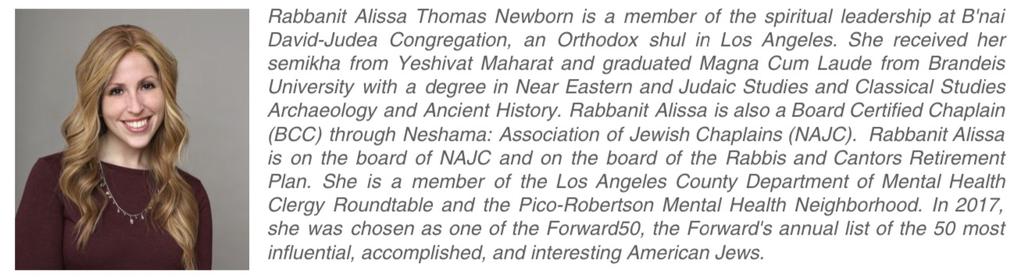
Rabbanit Alissa Thomas Newborn
Class of 2016
I want to share a Chassidic story with you called, ‘The Vanishing Flame’.
It was the first night of Chanukah, and the grandson of the Baal Shem Tov, Rebbe Baruch of Mezhibuz lit the menorah and sang Maoz Tzur with his Chassidim, his students. Suddenly, the candle flickered, as though dancing or struggling, and then the flame disappeared. The candle had not gone out-- there was no smoke. The light had just vanished. All of the students despaired and worried, ‘Should we relight the menorah?’ But the Rebbe insisted that they continue singing. Later that evening, a traveler came to the Rebbe and his Chassidim and said that he had been lost in the dangerous woods trying to get back in time to light the menorah. Suddenly, a single flame appeared in the darkness and guided him home, protecting him up until he arrived at the Rebbe’s Chanukah table. After the traveler finished his story, the Rebbe and his Chassidim turned and looked at the menorah to find that the flame that had vanished was now burning brightly, as though it had never disappeared.
We often speak of the great miracle of Chanukah as the fact that the oil did not run out for eight days. But in this Chassidic story we are challenged to uncover a miracle of Chanukah that is all too often overlooked. This is the miracle of faith. In the Chanukah story, the miracle is that the Jews had enough faith to search for the cruse of oil in the first place. They did not give up on themselves or on God; they did not give into uncertainty and doubt. Instead they returned to the Temple to rebuild and reconnect in the midst of destruction.
In our Chassidic story, we see Rebbe Baruch act out this very message. He models for his Chassidim his faith that the flame will return and his commitment that the absence of light is not enough of a reason to stop singing, praying, and engaging with God and his people. Every Chanukah, we celebrate our miraculous capacity to have faith and hope and to persevere in the midst of uncertainty-- an ability that is forged in the cauldron of the Jewish soul. And we are encouraged to find a way, as Rebbe Baruch did, to remind ourselves that despite destruction and loss, our lights will not go out and our hearts will not despair.
It is fortuitous that we read Parshat Mikeitz in our final nights of Chanukah. In this parsha, Yaakov Avinu, with two words that are also often overlooked, embodies this same ability to persevere and have faith in the midst of uncertainty. After he agrees to send his sons back to Egypt, this time including Binyamin, Yaakov utters two last words: ‘Shacholti shachalti’, ‘If I am bereaved, then I am bereaved’ (Bereshit 43:14). Rashbam hones in on the repetitive shoresh and argues that Yaakov’s ‘Shacholti shachalti’, ‘If I am bereaved, I am bereaved’ directly parallels Esther’s ‘Kaasher avadati avadati’, ‘If I die, I die’ in Megillat Esther. He explains that in both cases, Yaakov and Esther took a leap of faith and trusted in God. They acted ‘al hasafek’, with faith in the face of uncertainty, and with a willingness to enter the darkness-- even the death-- ahead of them. The threats of loss, death, and consuming darkness were not enough to stop Yaakov and Esther from serving God and caring for their loved ones.
It takes great spiritual strength to surrender to God’s plan and to have faith that the vanishing flame is not the end of the story. When we are surrounded by hatred, destruction, doubt, pain, and suffering, having the koach to find meaning and purpose can seem impossible. Chazal traditionally compare the rabbinic holidays of Chanukah and Purim, describing Chanukah as the holiday in which God’s Hand is obvious and Purim as the holiday in which God’s Presence is hidden. In reality, though, it is often the hiddenness of God’s Presence that characterizes our daily lives in a post-Chorban Bayit world-- a world in which destruction is deeply felt and in which faith takes great effort. The Gemara even recounts that in the city of Lod, Jews stopped practicing Chanukah after the Temple was destroyed because they felt the original message of the holiday, namely the rededication of the Temple service, was no longer applicable to their lives. Thus, when we face destruction and uncertainty, it is only human to struggle and require great strength to still maintain hope.
But this is the Messianic story. Like Yaakov, we as Jews are called to wrestle throughout the night in the darkness until the sun ultimately rises, knowing that the night is not permanent. It is davka when we enter into the darkness that our flames are best able to shed light on that which needs warmth, guidance, and perspective.
As we enter into the final nights of Chanukah, we will have the gift of seeing a menorah that began with a single flame build into a brightness that is completely full. The vanishing flame is not the end of the story, but the beginning. When the light of our menorah creates enough light to illuminate the paths of travellers, those who are lost, searching for comfort and meaning on roads that are littered with fear, despair, and danger, then we will merit the return of the vanishing flame. For us, this may mean bringing our flames, our unique souls to the sides of friends who are grieving or facing great hardship. It may require lending a hand to a community member who is struggling to balance family-life and work-life. Or it may mean illuminating a room with the light of laughter for someone who is feeling disconnected, alone, or unseen.
God gave the miracle of the oil that burned for eight nights. But we bring the miracle of faith to life by kindling the the lights ‘al hasafek’, even when we are uncertain of what will be, even when we or those whom we love are struggling or wandering. As we say every Friday night in Kabbalat Shabbat, ‘Veemunatecha baleilot’, ‘May we have faith in God at night, at the time of darkness’. It is through faith in the midst of darkness and the choice to never see the absence of light as a reason to stop singing that we will bring about the return of the vanishing flame, the realization of the ultimate redemption.