


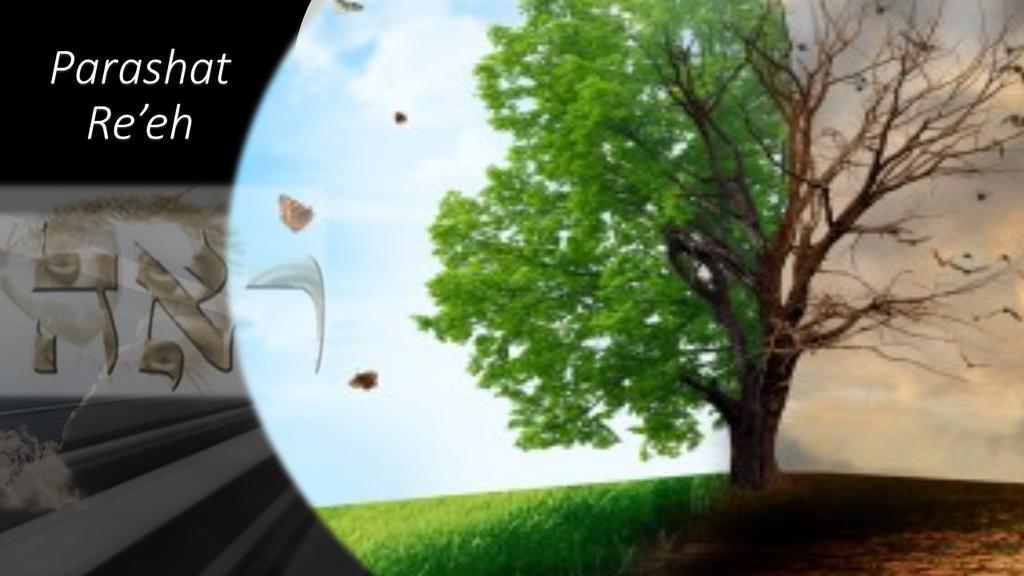
This Shabbat we read from Parasha Re'eh which literally means "to see" as we also usher in the new month of Elul, a time in which we are encouraged to search one's hearts and draw us closer to G-d as we begin to prepare for the Yamim Nora’im, the high holidays of Rosh Hashanah and Yom Kippur.
In this week's Torah portion, Moses impresses upon the Jewish people that we have a choice in abiding by G-d's laws regarding keeping kosher, the worshipping of other G-d's/Idols and observing the holidays in which we will be rewarded with an abundance of blessings. Whereas on the contrary, should we stray and ignored his commandments we risk a more uncertain fate of being cursed or even worse to perish.
There is certainly no more appropriate a time of year for us to think about our own balance of blessings and curses as we begin to look in the rear-view mirror of this past year and begin to make amends for has been, what could have been, what will be and what we aspire for in the year ahead.
Rambam said that “Throughout the entire year, a person should always look at himself as equally balanced between merit and sin and the world as equally balanced between merit and sin. If he performs one sin, he tips his balance and that of the entire world to the side of guilt and brings destruction upon himself. On the other hand, if he performs one mitzvah, he tips his balance and that of the entire world to the side of merit and brings deliverance and salvation to himself and others.” (Hilchot Teshuva 3:4)
How does one truly balance a life between merit and sin or equate blessings and what we perceive as curses? Would we in fact be able to truly recognize vs. the one if we had not our own personal experience with each to be able to differentiate the two?
We have all heard the expression which first originated in the year 1634 by John Milton in his poem Comus: A Mask Presented at Ludlow Castle:
I see ye visibly, and now believe
That he, the Supreme Good, to whom all things ill
Are but as slavish officers of vengeance,
Would send a glistering guardian if need were
To keep my life and honor unassailed.
Was I deceived, or did a sable cloud
Turn forth her silver lining on the night?
I did not err; there does a sable cloud
Turn forth her silver lining on the night,
And casts a gleam over this tufted grove.
But in fact, it wasn't the age of Queen Victoria did the phrase as we know it today, "there's a silver lining to every cloud that sails about the heavens if we could only see it" first appear.
I believe as in life, we all must learn to crawl, before we can walk. We must also learn to fall before we can run. As is life; Rambam so eloquently presents a key lesson we can pull from his perspective of balancing merit and sin, if only phrased and viewed another way; For every blessing we must look to it as having a curse or sin and for every curse or sin as having a blessing (hence the silver lining if we can see it); We have a choice in which when we proactively look to find this balance. In finding that balance, we are afforded the blessing of a greater appreciation for what has been, what could have been, what will be and what we aspire to be in the year to come.
Shabbat Shalom
In this week's Torah portion, Moses impresses upon the Jewish people that we have a choice in abiding by G-d's laws regarding keeping kosher, the worshipping of other G-d's/Idols and observing the holidays in which we will be rewarded with an abundance of blessings. Whereas on the contrary, should we stray and ignored his commandments we risk a more uncertain fate of being cursed or even worse to perish.
There is certainly no more appropriate a time of year for us to think about our own balance of blessings and curses as we begin to look in the rear-view mirror of this past year and begin to make amends for has been, what could have been, what will be and what we aspire for in the year ahead.
Rambam said that “Throughout the entire year, a person should always look at himself as equally balanced between merit and sin and the world as equally balanced between merit and sin. If he performs one sin, he tips his balance and that of the entire world to the side of guilt and brings destruction upon himself. On the other hand, if he performs one mitzvah, he tips his balance and that of the entire world to the side of merit and brings deliverance and salvation to himself and others.” (Hilchot Teshuva 3:4)
How does one truly balance a life between merit and sin or equate blessings and what we perceive as curses? Would we in fact be able to truly recognize vs. the one if we had not our own personal experience with each to be able to differentiate the two?
We have all heard the expression which first originated in the year 1634 by John Milton in his poem Comus: A Mask Presented at Ludlow Castle:
I see ye visibly, and now believe
That he, the Supreme Good, to whom all things ill
Are but as slavish officers of vengeance,
Would send a glistering guardian if need were
To keep my life and honor unassailed.
Was I deceived, or did a sable cloud
Turn forth her silver lining on the night?
I did not err; there does a sable cloud
Turn forth her silver lining on the night,
And casts a gleam over this tufted grove.
But in fact, it wasn't the age of Queen Victoria did the phrase as we know it today, "there's a silver lining to every cloud that sails about the heavens if we could only see it" first appear.
I believe as in life, we all must learn to crawl, before we can walk. We must also learn to fall before we can run. As is life; Rambam so eloquently presents a key lesson we can pull from his perspective of balancing merit and sin, if only phrased and viewed another way; For every blessing we must look to it as having a curse or sin and for every curse or sin as having a blessing (hence the silver lining if we can see it); We have a choice in which when we proactively look to find this balance. In finding that balance, we are afforded the blessing of a greater appreciation for what has been, what could have been, what will be and what we aspire to be in the year to come.
Shabbat Shalom