7 Nissan 5779 | April 12, 2019
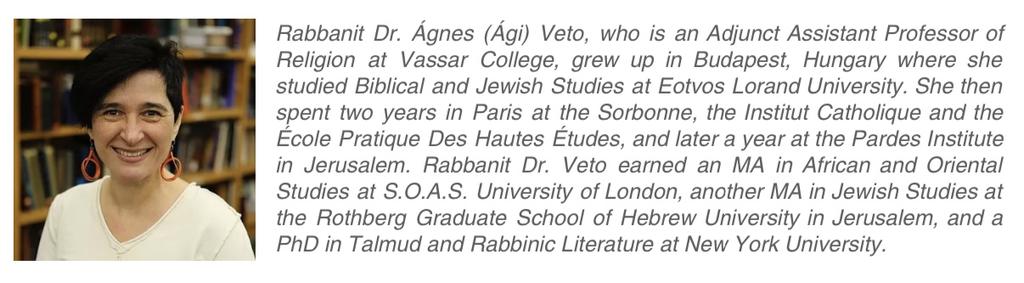
Rabbanit Dr. Ágnes Veto
Class of 2020
Six or seven years ago, while on a trip to the East Coast we visited a synagogue the Shabbat of parashat Metzora. The person giving the Dvar Torah began with the following statement: “Parashat metzora is about medical issues that no one finds pleasant or easy to talk about, so I would like to talk about another topic.” I cannot tell how good his subsequent drash was—he lost me right away when he gave up so easily on Metzora. But I agreed with him about one point. I, too, found the text very difficult to relate to. Did it offer anything beyond an Ancient Israelite account of human physiology and its diseases?
Not so long after this I came across a hefty volume about Leviticus written by Professor Jacob Milgrom. He dedicated three volumes to the third book of the Torah which collectively answer my question with a resounding “Yes!”
Milgrom begins with the seemingly direct observation that the parashah discusses the ways in which the impurities of a scale disease (metzora) and the impurities of male and female genital discharges can be purified.
But he goes on to try to understand what has been “broken” and what is required to “fix” it in a profound way: He asserts that the commonality between these two types of impurities is that they stand for life or death: scale disease, the condition of the metzora, for example is described in Numbers 12:12 as an illness leading to death. (When Aaron realizes that his sister Miriam is punished with tzara’at, he implores Moshe not to let her become “as one dead”.)
Genital discharges were, on the other hand, understood as connected with life. According to Ancient Israelite medical science menstrual blood was the female counterpart of semen and was, as such, one of the two genital fluids responsible for reproduction.
That death is associated with impurity should not surprise us, the Book of Numbers clearly indicates that a corpse imparts the most severe level of impurity. But why is reproduction—associated, as it is, with life— understood as an “impurity”?
For us, the English term “impurity” is associated with morality: If we lie, or cheat or speak badly of others — and of course we can do much worse than this — we might feel impure—as if we are “stained” in some ineluctable way— and others might think so too. This meaning is surely carried by the Hebrew term “tumah.” Yet “tumah” imparts another meaning as well, which cannot be transferred to our English word “impurity.” This additional meaning refers to a state in which one should not be in the physical presence of Hashem—that is, in the Tabernacle, the Mishkan.
Significantly, the impurity in this case is not related to any moral imperfection. The reason for which one should avoid Hashem’s presence in these cases seems to be a deep incompatibility: some experiences are all-consuming and cannot be or should not be reduced by the proximity of another all-consuming experience.
It seems natural that an encounter with Hashem, an encounter with death, or a sexual encounter would all fall into this category of all-consuming experience. In order to ensure that our unique encounter with Hashem is not compromised by the memory or impact of these two other uniquely powerful encounters involving death or the initiation of life (reproduction), encounters with death or with the initiation of life alike have to be contained and marked by a visible marker. That marker is the status of “ritual impurity,” which might seem a parallel to, but is not cognate with moral impurity. Thus, it makes logical sense that the laws in parashat Metzora ask for a menstruant to undergo a purification period culminating in a purificatory sacrifice, the so called purification (hattat) offering.
We can still agree with the congregant who shied away from giving a dvar Torah on parashat Metzora. What, after all, does all this have to do with us? Professor Milgrom argues that the last psuqim of the parashah shed light on this —absolutely legitimate — question. In Leviticus 15:31 we read:
You shall set apart the Israelites from their impurity, lest they die through their impurity by polluting my Tabernacle which is among them
All Israelites who share the status of ritual impurity — the zav, the zavah (males and females with genital discharge) and the niddah (the menstruant)— are warned to carefully observe the purification period culminating in the purification offering, in order not to pollute the Mishkan and die. The term “yamutu” refers to the death of the community by divine punishment.
That is perplexing: most of them could not have polluted the Mishkan simply because they never made it there. The average Israelite, though enjoined to visit the eventually-erected Temple on the Pilgrimage Festivals, would have had little to do with the Temple on more quotidian occasions, and—at the time of the Mishkan—even less. So why does the pasuq talk about communal punishment for the sin of a few individuals who neglect what we would think of as their “medical care”—the care of their ritual impurities?
Professor Milgrom maintains that the scripture understands the all-consuming experiences of contact with death and with the initiation of life as creating ritual impurity that impacts the Mishkan even from afar. Which is why it doesn’t really matter that only very few Israelites could actually visit the Mishkan. They did not need to visit it in order to pollute it!
The warning in the pasuq was necessary since the more Israelites neglected purification, the more pollution was accumulated in the Mishkan—even from afar— leading, eventually, to the departure of the Divine Presence from the sacred space—a national catastrophe by any measure. In this light, the warning “lest you die” is meant in a very real sense: with the departure of the Shekhinah from the Mishkan the entire community would have perished.
It appears that the impurity laws of parashat Metzora describe a community where the all-consuming experiences of individuals around sex and death, and the natural workings of the body via niddah impacted both the ability of the affected individuals to connect with Hashem, as well as everyone else’s ability to do so.
The text wants us to understand—perhaps to imagine—ancient Israel as an integral and integrated community, in which no individual was atomized, no person was on his or her own. Fellowship was inescapable, responsibility was shared. Israel itself was a corporate entity, a meta-body of sorts, and even the most intimate experiences of each member deeply impacted upon and affected the larger ingathering of the people—Knesset Yisrael. It was a means of creating a very strongly interconnected and engaged community. We can learn from this about our own connected spirituality and sense of corporate identity—even if we find ourselves at a distance from the seemingly very physical and material manner in which this spiritual connection is arrived at in the parashah.