29 Nissan 5779 | May 4, 2021
Parshat Acharei Mot
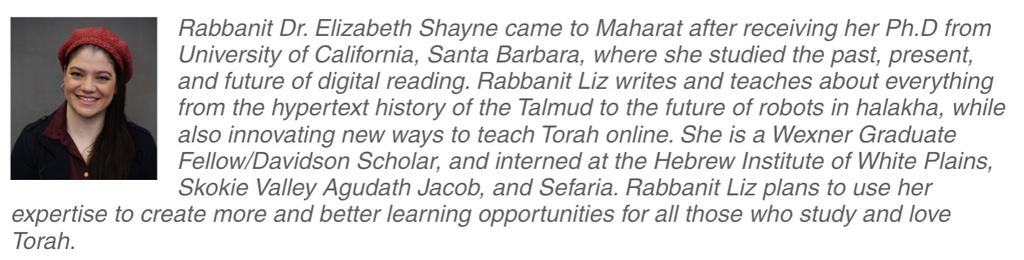
Rabbanit Dr. Liz Shayne
Class of 2021
This Shabbat, May 4, 2019, marks the beginning of a fascinating phenomenon in the weekly parshiot; one that will stay with us for roughly a quarter of the year before disappearing on August 3rd. For the next fifteen weeks, the Diaspora will be reading the parasha that Israel read the week before, until finally, Israel will read parashat Ma’asei and the Diaspora will read the double parasha of Matot and Ma’asei and we will finally be back in sync with one another. The reason for this disharmony lies squarely at the feet of the second day of Yom Tov we celebrate outside of Israel. Last week, when we read the Torah reading of the eighth day of Pesach, Pesach was already over in Israel and so they, quite reasonably, went on with Torah reading. Thus, we find ourselves strangely unmoored from one another in the cycle of parashiot until the end of the book of Bamidbar.
This seems, at first glance, merely like an interesting curiosity. It is a side effect of the calendar, yes, but a comprehensible phenomenon given the way that Yom Tov falls out. Except that, in some years, Acharei Mot and Kedoshim are read together as a double parasha. We could catch up this very Shabbat if we chose to. If we look more closely, we find that there are two others sets of double parashiot — Behar-Bechukotai and Chukat-Balak — that we in the Diaspora could combine in order to catch up to Israel and bring the parashiot back into sync. What, as they say, gives?
It is worth remembering that this phenomenon is far more noticeable in our day and age than it would have been in most of history. The ease with which we get up and travel around the globe is astonishing, or would be if we were not so used to it. For most of history, very few Jews would have any reason to either notice or experience this disconnect at all. There were no weekly divrei torah going out either a week early or late (depending on your perspective), no visitors swooping in for family smachot and hearing b’nei mitzah read the same parasha that said visitors just heard last week. Our contemporary situations primes us to wonder about something that, historically, would likely not have registered as a problem for most people.
For those of us for whom it does register, though, I can’t help but wonder why we do not resynchronize the parashiot as soon as possible. The answer can be found in the Shulchan Aruch, Orach Chayim 428:4. The author, R. Yosef Karo, explains that there are specific rules about when we must read certain parashiot.
(ד) לעולם קורין צו את אהרן קודם פסח בפשוט' ומצורע במעוברת חוץ מבה"ח מעוברת (וה"ש מעוברת) שקורים אחרי מות קודם הפסח ולעולם קורין פרשת במדבר סיני קוד' עצרת תשעה באב קודם ואתחנן אתם נצבי' קודם ר"ה ולכן כשר"ה ביום ב"ג שיש שתי שבתו' בין ר"ה לסוכו'... אבל כשר"ה ביום ה"ו אז אין בין ר"ה לסוכו' אלא שבת אחת שקורין בה האזינו אז וילך עם נצבי' קודם ר"ח...
We always read Tzav before Pesach in an ordinary year and Metzora before Pesach in a leap year — except in the years when we read Acharei Mot before Pesach in a leap year — and we always read Bemidbar before Shavuot, Vaetchanan right after Tisha B’Av, Netzavim right before Rosh Hashanah. When Rosh Hashanah falls on Monday-Tuesday, we split Netzavim-Vayelech so that we read Vayelech between Rosh Hashanah and Yom Kippur and Haazinu between Yom Kippur and Sukkot, [...]. But when Rosh Hashanah is on Thursday-Friday, there’s only on Shabbat between Rosh Hashanah and Succot, on which we read Haazinu, and so we read Netzavim-Vayelech together before Rosh Hashana [...]
Some of us may already be familiar with some of these rules: the rule that on the Shabbat after Tisha B’Av, Shabbat Nachamu, we always read Vaetchanan is the most famous. And some are self-evident. If we fail to read Haazinu on the last Shabbat before Succot, we will not be able to read the final parasha, V’zot Habracha, on Simchat Torah. And then there are the rules that are driving our current split. With the way the parashiot are divided now, it is impossible for Israel to read Bemidbar right before Shavout. However, if we in the Diaspora read no double parashiot, we will read Bemidbar right on time. Which is why we do not merge either Acharei Mot with Kedoshim or Behar with Bechukotai. And since we are concerned that it might look like Israel is changing the Torah reading just to match up with the Diaspora, we wait until as close as possible to Vaetchanan to alter the reading to make it clear that the change is not about letting the Diaspora catch up, but about ensuring that Vaetchanan is read at the right time.
This passage in the Shulchan Aruch raises more questions for me than it answers. Why does it matter when we read the parashiot? Why can we not be content with making sure we get to V’zot Habracha at the proper time and have that be enough? Why, to be more pointed with the question, does it matter when we read Bemidbar? The Biur Halacha, written by the Chofetz Chayim, quotes an answer given by the Levush, R. Mordechai Jaffe writing in the 16th century, that says that we specifically separate the Tochacha, which we read in Bechukotai and which describes all the curses that will fall on the people and the land if we fail to obey God’s commands, and Shavout, which is the New Year for fruit trees. By making sure that Bamidbar is always read on the Shabbat before Shavuot, we make space between the curses and the creations they might fall upon.
The commentaries in the Shulchan Aruch draw out additional connections between the parashiot that we read and the events of the yearly cycle. The parashiot are not merely superimposed on the cycle of Jewish holidays; they are in conversation with them. We often put ourselves in conversation with both the parasha and the holidays, asking what we are meant to take from Acharei Mot or what we are supposed to learn about freedom through Pesach, but this strange alignment asks us to step back from the discussion and look, instead, at the cycle as a dialogue in which we are invited to listen. The world is filled with cycles, turning and returning, and I challenge us — in this strange season where we are literally hearing different Torah read — to not only think about what is being said to us, but to everyone and everything around us. Let us ask ourselves who needs to hear which words and, like the care we exercise not to mention the tochacha too close to the trees’ day of judgement, account for the impact of our words on all those who hear them.