10 Tamuz 5779 | July 13, 2019
Parshat Chukat
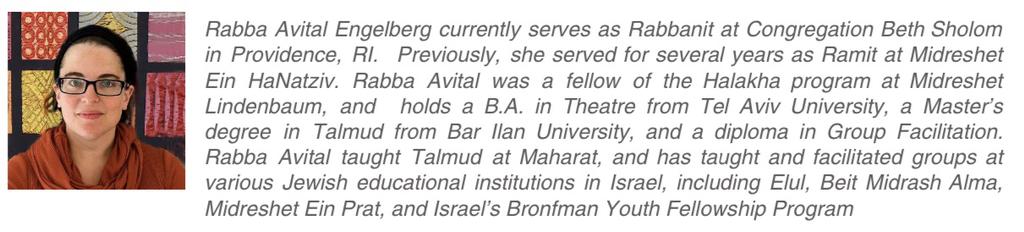
Rabba Avital Engelberg
Class of 2015
Translated from Hebrew by Michal Kohane
Our Torah portion is full of transitions - from the impure to the pure at the beginning of the parsha; arguments and torments of the Children of Israel with Moshe and Aharon, as well as the Copper Snake, the transition to mercy and God’s way to stop the Children of Israel’s punishment.
The way God chooses to stop the snakes is through a statue that acts in a miraculous manner which can easily - and dangerously - be associated with idolatry. The mishnah in tractate Rosh Hashana 3:8 explains: “And does a snake cause death and life? But rather, as long as the Isrealites gaze upward, and their heart is dedicated to their heavenly Father, they would be healed”. The snake is only a symbol of the real thing, a reminder to look up and remember who is On High, who is the true Care-Taker and Healer, while the fear still lingers.
The fear still existed many years later, when it turns out that Moshe saved the Copper Snake for generations to come:
וכתת נחש הנחשת אשר עשה משה כי עד הימים ההמה היו בני ישראל מקטרים לו ויקרא לו נחושתן אפשר בא אסא ולא ביערו בא יהושפט ולא ביערו והלא כל עבודה זרה שבעולם אסא ויהושפט ביערום אלא מקום הניחו לו אבותיו להתגדר בו
And the Copper Snake which Moshes had made still existed until the days when the Children of Israel would offer it burnt incense calling him Nechushtan (from the word, nechoshet, copper). Is it possible that Asa came, and did not get rid of it? That Jehoshapahat came and didn’t get rid of it? We’re told that any idolatry whatsoever exits in the world, Asa and Jehoshapahat got rid of them! But rather, our forefathers left it a little place where it was allowed.
In the days of Hezekiah, in the year 700 BC, the Copper Snake still existed. Not only did it exist, but the Children of Israel worshipped it idolatrously. The Gemara asks how is it possible that Asa and Jehoshaphat, who were kings earlier and got rid of all idolatry, allowed this to linger, if it is an actual source of idolatry? And I would like to add to this question and ask, how can it be that such a symbol which was used to heal the Children of Israel in the desert became a tool for idolatry?
The Gemara attempts to answer the challenge regarding Asa and Jehoshaphat with the words - “But rather, our forefathers left it a little place where it was allowed”. The original Hebrew is complicated, because we don’t exactly know what the Gemara meant by saying מקום הניחו לו אבותימן להתגדר בו. What does it mean “they left it a place where it was allowed”? Did they realize that the Copper Snake is already used as idolatry, but opted to leave Hezekiah ‘something to do’? Did they deliberately maintain idolatry for a few generations?
The various interpretations on this subject open for us an opportunity for value-based observations on religious rulings and halachic decision-makings in a complex world.
The Yalkut Shimoni on our parasha explains that neither Asa nor Hezekiah break the Copper Snake because the Copper Snake was made by Moses following the Holy One, blessed be He’s instructions:
Therefore they assumed that the serpent was 'out of touch' as a divine creation.
Hezekiah, who comes generations later, sees in the snake a very problematic situation with a clash of values. On the one hand, the Copper Snake is a divine creation, while on the other hand, he cannot stand idly by when he sees how this holy and ancient object turns into idolatry. In a world of such halakhic values clashing, Hezekiah chooses to crush the serpent. His desires for a holy people exceeds the value of preserving that which is in existence even if at a certain time it was a symbol of holiness. Hezekiah sees that even a symbol of holiness, an object that once saved the people, now harms him, and therefore, he cuts it off.
The Chatam Sofer on Tractate Pesachim (56a) explains what happened in a slightly different way:
ונראה שהיה הנחש הלז לתועלת גדול להמאמיני' בה' ולא טעו אחריו לעשותו ע"ז ולהם היה בזה תועלת גדול לראות כי הוא ית' מחיה בהממית ומרפא בהארס ואם תרצה לעמוד על דברינו תעי' מ"ש רמב"ן בפ' נחש הנחשת כי ההסתכלות בו היתה סכנה עצומה להנשוכי' מהנחש שרף והקב"ה הראה שהוא הרופא נאמן חוץ לטבע המציאות ולכן שמרוהו לדורות שיהיה בזה רפואה להמתפתי' אחר ספר הרפואות להסיר בטחונו מהי"ת יביט בנחש הנחשת וחי חיי נצחי' ישום אל ה' בטחונו וישבחהו על טובתו שהזמין רפואות הללו עמ"ש הרמב"ם בפי' המשנה בשמעת' ואח"כ תעיין ברמב"ן פ' בחוקותי ותהי' רפואה למכתך ולכן לא כתתוהו הראשונים אעפ"י שהיה בזה מכשול לרשעים הטועים כל כה"ג אמרי' ישרים דרכי ה' צדיקים ילכו בם ופושעים יכשלו בם אבל חזקי' יעץ לגנוז ספר רפואות ותו לא נצטרך לנחש הנחשת...
And it seems that the serpent was of great benefit to those who believed in Hashem, and did not err to make it as idolatry, and it was of great benefit to see it for He, Blessed, cause life in death, and healing in its venom...And the Holy One showed that God is the most loyal healer outside of natural reality and therefore, they saved it for generations, so that the ones seeking healing, tempted by the book of medicine to lose their faith in God Almighty, will gaze upon the Copper Snake and live an everlasting life...and therefore, the early ones didn’t cut it down, even though it was an obstacle to the mistaking wicked ones, for we say, “The ways of Hashem are straight; the righteous will walk in them, and the wicked will fail in them”, but Hezekiah, advised to shelve a book of medicine so we won’t need the Copper Snake...”.
For the people who believe in God, the Snake helped. It’s role was to remind the Children of Israel that it is not only the book of medicine which aides, but also relying on God. The combination of the Snake and the Medicine Book increased God’s awe in the world. The Chatam Sofer explains that there were indeed people for whom the Snake was a source of idolatry, but because there were people who were helped by it, and there was room for it in the world.
In other words, the Chatam Sofer tells us that even if there are problematic things in the world, as long as the righteous benefit from them, then they belong to the world, even if they harm those who have less faith. But from the moment that the object causes only damage, then it can be destroyed. The Chatam Sofer’s approach is, “feed it to the wicked and let it die”; namely, in halachic deliberation over a problematic matter, what we should be focused on are those who believe in God and not the concern for the sinners. We don’t have to worry about the observance of those who don’t observe the mitzvot. As long as the faithful benefit, we can preserve it; when the faithful ones have no benefit, then the object can be broken.
The last interpretation I would like to share is that of the Pesikta Zutrata, from the Lekach Tov on Parashat Lech Lecha, and so he writes:
וכן מצינו כי חזקיהו מלך יהודה כיתת נחש הנחשת... ראה משה תיקנו להיות לאות בישראל לזכור נסי אלהינו... ועוד כמה עתידות אמר משה רבינו ולא היה יודע כי ישראל עתידין להקטיר לו. ולמה הניחו להיות מכשול לישראל.
This is the way of the world. This is one in his generation, and this one - in his generation, and all of them who serve our God truly are called His servants, and there is no single generation that can repair all the other generations. Rather, in every generation the ministers of Israel notify the people which is the path of Hashem, and they fix, renew and add to what earlier generations brought regarding the way of worship of our God...
This is the way of the world: Moshe does not have to worry about what happens a few generations in the future, but he must see his own generation clearly and shepherd his people in the right manner. “There is nothing before the judge except what his eyes can see.” The role of the sages in each generation is to correct, renew, and add - so that we will not remain with idolatry, only because the same object was holy once upon a time.
So how does a miracle become idolatry? How does an object which was holy, made by the word of God, become in Hezekiah ’s time, a statue that incense was offered to it? When we try to keep what is in existence, ‘because that’s how it always was’, the Lekach Tov warns us that sometimes we pay a big price if we opt to maintain, at any cost, that which has been until now. Sometimes we need the courage to really see what is happening around us, and at times, even sorrowfully, break the holiness of the past, so that we can preserve the sacredness of the present.
Shabbat Shalom, and may we all be able to see the present with our open eyes, so that we too will merit to maintain the holy.