15 Av 5779 | August 16, 2019
Parshat Va’etchanan - Shabbat Nachamu
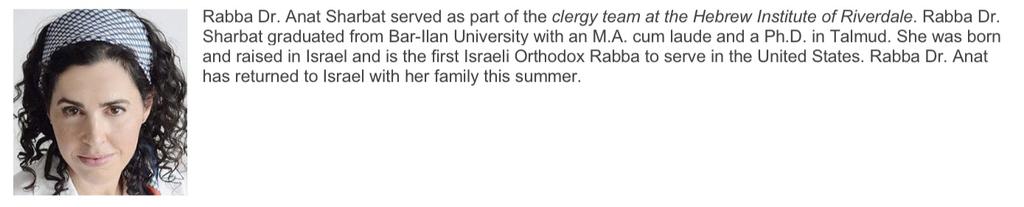
Rabba Dr. Anat Sharbat
Class of 2015
I remember the Shabbat when my beloved grandmother – Savta Rachel – passed away. It was sudden, unexpected: she was only 67. My mother and the rest of my family descended into deep mourning. I remember going outside before the funeral and feeling amazed to see the harsh contrast – while "חרב עלינו עולמינו" our world has collapsed, out there, on the street - "עולם כמנהגו נוהג" the world was carrying on as normal.
These difficult feelings of destruction happen at some stage in every home and every family. They are also experienced in a symbolic way each year in the Jewish calendar during the period between the 17th of Tammuz and Tisha B'Av. On the 17th of Tammuz we begin to observe the increasingly severe customs of mourning that reach their peak on Tisha B'Av.
As a people, we are offered a process of nechama - a process of comfort, each year. This process begins on the afternoon of the 10th of Av and is expressed especially on the shabbatot on which we read a haftara of comfort from the Book of Isaiah. These shabbatot are called in Aramaic שבע דנחמתא - the seven shabbatot of comfort. Each Shabbat, starting this week, we read a haftara not related, as usual, to the weekly parsha but rather to nechama and comfort – a process that provides an opportunity to heal from the trauma of the destruction and exile.
What does this tradition teach us?
The cycle of the year teaches us that in life we sometimes encounter times of trauma, and afterwards we are offered a process of comfort and healing. This cycle is a natural part of our lives. This is life. Offering nechama or going to a mourner's house is one of the most important mitzvot and acts of chesed we can offer one another as a cohesive and supportive community. This is not an easy task, though, and we all want to do it better.
What can we apply from the order of these seven haftarot to our practices of comforting mourners?
The מחזור ויטרי - Machzor Vitry, a book written at the beginning of the 13th century and containing customs of prayers and Torah readings, says that the opening lines of the seven haftarot and their order teaches us how to offer comfort. These are the author’s words: “And the haftarot, which are all of nechama,
כדרך המנחמים לנחם מעט מעט.
As is the way of the comforters - to comfort gradually.
One who says too much to the mourner is like one who says to a person asking for charity: Tomorrow you will be a king - he does not believe it. As it is said: ‘And they did not listen to Moses because of their impatience and hard labor.’”
Here we have the first principle: be gradual. Say little and add things only gradually. According to this principle, we cannot come to someone whose world has collapsed with sentiments that do not match his or her situation. Theological reasoning, for example, will not necessarily be what the mourner is ready to hear, unless he or she offers it themselves. We should also refrain from saying things such as "everything is for the best" or even "that's the way of the world." Such phrases are not be appropriate for the initial stage of the process. They are, as Machzor Vitry says, too much.
If this is so, then the second principle we learn from this text is that we must pay attention to the stage in which the mourner currently exists. I wish to point out here that the pace of the comforting process may differ from one mourner to the next. We must allow each mourner the legitimate personal space to go through the process he or she needs in order to be comforted.
"Therefore”, Machzor Vitry - מחזור ויטרי continues: "Comfort."- נחמו.
This is the reason that the first haftara we read begins with the words "נחמו נחמו עמי - Comfort, comfort my people". These simple and direct words of the prophet who sees the people in the early stages of mourning affirm and recognize the people's emotional struggles and offer simple support.
This is the beginning of the process of comfort. The words we offer during the shiva are similar: Ashkenazim say, "May God comfort you among the mourners of Zion and Jerusalem," and Sephardim say, "May you be comforted from heaven." Simple words. Isaiah offers the nation an invitation to start the process with direct and simple words, simple comforts - נחמה פשוטה; no reasoning, no theology, no promises, just being there with the mourners.
The third principle, offered next, is that the mourner is allowed to remain without comfort; she or he is allowed to shout and scream, to be angry and even to ask hard questions. This is all part of the process.
As מחזור ויטרי - Machzor Vitry says:
‘And Zion said: 'God has forsaken me, and the Lord has forgotten me.' Even though it is destroyed, do not say it has been forgotten. And then - (in the third haftara the opening words are) עניה סוערה לא נוחמה.
'Oh afflicted one, tossed with storm and not comforted" – these words of the prophet describe Israel as uncomforted, despite the prophet's attempt to comfort them. Here we see that the people set the pace of their feelings, not the comforter. He cannot rush them or prompt them to feel something they are not yet ready to feel.
"I, - Says מחזור ויטרי - Machzor Vitry, even I, am the one who comforts you." When Israel remains uncomforted by the words of the prophet, God comes to comfort Zion. And, with God’s help, the people do indeed begin to feel comforted, as we see in the lines below.
"And after comforting, God then provides words of favor:
רני עקרה לא ילדה - 'Rejoice, barren one who has not given birth';
קומי אורי - 'Arise, shine';
שוש אשיש ביקוק - 'I will greatly rejoice'".
These are the opening words of the last three haftarot of the seven haftarot of comfort.
This is a fourth principle – that words of encouragement, מילות עידוד, may follow after the mourner has been comforted. Professor Shimshon Rubin, from The International Center for the Study of Loss, Bereavement and Human Resilience, acknowledges the discomfort that we, the comforters, bring to these sometimes-awkward situations. He recommends that we take responsibility for ourselves and be aware of our difficulty when faced with the situation in which we are witness to someone else's suffering. This feeling of discomfort must not attempt to shut down sadness. As comforters, we must confront our own difficulty with maturity and self-awareness in order to be able to support those really contending with their loss. Practically, he suggests that before entering the mourners' house, we take a moment to stop and think about their pain, to focus ourselves on our task.
Together with the explanation from the ancient Vitry prayer book, these ideas identify the comforting process as complex and personal. Its different stages are determined by the mourner and the mourner’s needs, just as we don't read the chapters of Isaiah in chronological order but, rather, select chapters each Shabbat according to the people's needs.
God provides comfort and allows the process to develop with care and sensitivity until the people are comforted.
After my dear savta’s passing, I asked my mom what comforted her the most when she sat shiva, and I think her answer summarized all four of these central principles: “the very willingness of others to come and give comfort, their very presence in time of need, offers a large degree of comfort,” she said.
The sensitivity for, understanding of and attention to the mourner are tools that support comfort.
Words are not always necessary. And if words are needed, we can offer them gradually. Each stage has its own appropriate words.