Tishrei 5780 | October 2019
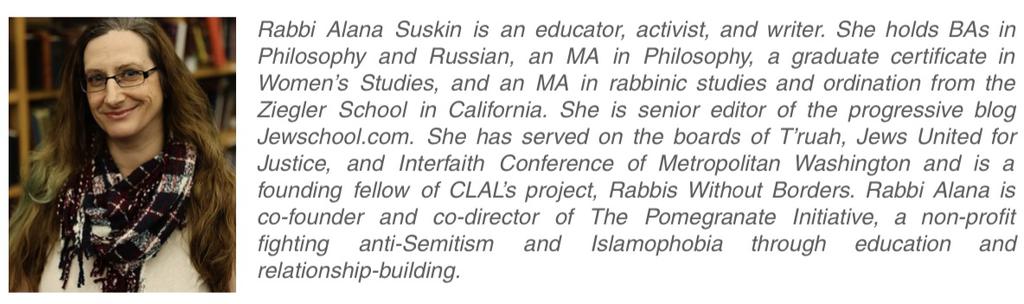
Alana Suskin
Class of 2020
On the first day of Rosh Hashana, the Torah reading begins “And God remembered Sarah.” We also read, as part of the haftarah, that after Hannah poured out her heart in prayer, “God remembered her.” Both of these narratives deal with women wanting children and being remembered by God.
It is curious that we find that the focus of both the Torah and haftarah readings of the first day of Rosh Hashana is on women, since so many of our central stories are about men.
Why is this? The Torah says about Sarah that God pakad her, and for Hannah it says zechrah, but both mean that God took notice of them. On Rosh Hashana we too are hoping that God will remember us. And it is fitting that the model for the remembrance we desire is God’s remembering a barren woman by giving her a child. This model reflects our hope that the relationship between ourselves and God will be one of mercy, echoing the relationship between rechem – womb, and rachamim – compassion. We hope and pray that God will look upon us as a mother looks upon her child, especially a child long hoped for and finally granted.
But there is another mother in the Torah reading for the first day of Rosh Hashana – Hagar, who is turned out with her son into the wilderness, where she believes her son will die. The Torah’s language is puzzling. It says that Hagar cried out (“she lifted up her voice and wept”), and continues by saying that God “heard the voice of the youth.” How strange: Hagar cries out, and God hears the voice of her son. Even though, in the verse, it seems that God responds to Ishmael, it is also clear that it is Hagar’s voice which has stirred God’s response, as it did when she fled from Sarah’s oppressing her the first time. Like the call of the shofar, when Hagar cries, it is not only her voice that God hears, but the voice of someone who cannot cry out for himself. On Rosh Hashana, we repent not only for ourselves (which, after all, we can do at any time), but as a community. We take upon ourselves the task of crying out to God to save the community, not just to repent of our own deeds.
Hannah, Sarah, and Hagar provide us with three models of communicating with God about our longings. Hannah models the ideal. Hannah’s belief in God is strong, and when she is denied what she wants most, she pours her heart out before God, with such intensity that Eli the priest accuses her of being drunk. Perhaps, in a sense she is drunk – with God, like the early chasidim, whose relationships with God were very personal and intimate in a way we long for but seldom achieve today. Rabbi Nachman, a leading chasidic rebbe, tells us that our relationship with God should be like that of a child to its father – that like a child, we should simply demand what we want. The model of Hannah’s longing and God’s response is simple, direct and intimate – ask, in the cry of your heart, and receive.
The second model is that of Sarah. Sarah is fiercely independent and yet has buried her desire for a child so deeply that when messengers from God tell Abraham that she will get her desire, she laughs – a laugh perhaps tinged with bitterness. And then she laughs again when Isaac is born, because God has recognized her deepest desire without her ever being able to ask for it. Sarah’s model of longing is one of suppression – a longing no longer spoken or even acknowledged, but answered anyway, through God’s grace.
And then there is Hagar: Hagar who sees before her only the possibility of death and pain, and cries out – perhaps not even to God, perhaps only involuntarily, like someone who is physically hurt and experiencing pain. And God answers her by addressing the source of her pain, without her even knowing that she has asked for it. This is why God’s answer is addressed to Hagar’s son – even though it is really Hagar’s cry that is being answered. Hagar’s model is one of pure pain-in-the-moment; she doesn’t even recognize that she is in pain. And God answers her indirectly, but in a way that satisfies her needs without forcing her to acknowledge that it is her need and her pain which is being salved.
God’s response to these three women reminds us that God answers all who ask God for mercy. Hannah is the model Jew. She goes to the Temple and prays before God – she is emotional, she is expressive, and she uses language which falls within the linguistic paradigms of prayer. Sarah has turned away – not that she refuses God, but she no longer counts on God to answer her deepest prayers. And Hagar is not even a Jew, but an Egyptian. An outsider, literally and metaphorically. Not only that, but one who Sarah believes has wronged her, to the extent that Sarah cannot bear to have her around, and has tried to expel her from her presence. Her prayer, too, is answered.
On Rosh Hashana, we stand before God, crying out our longing and revealing our deepest desires. Some few of us may be like Hannah, who can weep before God with the same intimacy and ecstasy that the chasidim had. More of us are like Sarah, who feels that her prayers have gone unanswered so long that there’s no chance that anyone will ever answer them. But most of us are like Hagar. We can’t even express ourselves well. Inarticulate, with no words to respond to the pain of her life, with only the instinctive response to cry out.
And so on Rosh Hashana we come to shul to hear the sobbing voice of the shofar, crying out for us – crying like Hannah, like Sarah, like Hagar, as we join with our community, so that we can raise up our voice in a roar of sorrow and pain for the things that were not right this year, that we hope will change in the future, a great sobbing cry that lifts the hairs on our necks and rises up to God, so that our one voice can rouse the rachamim, the mercy of God, that God’s rechem, womb, will open for us, and will give birth to something new, a year of forgiveness, and hope and reconciliation.