Tishrei 5780 | October 2019
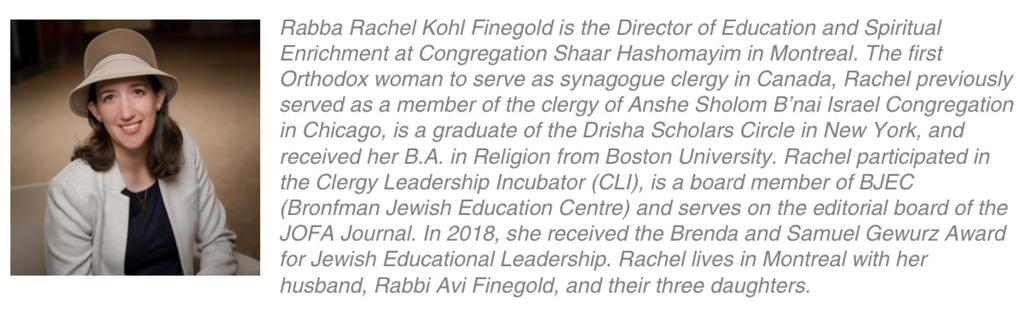
Rabba Rachel Kohl Finegold
Class of 2013
My paternal grandfather was a very learned man. His soft white beard always framed a smile, a warm greeting, and a word of Jewish wisdom for us grandchildren. For most of his life, my Zaydeh Kohl was immersed in the world of Torah study. For fourteen years, he served as a classroom rebbe, a teacher at Yeshiva Torah V’daas, an ultra-Orthodox yeshiva for boys in Brooklyn. Even after he left teaching to start his business in the diamond district in Manhattan, Zaydeh continued his own studies.
My earliest memories of my Zaydeh were always with a sefer, a Jewish book, open in front of him. He would sit before a large volume of Talmud in his study. When we came over to visit, he would ask us to tell him about the Jewish subjects we were learning in school. For my two brothers, he did a “faher”, bringing them into his study and test them, to see that they had mastery over whatever page of Talmud they were learning in Yeshiva.
My Zaydeh passed away, sadly, while I was in university. He never got to see me studying Jewish texts full time, never got to see the path that my career has taken. But I was so moved when my grandmother, now in her nineties (may she live and be well) shared with me a number of years back, as I began the years of my post-graduate Jewish studies, that my Zaydeh used to say about me: “If only Rochel were a boy, she would be a talmid chacham (a Torah scholar).”
If only. If only I’d been a boy. In his world, had I been a boy, I would have had the opportunity and perhaps the natural ability to become a Torah scholar. Some of you may think that I was hurt or offended by this remark. (Nebach, if only I had been born a boy!) Actually, I experienced it as the deepest compliment that my Zaydeh could have paid me. To him, this was the pinnacle, to be a talmid chacham. And had I been a boy, he felt that I could have attained it. It was a deep compliment to my intellect and my passion for Judaism to say that had I been born male, I might have been a Torah scholar. Something tells me that, were he to see me today, my Zaydeh would realize that he didn’t need those words, “if only”.
Pirkei Avot, Ethics of the Fathers (4:20), teaches:
אֱלִישָׁע בֶּן אֲבוּיָה אוֹמֵר, הַלּוֹמֵד יֶלֶד לְמַה הוּא דוֹמֶה, לִדְיוֹ כְתוּבָה עַל נְיָר חָדָשׁ. וְהַלּוֹמֵד זָקֵן לְמַה הוּא דוֹמֶה, לִדְיוֹ כְתוּבָה עַל נְיָר מָחוּק.
Elisha ben Abuyah said: One who learns Torah in his childhood, to what is this comparable? To ink inscribed on fresh paper. One who learns Torah in his old age, to what is this comparable? To ink inscribed on erased paper.
In the ancient world, paper was scarce, and one would erase and rewrite many times over. Think of the Latin expression “tabula rasa” - a clean slate, which literally refers to a clear place to write. This teaching is something we all know - it’s much easier to learn new things when you’re young, when your mind is fresh and uncluttered. If you’ve ever tried to pick up a new instrument or learn a new language as an adult, you know this to be true. It’s easier to learn and retain information when one is younger. It’s like writing on fresh paper.
But before we get too frustrated or depressed about our age, the teaching continues:
רַבִּי יוֹסֵי בַר יְהוּדָה אִישׁ כְּפַר הַבַּבְלִי אוֹמֵר, הַלּוֹמֵד מִן הַקְּטַנִּים לְמַה הוּא דוֹמֶה, לְאֹכֵל עֲנָבִים קֵהוֹת וְשׁוֹתֶה יַיִן מִגִּתּוֹ. וְהַלּוֹמֵד מִן הַזְּקֵנִים לְמַה הוּא דוֹמֶה, לְאֹכֵל עֲנָבִים בְּשֵׁלוֹת וְשׁוֹתֶה יַיִן יָשָׁן.
Rabbi Yose ben Judah a man of Kfar Ha-babli said: One who learns Torah from youngsters, to whom is he comparable? To one who eats unripe grapes and drinks [unfermented] wine from the press. One who learns Torah from the old, to whom is he comparable? To one who eats ripened grapes and drinks aged wine.
Of course, aged wine is far superior to grape juice. It is preferable to have a teacher who is experienced, who is rich with knowledge of the world, than to learn from a rookie. To study from an older teacher is to drink really great wine.
But the teaching concludes in a most surprising way:
רַבִּי אוֹמֵר, אַל תִּסְתַּכֵּל בַּקַּנְקַן, אֶלָּא בְמַה שֶּׁיֶּשׁ בּוֹ. יֵשׁ קַנְקַן חָדָשׁ מָלֵא יָשָׁן, וְיָשָׁן שֶׁאֲפִלּוּ חָדָשׁ אֵין בּוֹ:
Said Rabbi Meir: Look not at the vessel, but at what it contains. There are new vessels that are filled with old wine, and old vessels that do not even contain new wine.
Rabbi Yitz Greenberg explains that this last line is here to challenge the previous two teachings. We may think that we need to be young in order to be a student, and we may think that only the elders have something to teach. But in reality, there are young people who have wisdom beyond their years. There are older people who have the curiosity and openness of the young. Do not judge a wine by its vessel!
This teaching begins by acknowledging our instinct towards “if only”. If only I were younger, I would be able to study. If only I were older, I would have something to teach. But R’ Meir is recognizing that saying “if only” is not necessary. These limitations need not hold us back.
Think about the last time you thought “if only” -- if only something were different. If only I made a little more money, I would feel comfortable. If only my spouse weren’t so stubborn, I would have a better marriage. If only I had more time, I would exercise. If only I knew more Hebrew, I would come to synagogue more often. The trouble with “If only” is that it focuses us on what is not true, instead of making the most out of what is true, and what is possible.
Michael Phelps has stood on the Olympic podium 28 times. After the 2016 summer Olympics, where he earned five gold medals, he became the most successful athlete of the Games for the fourth Olympics in a row, and the most decorated Olympian of all time. Seeing Michael Phelps swim, you know he was made for the sport.
As a child, Michael Phelps was tall and lanky. His arms were so long that they swung below his knees when he stood up. Kids made fun of him for his long arms, and for his protruding ears. At the age of nine, he was diagnosed with ADHD. He had a hard time sitting still or concentrating; he was always on the move. His mother says that she began him in swimming as a way to use his boundless energy.
I could imagine little Michael saying, “If only my body were different. If only my torso weren’t so long and my arms didn’t hang this way.” I could imagine his parents wishing things might be different for him -- as parents, we all wish the best for our kids. But, of course, it turns out that Michael’s body was perfect. Perfect for swimming. He simply needed to discover this. He needed to learn who he was meant to be, instead of wishing he were someone else.
The Biblical Jacob lived his early years wishing he were someone else. He wanted to be his brother Esau. Even at birth, he is holding onto his twin brother’s ankle, trying to catch up to Esau. Later, he literally tries to take on Esau’s identity, dressing up as his brother. In physically becoming Esau, Jacob deceives his elderly, blind father Isaac into giving him the blessing that was intended for his brother.
On the surface, this story is about sibling rivalry; the younger brother is jealous of the elder. But Rabbi Jonathan Sacks writes that this story is about Jacob’s very identity. He thinks that in order to succeed in life, he needs to become his brother, symbolized by his stealing the blessing through deception. But later in the narrative, Isaac blesses him again, this time knowing that he is speaking to Jacob. The first blessing, intended for Esau, was a blessing of wealth and power. But this second blessing, when Isaac is aware that he is speaking to Jacob, is the blessing of a nation and a promised land - the covenantal blessing of Abraham - the blessing with which God blesses the patriarchs again and again. Wealth and power have nothing to do with the covenant; they are not part of Israel’s destiny (as much as we might wish it were otherwise…).
What Isaac is doing in this second blessing is telling his son Jacob that there was never a need for the deception. Jacob didn’t have to steal his brother’s blessing -- he simply needed to receive his own. Isaac intended to bless each son with what was appropriate for him. Esau would receive power and material success; Jacob would receive the covenant and spiritual success. The blessing that Jacob stole was never intended for him.
The story concludes more than twenty years later, as the brothers meet again after a long separation. It is an emotional encounter. Jacob has spent these years building his own family. The brothers embrace, Jacob bows to Esau and offers gifts of material wealth -- herds and flocks. Then he says these words to Esau: “Please accept my blessing that was brought to you, for God has been gracious to me and I have everything.”
Rabbi Sacks says this is a pivotal moment. As Jacob acknowledges “I have everything” - “Yesh li kol” - he is saying, I am complete, I am who I was meant to be. In giving Esau material wealth, Jacob was giving back the blessing he had stolen from his brother all those years before. Jacob has come to terms with who he is. He knows now that the blessing he stole from Esau was never meant for him. It is during this process that he becomes known as Israel, one who wrestles with God. As he has wrestled with God, he has wrestled with his own identity, and finally realizes that he is who he was meant to be. This allows him to move forward with his own mission, the mission of the people of Israel. This episode is so important because not only does Jacob let go of trying to be Esau, but it is only in that letting go that he is able to embrace his identity and become the father of the Jewish people.
Saying “If only” holds us back from being who we are meant to be. It prevents us from taking action, from fulfilling our unique mission in the world.
Sometimes that “if only” comes from within ourselves, but sometimes it comes from others around us. Rabbi Alan Lew, a Conservative rabbi in San Francisco, said that his parents always wanted him to be a doctor. In Rabbi Lew’s own words: “there were only two alternatives for me in this world - to be a doctor or to be a failure.” He tried. He really did. He took pre-med courses, he studied chemistry, but he was terrible at it. In fact, he kept causing explosions in the chemistry lab and breaking expensive equipment. Finally, he began pursuing his own path, and became a successful graduate student, rabbinical student, and eventually a beloved rabbi. But he says he never got praise or validation from his parents, and for this he harbored much resentment and pain. He writes, “They just didn’t see who I was, and it hurt me deeply.” They held onto the “if only”, wishing he would have been a doctor. But one day, he writes, it suddenly came to him. He had needed that struggle. He says, “My soul had needed to fight off my parents’ idea of who I should be. It had needed to do this to become strong… It was my parents’ job to provide me with an impediment, to give my soul something to prove itself against, something to express itself by overcoming.”
Sometimes we are faced with incredible challenges. We are faced with our own “if only”, wishing something were different, or perhaps we are faced with the “if only”’ that our family or friends project onto us. But this can actually fuel our discovery. It can be the impetus for working even harder, and creating new possibility. What’s true for an individual can also be true in the political and communal spheres. “If only” can either stop us in our tracks, or can help us find opportunities for deep impact.
Not long ago, we lost Elie Wiesel, a man who defied description. Poet, writer, orator, great communicator, a man who was called the moral conscience of humanity. I think of him as a prophet in our own time. In 1965, Wiesel made a visit to the Soviet Union at this time of the year - during the high holidays. He bore witness to the suffering of the Jews behind the Iron Curtain. Wiesel wrote: “For the second time in a single generation, we are committing the error of silence.” He, of course, became an active and important part of the efforts to free Soviet Jewry from the grips of Communism.
Soon after Wiesel’s passing, Natan Sharansky wrote a beautiful piece about his involvement in the Soviet Jewry cause. Sharansky recalled his own frustration with the mainstream Jewish organizations during those years. When it came to planning the March for Soviet Jewry in Washington in 1987, Sharansky wrote: “Elie and I had first discussed the idea of a march more than a year earlier, in mid-1986. Yet six months after our initial conversation, I found myself lamenting to him that the Jewish establishment was too resistant to the idea... Elie replied that we should not expect establishment organizations to take the lead and should instead mobilize students, who would pressure them from below to get on board. So I traveled to about 50 U.S. universities,” says Sharansky, “in the months leading up to the march, galvanizing activists who were eager to participate. And sure enough, just as he predicted, all of the major Jewish organizations eventually united behind the idea.”
Wiesel could have stewed in his frustrations. If only the Jewish organized world would back us up, if only the establishment community would be willing to speak out. But instead, he moved forward. He avoided excuses. He harnessed the power of the students. And ultimately, he created a force that brought about lasting change.
What is the opposite of “If only”? It must be the teaching of Hillel: “If not now, when?” (“Im lo achshav, eimatai?”) Rather than wait for something to change, just begin. Begin in small ways. If we have limitations, work within those limitations.
Most of time, we say “If only things were different” as a way to escape reality, to avoid what we could actually be doing. When Tevye sings, “If I were a rich man” we find this entertaining because we know that Tevye the milkman will NEVER be a rich man! It’s nonsense. Most of us don’t go around lamenting, “if only I were the Prime Minister.” But we say, “If only I were the VP of the company… then I could really make some changes around here.” We say “if only” in areas where we actually could conceive of things being different.
I like to think that my Zaydeh said “if only” - if only I was a boy - because he could perhaps imagine the world a little different. He could imagine that someday women would study and teach at the highest level. But for me, those words are irrelevant. In fact, it is precisely because I happen to be female that I’ve been privileged to be part of a pivotal moment in history.
Instead of focusing on what is not, let’s focus on what is. It is true in the political sphere, it is true in family life, and it is true in our careers. We will do much better to focus, not on what is outside of our power, but on where our power does lie. For example: If your grown children live out of town, instead of kvetching, “If only they lived closer” ask yourself, How can I make the relationship better within the long-distance context? If your spouse has a tendency to be late, instead of trying to make him/her a punctual person, focus on how to manage your expectations of punctuality. Work within your own power. This is how to make change.
Every single one of us has an “if only”. This Rosh Hashana, we can decide not to let that stop us. We can change our “If only” into “If not now, when?” If only we would stop trying to be someone else. The world is waiting for us.