Tishrei 5780 | October 2019
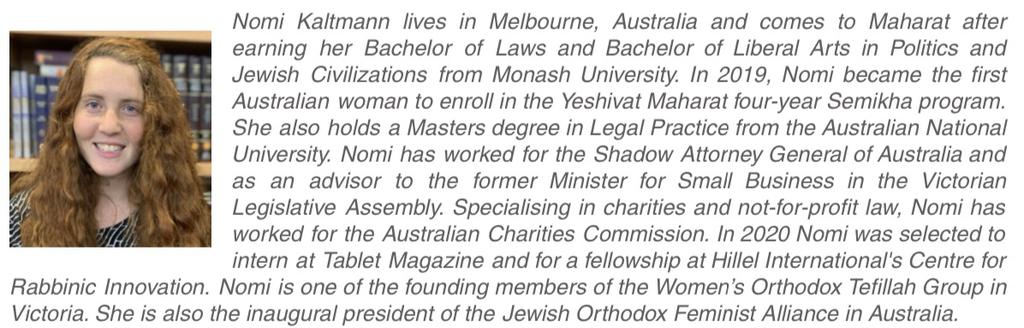
Nomi Kaltmann
Class of 2023
“A year is just another 365-day trip around the sun, enjoy it.”
When I was a child it seemed that a year was an exceptionally long amount of time, with the jump from year to year signifying a monumental change. However, as the parent of young children, it seems that the opposite is true. The dimensions relating to time have seemingly short-circuited and the years are flying by at an alarming pace. While there are certainly days that seem long, the overwhelming feeling is that the years are short and the months just race by.
The past year has gone by in just a blink of the eye, and I cannot seem to fathom how we are once again at this auspicious time of year celebrating the High Holidays. When I arrive at Rosh Hashana, I like to reflect on the year that was -- the things I could have done better, and the things that brought me joy.
For my husband Daniel and me, one of the happiest moments of the last year was the birth of our beautiful daughter Rosie. When a new child is born it is a time of great excitement, as the child represents a new life with all its potential before it. Yet even as we bless our children for success, happiness, and good things, we are aware that there is also much unknown in the journey ahead that we will not be able to control or shape.
Similarly, the time period between Rosh Hashana and Sukkot represents a period of opportunity and rebirth as well as the unknown that lies stretched out before us. The start of a new year is a time of reflection that encourages us to assess ourselves and re-examine our progress, a time of new beginnings and fresh starts that brings the possibility for change. In this vein, while we approach a new year joyously and with gratitude for the year that was, there is also some apprehension for the year ahead and whether we will meet our expectations.
Many mitzvot and Jewish times of worship are anchored around our understanding of time. From a Jewish perspective, time and the way we understand it is central to our festivities, our periods of mourning, and our calendar. The way in which our year is structured helps us experience the different emotions required to work on ourselves leading up to the new year.
These ‘landmarks,’ whether holidays or festivals themselves, such as Pesach or Shavuot, or time periods, such as Sefirat Ha’omer or the Three Weeks, are metaphors for the inner journey that the soul goes through as it traverses the Jewish map of the year.
And it is not just the months and weeks of time that reflect inherent periods in our time-map. Each week the Shabbat signifies a different type of time break, one in which we step back from our daily lives and rest. The Jewish week is centered around Shabbat and a consciousness that while time may fly past, each week we are required to stop and reflect on the week that was.
You see, while humans may perceive time in steps that take place day after day, Jewish thought sees time differently. Certain periods may seem to have a distinct beginning, middle, and end that demonstrate a familiar linear pattern, but as people who have existed for many millennia, we see time differently. Rabbi Natan of Breslov teaches that time does not progress linearly, but rather things that we have previously experienced may repeat themselves at a later stage in the future but with a new shape or form.
Rosh Hashana, which is not only the Jewish New Year but also the anniversary of the creation of the world, imbues us with special qualities. When humans were created, they symbolized God’s hope for a world in which people choose to do good and act righteously and fulfill their potential. When we return to Rosh Hashana we are imbued with these same qualities and we are empowered to recreate ourselves through introspection, active steps for growth and improvement, and calling upon ourselves to be better for the coming year.
On Rosh Hashana, we proclaim: “Hayom Harat Olam!” (“Today is the birthday of the world!”) Not just of Jews, but of all humanity! It is one of the main themes of the Jewish New Year. It says very clearly that we are part of the world, and we are here to fill the world with kindness and goodness and make a difference to others. As we enter this period, we can look back on the year that was and the potential for the year ahead.
However, as we approach the Jewish New Year, it is a time not just to contemplate our resolutions for the year ahead, but to stand before God and realize that our fate stands in the balance. Life is so very precious and often it is easy to forget that we are here for a short amount of time before our time is up. Rosh Hashana reminds us that we must take stock and be the best versions of ourselves.
May this year bring new happiness, new goals, new achievements, and new inspirations to our lives.