




This sheet on Deuteronomy 11 was written by Avner Moriah for 929 and can also be found here
“For the land that you are about to enter and possess is not like the land of Egypt from which you have come. There the grain you sowed had to be watered by your own labors like a vegetable garden; but the land you are about to cross and possess, a land of hills and valleys, soaks up its water from the rains of heaven” (Deut. 11:10–11).
Why did Moses compare Canaan with Egypt in speaking of the wonders of the Promised Land? What was his purpose in comparing a country that sits on the Nile and so has an abundance of water with the arid land of Canaan, where one has to depend on rain to water one’s fields? How does all this support the message Moses wanted to convey?
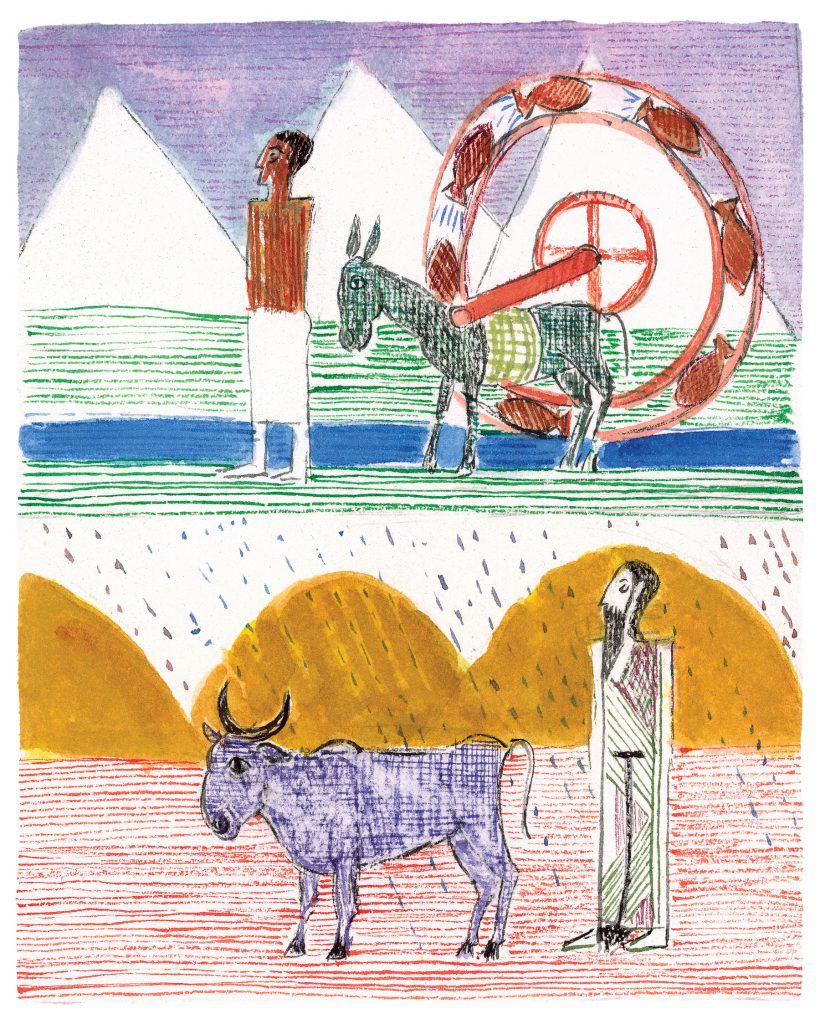
Avner Moriah’s illustration for this chapter hints at some answers. The painting is divided into two parts. The upper image depicts a typical agricultural scene in Egypt. In the background white pyramids are set against dreamy pink skies. In the foreground we see the River Nile, pictured as a blue strip, with green fields along both its banks. A scantily clad Egyptian farmer is standing at the bank near a donkey harnessed to a wheel that is used to pump water from the river. This scene is a visual description of the Hebrew expression above about “the grain you sowed had to be watered by your own labors like a vegetable garden.”
The lower image visualizes a farm scene in the land of Canaan, with a background of yellow arid hills against cloudy white skies. We see an Israelite farmer, fully dressed in a striped gown, standing in a field behind an ox, holding what might be a shovel or a plow. Apparently the farmer has plowed and sown his field and is now looking in awe and gratitude at the sight of the falling rain, which will water his crops, ensuring a good yield for the coming year.
Comparing the two portrayals we can understand why Moses chose to contrast irrigation in Egypt with the way the Israelites will water their crops in Canaan. God’s rain is not to be taken for granted: “If, then, you obey the commandments that I enjoin upon you this day, loving the Lord your God and serving Him with all your heart and soul I will grant the rain for your land in season” (Deut. 11:13–14). Moses tells the people that their having to depend on God will open the way to forging a viable relationship with the Lord.
The Israelites’ reliance on rain will go far toward making them fully aware of their own limitations and appreciative of God’s care, which will afford them “a land which the Lord your God looks after, on which the Lord your God always keeps His eye from year’s beginning to year’s end” (Deut. 11:12).
Why did Moses compare Canaan with Egypt in speaking of the wonders of the Promised Land? What was his purpose in comparing a country that sits on the Nile and so has an abundance of water with the arid land of Canaan, where one has to depend on rain to water one’s fields? How does all this support the message Moses wanted to convey?
Avner Moriah’s illustration for this chapter hints at some answers. The painting is divided into two parts. The upper image depicts a typical agricultural scene in Egypt. In the background white pyramids are set against dreamy pink skies. In the foreground we see the River Nile, pictured as a blue strip, with green fields along both its banks. A scantily clad Egyptian farmer is standing at the bank near a donkey harnessed to a wheel that is used to pump water from the river. This scene is a visual description of the Hebrew expression above about “the grain you sowed had to be watered by your own labors like a vegetable garden.”
The lower image visualizes a farm scene in the land of Canaan, with a background of yellow arid hills against cloudy white skies. We see an Israelite farmer, fully dressed in a striped gown, standing in a field behind an ox, holding what might be a shovel or a plow. Apparently the farmer has plowed and sown his field and is now looking in awe and gratitude at the sight of the falling rain, which will water his crops, ensuring a good yield for the coming year.
Comparing the two portrayals we can understand why Moses chose to contrast irrigation in Egypt with the way the Israelites will water their crops in Canaan. God’s rain is not to be taken for granted: “If, then, you obey the commandments that I enjoin upon you this day, loving the Lord your God and serving Him with all your heart and soul I will grant the rain for your land in season” (Deut. 11:13–14). Moses tells the people that their having to depend on God will open the way to forging a viable relationship with the Lord.
The Israelites’ reliance on rain will go far toward making them fully aware of their own limitations and appreciative of God’s care, which will afford them “a land which the Lord your God looks after, on which the Lord your God always keeps His eye from year’s beginning to year’s end” (Deut. 11:12).
Avner Moriah is a prolific Israel artist who is illuminating the entire Chumash.
929 is the number of chapters in the Tanakh, the Hebrew Bible, the formative text of the Jewish heritage. It is also the name of a cutting-edge project dedicated to creating a global Jewish conversation anchored in the Hebrew Bible. 929 English invites Jews everywhere to read and study Tanakh, one chapter a day, Sunday through Thursday together with a website with creative readings and pluralistic interpretations, including audio and video, by a wide range of writers, artists, rabbis, educators, scholars, students and more. As an outgrowth of the web-based platform, 929 English also offers classes, pop-up lectures, events and across North America. We invite you to learn along with us and be part of our dynamic community.
To join 929's listserv for new and dynamic content each week click here
To join 929's listserv for new and dynamic content each week click here
