10 Cheshvan 5780 | November 8, 2019
Parshat Lech Lecha
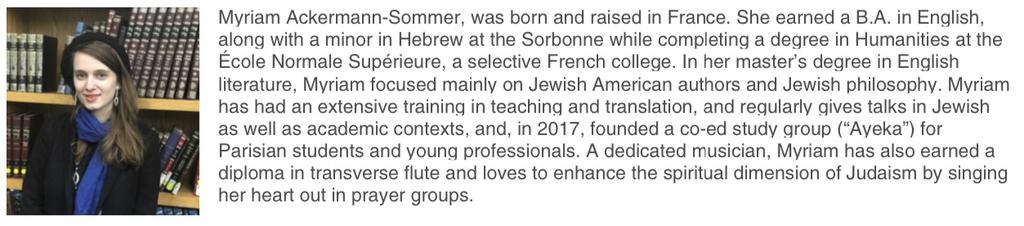
Myriam Ackermann Sommer
Class of 2023
“Lech lecha”: what a startling injunction to initiate the dialogue between Hashem and Avram! Indeed, this week’s parsha begins in medias res with Hashem’s command to the first Patriarch.
(1) Hashem said to Avram, “Go forth from your land, from where you were born and from your father’s house to the land that I will show you.”
This harsh command is usually understood as one of Avraham’s trials in his quest for Hashem. Yet, while some struggle with the content of the imperative itself, which seems to assert the necessity of leaving everything behind (in an order that reflects the increasing difficulty of the task: it is easier to leave one’s land than one’s birthplace, and one’s birthplace than one’s father’s house. See Or haChaim and the Tur on this pasuk for more insights on this striking gradation) so as to meet the terms of the alliance, I have always had a hard time with the “lecha” (literally “for you”) rather than with the “lech” (“go”). “Lecha”, as was highlighted by many a commentator, is somewhat grammatically redundant, as the imperative “lech” already mentions the second person: it is obvious that the intended addressee is Avram. “Lecha” thus lends itself to be interpreted as a meaningful allusion in its own right. Rashi (along with Radak, among others) famously read “lecha” as follows.
(א) לך לך. לַהֲנָאָתְךָ וּלְטוֹבָתְךָ, שָׁם אֶעֶשְׂךָ לְגוֹי גָדוֹל, כָּאן אִי אַתָּה זוֹכֶה לְבָנִים, וְעוֹד שֶׁאוֹדִיעַ טִבְעֲךָ בָּעוֹלָם:
(1) (Go for yourself) — for your own benefit, for your own good: there I will make of you a great nation while here you will not have the privilege of having children (Rosh Hashanah 16b). Furthermore, I shall make known your nature throughout the world (Midrash Tanchuma, Lech Lecha 3).
This pshat, however inspiring and reassuring, once sounded somewhat puzzling to me - perhaps even slightly disappointing. I used to think that it toned down the ordeal that the Patriarch was to experience, and the uprootedness that would result from it. In my mind, it was linked with other popular translations of “lech lecha” as an imperative to “find oneself” or “go (back) to oneself”, a model for personal growth urging us on a quest for our hidden, innermost selves. However, I wondered, is this really what the parsha is about? Are we to find ourselves by leaving behind everything that made us what we are today? If Hashem’s command was merely another “know thyself” akin to the maxim of the Temple at Delphi, why not look inward, to one’s land and one’s home, to find oneself, rather than outward? I disagreed with this feel-good reading of the injunction addressed to Avram, whereby we need only “go to ourselves” to find meaning in our lives. Rather, it is by turning to Hashem that Avram finds himself. It is the quintessential Other, and others, the people that we meet on the way, that make us who we are. We exist only in relation, and through the displacement and instability that relationships imply and make us experience.
Thus, this week’s parsha, it seemed to me, vividly expresses the disruption of identity as a process submitted to change and, to use an even more significant word, alteration (through the encounter with the alter, the Other, Hashem). This breach in the continuity of selfhood is epitomized by the adjunction of the "ה" in the names of Saraï/ Sarah and Avram/ Avraham (Gen. 17:5 and 17:15), which enacts this inscription of the Other at the heart of the self. One can never be the same after encountering Hashem - the Other, the commanding voice that displaces the self out of the safety of its home, that orders it out of its safe dwelling place. According to Jewish French thinker Emmanuel Levinas, whose works focus on the philosophical foundations of ethics, this impossibility to go back to where we used to be (at a geographical, but more importantly at an existential level) is what defines the specificity of Avraham’s journey. To highlight the uniqueness of the journey that Avraham Avinu undertakes, Levinas writes in “The Trace of the Other” (1963): “To the myth of Ulysses’ return to Ithaca I would like to oppose the story of Avraham, who leaves his homeland for a land yet unknown and forbids his servant to ever bring his own son back from whence he came”. Identity, in this regard, is not circular: to quote Whitman’s phrase it “launches men and women forward into the unknown”.
In the light of this suggestion, let us go back to the first word that Hashem addresses to Avram - “lech”. The “lech”, it seems, requires a movement beyond everything that made the individual what he or she was - one’s land, one’s place of birth, one’s family (what was familiar), beyond one’s geographical and spiritual situation, understood literally, as a “site”, a situatedness in terms of identity.
“Lech Lecha”: to leave behind the given, the stability and situatedness of everyday life to embark on a journey whose outcome rests on Hashem’s promise (“... to the land which I will show you”). There is no alliance or trust without running the risk of losing everything. Identity, in this new reading of the introductory injunction, is all about wandering into the unknown, led by a mere promise - not “to find yourself” again but rather “for your own benefit”. And this is how I now read Rashi’s illuminating comment: even though you feel that you are leaving a lot behind, you will find more in this journey that you could ever expect to find here in your homeland, where you feel comfortable. “Lech lecha”, or “lechi lech”: wander for your own good. Avraham and Sarah’s identity is always in the making, progressive, nomadic. This is emphasized by the Sforno’s reading of the end of the pasuk.
(א) אל הארץ אשר אראך אל המקום מהארץ אשר אראך אותה במראות אלקים לפיכך עבר בארץ ולא נטע אהלו עד המקום שנראה אליו שם האל יתברך...
(1) To the land that I will show you: to the place in the land that I will show you in a Godly vision. This is why [Avram] kept moving further into the land without pitching his tent to settle down until he reached the place that Hashem indicated him. (...)
Avraham and Sarah seem to be defined by this vision of identity in progress, whereby uprootedness also means openness. Openness not only to the voice of the Other, Hashem, but to that of others in general, the people that they met on their way out of Haran, these “souls which they made”, who are traditionally understood to refer to the converts, men and women, who met Sarah and Avraham (Genesis Rabba 39:14). “Lech lecha” also makes sense in this regard: "ועוד שאודיע טבעך בעולם," Rashi adds, “I shall make known your nature, your character in the world”. You will become a beacon for others as you go out of your way (literally) to greet them and welcome them into your life.
One last comment on this matter. Avraham and Sarah are known for their characters, but also, almost metonymically, for their dwellings. The tent, the “ohel”, seems to encapsulate this tension between stability and motion, between inwardness and outwardness, and between privacy and openness, through which identity as process can unravel through time and through meaningful encounters with the outside world. Hence Avraham’s position in the beginning of the first pasuk of the following parsha, at a liminal place from where the other can be welcomed: "והוא יושב פתח-האוהל", and he was standing at the entrance of the tent” (Gen. 18:1). It is often said that Avraham was exceptionally hospitable, but even that is an understatement. Avraham Avinu, Rashi teaches us, was actually sitting at the tent-door purposefully, seeking people passing by the ohel to invite them in. May we learn from the middot of our Patriarchs and Matriarchs as we open our own tents and in turn get ready to start the mysterious journey that awaits us.