


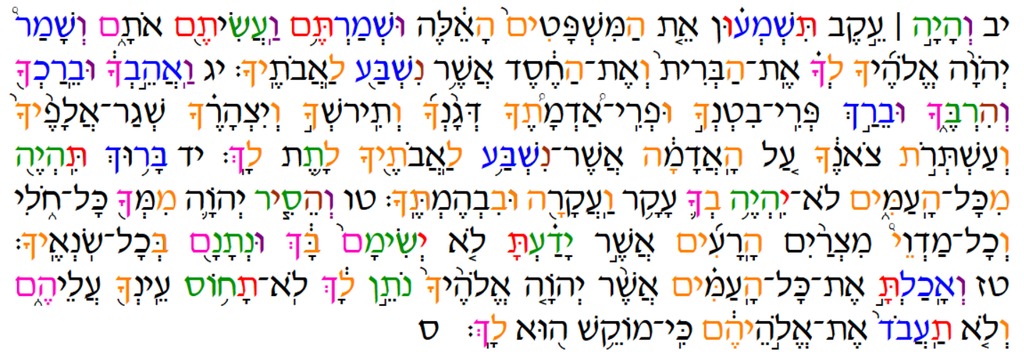
וְהָיָה עֵקֶב תִּשְׁמְעוּן אֵת הַמִּשְׁפָּטִים הָאֵלֶּה וּשְׁמַרְתֶּם וַעֲשִׂיתֶם אֹתָם וְשָׁמַר יְהֹוָה אֱלֹהֶיךָ לְךָ אֶת־הַבְּרִית וְאֶת־הַחֶסֶד אֲשֶׁר נִשְׁבַּע לַאֲבֹתֶיךָ׃ וַאֲהֵבְךָ וּבֵרַכְךָ וְהִרְבֶּךָ וּבֵרַךְ פְּרִי־בִטְנְךָ וּפְרִי־אַדְמָתֶךָ דְּגָנְךָ וְתִירֹשְׁךָ וְיִצְהָרֶךָ שְׁגַר־אֲלָפֶיךָ וְעַשְׁתְּרֹת צֹאנֶךָ עַל הָאֲדָמָה אֲשֶׁר־נִשְׁבַּע לַאֲבֹתֶיךָ לָתֶת לָךְ׃ בָּרוּךְ תִּהְיֶה מִכׇּל־הָעַמִּים לֹא־יִהְיֶה בְךָ עָקָר וַעֲקָרָה וּבִבְהֶמְתֶּךָ׃ וְהֵסִיר יְהֹוָה מִמְּךָ כׇּל־חֹלִי וְכׇל־מַדְוֵי מִצְרַיִם הָרָעִים אֲשֶׁר יָדַעְתָּ לֹא יְשִׂימָם בָּךְ וּנְתָנָם בְּכׇל־שֹׂנְאֶיךָ׃ וְאָכַלְתָּ אֶת־כׇּל־הָעַמִּים אֲשֶׁר יְהֹוָה אֱלֹהֶיךָ נֹתֵן לָךְ לֹא־תָחוֹס עֵינְךָ עֲלֵיהֶם וְלֹא תַעֲבֹד אֶת־אֱלֹהֵיהֶם כִּי־מוֹקֵשׁ הוּא לָךְ׃ {ס}
Specific Mishpatim and why not Chukin
Order of 3 Actions
Lecha Sing vs begin Plural
Brit VS Chesed - totally different.
Brit = Contract vs Chesed = Beyond the Contract
- Mishpatin (civil laws) vs also Chukim
- Why "Guard" vs Upload/Remember/Implement. Guard - Active Defense.
- Eikev - HEAL (birth of Yaakov) vs אם. "It will follow on the HEALS" - Cause and Effect. EIKEV - Reward/Compensation. END - Ikvot DeMashichah- Reward "follows on the heals" of a Good DEED. HEAL - last generation, least sensitive (walking on hot coals) and yet most sensitive to tickling (shallow external stimulation- generation of "sound bite"). Tickle of the Feather on the Foot.
- Reward Mechanism - Torah is the Contract - Hashem says, "If you do this then you will receive that". Cause & Effect. Business Contract - Rights & Obligations - get check at the end of the month. VS וְשָׁמַר יְהֹוָה אֱלֹהֶיךָ לְךָ אֶת־הַבְּרִית וְאֶת־הַחֶסֶד אֲשֶׁר נִשְׁבַּע לַאֲבֹתֶיךָ. "Hashem will Guard for you the Covenant and the Kindness that he Swore to your Fore Fathers". Difference - 1) Safe Guard vs Implement 2) "Kindness" (beyond what is agreed, Bonus "clause") what does this have to do with an OATH. ONE HAND - Reward is dependent on OUR OWN Actions (begining of the posuk) VS OTHER HAND (end of posuk) - reward is dependent on 1) Covenant 2) Kindness 3) Swore to our Fore Fathers.
- Why does Hashem need to take an OATH vs simply "Say". Hashem does not break "His Promises".
יב
Why use the word עקב here?
Seems there are 3 ways to get the reward described
1. תשמעון
2. ישמרתם
3. ועשיתם
Why are these verbs split? Why are they all necessary?
What is the the חסד described here which was to the Avos?
יג
As a result of listening etc. Then the Hashem will
1. Love
2. Bless
3. Increase
What is the result of his love? What is the generic וברכך if this isn't the increasing? (in Bereishis the first brocha we see is in relation to פרו ורבו)
The remaining details seem to be the elaboration of the general statements before?
These seem to be limited to being applicable in ארץ ישראל?
יד
Would have thought that not being barren would be the included in the brocha explained in the previous passuk?
טו
Is this brocha the love described above?
טז
What is the link between this passuk and the previous ones relating the brocha?
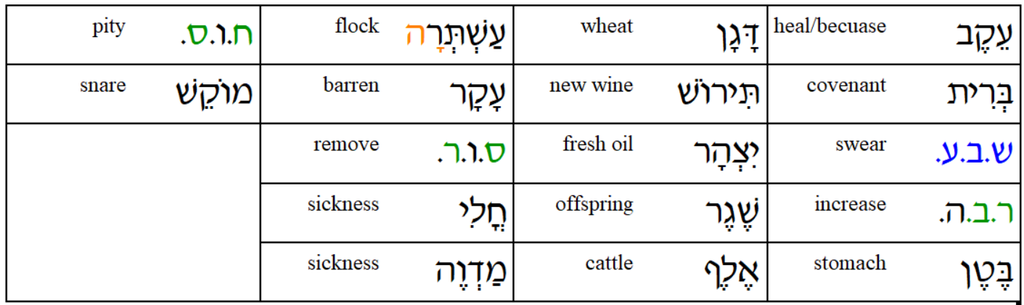
עֵקֶב "heal/if/because/reward" - Why not use the regular word of אם "if" instead of עֵקֶב?
תִּשְׁמְעוּן "you (m.p.) will listen - What is the significance of תִּשְׁמְעוּן " (listen) and what is the extra ן at the end of the word?
הַמִּשְׁפָּטִים "the laws" - Why only mention הַמִּשְׁפָּטִים "the logical laws", what about the other 2 categories of חוקים and מצות.
הָאֵלֶּה "these" - What are these "laws" and why limit it to only "these" laws? Why is the word הָאֵלֶּה in the middle of the תִּשְׁמְעוּן and וּשְׁמַרְתֶּם וַעֲשִׂיתֶם and not at the end of 3 verbs.
וּשְׁמַרְתֶּם וַעֲשִׂיתֶם "and you will guard and do" - What is the meaning of these 2 verbs?
וְשָׁמַר "and he will guard" - Why does Hashem need to specifically "Guard/Protect" the Covenant & the Kindness if He has already Sworn it to our Fore Fathers?
לְךָ "to you m.s." - In the beginning of the posuk it speaks about YOU Plural now it speaks about YOU Singular?
הַבְּרִית "the covenant" - What "covenant" did Hashem make with the Fore Fathers? What is the nature of a covenant?
הַחֶסֶד "the kindness" - What is the need of the addition of "Kindness" beyond the "Covenant"?
נִשְׁבַּע לַאֲבֹתֶיךָ "He swore to your Fathers" - What exactly did "Hashem Swear" to our Fore Fathers?
והיה עקב תשמעון. אִם הַמִּצְווֹת קַלּוֹת שֶׁאָדָם דָּשׁ בַּעֲקֵבָיו תשמעון.
ושמר ה' וגו'. יִשְׁמֹר לְךָ הַבְטָחָתוֹ (עי' תנחומא):
אם המצות הקלות כו'. רצונו לתרץ, מה דכתיב עקב שהוא לשון יען משמע דודאי הוא שישמעו אל המצות, כמו באברהם דכתיב (בראשית כו ה) עקב אשר שמע בקולי וגו', והתם קאי אדבר שהוא ודאי, דהא אברהם שמע בקולו ורצה לשחוט את בנו, אם כן כאן נמי משמע שודאי הוא שישמעו, והא אמרינן (מגילה כה.) הכל בידי שמים חוץ מיראת שמים. ועל זה פי' דלשון עקב היינו המצות הקלות וכו', כלומר שאינן חשובים בעיני אדם לקבל עליהם מתן שכר גדול. לכך נקט רש"י נמי אם המצות קלות, ר"ל דלאו ודאי הוא. ומפני שפירש משפטים פה הן המצות בכלל, לא דיני ממונות בייחוד, כי לא הוזכרו פה, ואיך יאמר האלה. לכן החליף המשפטים במצות. [רא"ם]: אי נמי דקשה לי', דהי' לו לומר והיה אם תשמעון את המשפטים, כמו שכתוב בפר' כי תבא (להלן כח א) והי' אם שמוע תשמע, והי' אם לא תשמע (שם טו). אלא להכי כתיב עקב, ר"ל המצות הקלות וכו':
ישמור לך הבטחתו. ר"ל מה דכתיב ושמר וגו' משמע לשמור השבועה וכו', מהיכא תיתי שלא יקיים השבועה. לכן פירש ישמור הבטחת הברית. ופי' ישמור במקום ושמר, להורות שאין הוי"ו וי"ו החיבור אלא וי"ו ההיפוך, שמהפך העבר לעתיד:
והיה עקב תשמעון וגו'. צריך לדעת אומרו והיה מה יהיה, אם השמירה שהוא אומר בסמוך, לא היה צ''ל אלא עקב תשמעון ושמר, ומה צורך בתיבת והיה, עוד צריך לדעת אומרו עקב ולא אמר אם תשמעון כדרך אומרו (ויקרא כ''ו ג') אם בחקותי, ורבותינו ז''ל דרשו (תנחומא) אם מצות שהאדם דש בעקביו תשמעון, וזה דרך דרש.
ויתבאר על דרך אומרם ז''ל (ב''ר פ' מ''ב) אין והיה אלא שמחה, והנה אדון הנביאים בא בנועם דבריו להעיר במוסר נעים כי אין לאדם לשמוח אלא כשישמור לעשות את כל אשר צוה ה' לעשו' אז ישמח לבו ויגל כבודו, אבל כל עוד שיחוש שחסר אחת מכל מצות ה' בין מצות לא תעשה בין מצות עשה עליו אמר שלמה (קהלת ב') ולשמחה מה זה עושה, והוא אומרו והיה שמחה תהיה לך עקב תשמעון פירוש עקב הוא סוף ותכלית, כדרך שמצינו שישתמשו חז''ל בלשון זה בלשון המשנה (סוטה מ''ט:) בעקבות משיחא וכו' כי בגמר זמן ביאתו יקרא עקבות, כמו כן אמר עקב תשמעון את המשפטים ושמרתם ועשיתם אז הוא זמן השמחה וכל שלא הגיע לזה אין לו מקום לשמוח וכמאמר חסידי ישראל (חובת הלבבות שער הפרישות פ''ד) שהפרוש אבלו בלבו וצהלתו בפניו, כי אין נכון לשמוח מי שהוא עתיד לעמוד בבושה וכלימה לפני מלך הגדול ואין צריך לומר מי שמחויב ראשו למלך, וכפי זה שיעור עקב הוא סוף שמיעת כל המשפטים:
עוד נתכוון לומר שאין שמחה לאיש אלא בסוף השמיעה, וכל עוד שלא גמר אדם עבודתו לא יאמין בצדקות מעשיו על דרך אומרו (איוב ט''ו) הן בקדושיו לא יאמין:
עוד נתכוין שצריך שילמוד התורה בשמחה ולא בעצבון כי דברי תורה אסורין לאבל (יור''ד סי' שפ''ד):
עוד רמז על דרך אומרו (תהלים י''ט) פקודי ה' ישרים משמחי לב, והוא אומרו והיה השמחה תהיה עקב תשמעון, ופירוש עקב שכר עסק התורה תשמחהו, והוא מה שרמז התנא באומרו (אבות פ''ד) מצוה גוררת מצוה וכו' ששכר מצוה מצוה שהיא השמחה:
עוד רמז למה שאמרו בספר הזוהר (ח''ג רי''ג) וז''ל דלית חדוותא קמי קב''ה כשעתא דישראל משתדלי באורייתא, והוא אומרו והיה סתם שמחה כללית למלא עולם וכשהוא שמח כל העולם בשמחה וששון עקב תשמעון וגו', ורמז בתיבת עקב מדת התורה שיהיה אדם הולך עקב לצד גודל בענוה ושפלות ואז ישכיל לשמוע בלימודים והוא אומרו תשמעון גם בכנוי לנשמעים לומר שבאמצעות שאדם משים עצמו כעקבים יתגלו לו ויבין סתרי תורה:
ואפשר שרמז באות הנו''ן שישיג ויבין חמשים שערי בינה ולדרך זה גזירת הכתוב היא תשמעון שאם ישיג מדרגת הענוה ישיג לשמוע דברי תורה ואומרו ושמרתם וגו' פירוש שעל ידי השכלה בתורה ישיג לשמור ולעשות שהתורה מגנא ומצלא מן החטא שהיא השמירה גם מביאה לידי קיום המצות שהוא המעשה:
ושמר וגו'. אומרו בתוספת וא''ו, ולפי משמעות הכתוב הוא גזרת הדבור והיה צריך לומר ישמור ה' וגו', ולפי מה שפירשתי בפסוק שלפני זה לאחד מהדרכים שהגזרה היא עקב, ולא' מהדרכים הגזרה היא תשמעון יבוא על נכון אומרו ושמר בתוספת וא''ו:
לך את הברית וגו'. קשה שמדבריו כאן משמע שאחר שישמעו וישמרו ויעשו כל המשפטים בזה יזכו לשמור להם הבטחתו, וממה שאמר בפרשה זו עצמה (ט' ה') לא בצדקתך וגו' כי ברשעת וגו' ולמען הקים וגו' זה יגיד שהגם שאין להם צדקה בהכרח שיקיים ה' את השבועה וזה לך האות כי לא בצדקתו בא וירש מה שירש, ואולי כי כניסתם לארץ היתה בשביל שבועת האבות ותנאי הוא הדבר אם ישמרו ויעשו ישמור ה' המתנה לעולם ועד, והוא אומרו כאן ושמר ה', ואם לא ישמרו תהיה קיום השבועה בזמן המועט שנכנסו לארץ וישלחם לנפשם:
עוד יתבאר על זה הדרך לפי שהבטחת אברהם מצינו שאמר לו שני הבטחות א' להוציאם ממצרים ויביאם אל ארץ כנען דכתיב (בראשית ט''ו י''ד) ואחרי כן יצאו ברכוש גדול ודור רביעי ישובו הנה, ב' לתת לו מנהר מצרים עד נהר פרת ועשרה אומות, והן עתה הגם שלא היו צדיקים כמצטרך כאומרו לא בצדקתך וגו' אף על פי כן קיים ה' לבניהם הבטחה ראשונה שהוציאם ממצרים והביאם אל הארץ והנחילם שיעור המספיק, והלא תמצא שאפילו שיעור הצריך להם לא נחלו שהרי בני יוסף עומדים וצווחים שלא הספיקם נחלתם (יהושע י''ז), הדי שעדיין לא הגיעה לידם הבטחת מנהר מצרים עד נהר פרת ועשרה אומות, לזה אמר משה עקב תשמעון וגו' ושמר ה' וגו' את הברית וגו' פירוש לתת מנהר מצרים ועשרה אומות בשלימות:
או אפשר לומר כי על ז' אומות אומר את הברית ועל תשלום העשרה הוא אומר ואת החסד, כי מתנת הג' הוא חסד מופלא שהם מלבד ארץ כנען, והמשכיל על דבר יראה כי הם כללות רוב העולם כי אדום עמון ומואב הם פינה גדולה, ומה גם לדבריהם ז''ל (יומא י':) שאמרו עתידה מלכות אדום שתתפשט בכל העולם, מעתה יש במתנה זו כל העולם בכלל וחסד מופלג יקרא ועליו הוא אומר ואת החסד, ותדע שכן הוא שהרי עדיין לא זכו ישראל להבטחה הנזכרת ואותה אנו מבקשים ומצפים להנחיל עליון לנו גוים רבים:
עוד ירצה על זה הדרך עקב תשמעון וגו' לא תצטרכו לזכות בטוב ה' ובחסדו מצד שבועת האבות אלא תזכו מצד עצמיכם לשמור ה' לכם הברית וגו' שנשבע לאבותיכם, כי אינו דומה הבא לזכות בשביל עצמו כמו לזכות בשביל אבותיו, והוא שדקדק לומר לך את הברית ולא אמר ושמר לך ה' אלהיך וגו' שנתכוון להסמיך תיבת לך עם תיבת הברית להעירך לדברינו, ולדרך זה אומרו ושמר פירוש שכל הבטחות ה' ואין צריך לומר בריתו הם בטוחים ושמורים לעולם ועד, ודברים אלו כנים הם שהלא אברהם זכה לכל הכבוד לצד מעשיו, ואם ישראל ישמרו תורת ה' למה יגרעו לבא בכח זכות אבות ואדרבא שלהם גדול משל אבותיהם כי הם עמדו על הר סיני וגם היותם מצווים בתורה ובמצות מה שאין כן האבות שלא נתנה להם התורה, ומעתה גדול כח הבנים כשיטיבו מעשיהם מכח האבות:
And the commentators have said that the meaning of the word eikev is that “in the end” there will be reward. Similarly, in keeping them [the ordinances of G-d] ‘eikev rav’ (there is [in the end] great reward). The verse here is thus stating: “and the end [the ultimate consequence] of your hearkening to the ordinances and your observing them is that G-d shall keep the covenant and the mercy, and He will love thee. ” This is correct, for in the Sacred Language the beginning of anything is called rosh [literally: “head”], as it is said, ‘rosh’ (the beginning of) Thy word is truth. So also is the leader of the generation called “the head of the people,” and the best of spices is called rosh. Similarly, the conclusion of any matter is called akeiv (heel) as the Sacred Language adopts these figurative expressions from the human body; and thus “the head” is the beginning while “the heel” is the conclusion and end of the body. Scripture also speaks of the head and the tail [with reference to people], figuratively using the body of the animal.
And Onkelos rendered the word eikev as chalaf (“in exchange for”), like ‘cheilef’ (in return for) your service. Onkelos thus made it an expression of “roundabout” [the end result of a series of events], derived from the verse, and ‘he’akov (the crooked) shall be made straight — that is, the circuitous road which goes roundabout [will become a straight, level path]. So also ‘akubah’ of blood means “it is surrounded and encircled” [with blood]. The verse here is thus stating [according to Onkelos]: “and it shall come to pass that the effect caused by your hearkening to the ordinances and your performing them will be that G-d will keep His covenant with you.” He has explained it well. A similar expression is ‘biglal’ (for the sake of) this thing which means “on account of,” from the word ‘v’gal’lu’ (and they roll) the stone. Similarly it is my opinion that every expression of akeivah is a term denoting “circle” or “circuit.” Thus: ‘akov haleiv’ (the heart is deceitful); ‘vaya’akveini’ (and he hath gotten the better of me) these two times; but Jehu did it ‘b’akbah’ (in subtlety) — all these being expressions of “rolling” and “circling.” Therefore they called Jacob “Jeshurun” [from the root yashar (straight and upright)] because the opposite of “the deceitful one” is he who is “upright” [as indicated by the name “Jeshurun”]. Similarly, the end-part of the foot, called akeiv — as it is said, and his hand seizing ‘ba’akeiv (the heel) of Esau — is so called because of its roundness, just as the [Sacred] Language calls the middle part [palm and sole] of the hand and foot kapoth, because of their being shaped like golden kapoth (spoons). This usage [of the term akeiv] is common in the [Sacred] Language, just as the Rabbis have said in the Sifre: “At His right hand was a fiery law unto them. When the word came forth from the mouth of the Holy One, blessed be He, it would go by way of the right hand of the Holy One to the left of Israel, v’okeiv (and it encircled) the camp of Israel twelve miles by twelve miles.” So also is the expression: “they come upon him ba’akifin,” meaning “with circuitous and subtle arguments,” like the word akeivin as these two letters [the veth and the fei] were considered by the Sages to be interchangeable, as I have already explained.
He mentioned these ordinances in order to warn exceedingly concerning the ordinances [i.e., judgments], for it is impossible that of a large nation, everyone be heedful of all commandments so as not to transgress any of them, and it is only through the judgments [of the court] that they establish [the firm authority of] the Torah, just as it says of them, and all Israel shall hear, and fear. Moreover, many people will have pity [and refrain from] stoning a man or burning him after the transgression had been committed, as it is said, Thine eye shall not pity him. Then also they might fear the mighty ones as well as those who lead astray, as it is said, ye shall not be afraid of the face of any man, for the judgment is G-d’s, and in the case of the false prophet it says, thou shalt not be afraid of him. He mentioned all these in the case of an inciter [to worship idols] saying, thou shalt not consent unto him, nor hearken unto him; neither shalt thine eye pity him, neither shalt thou spare, neither shalt thou conceal him, warning nor hearken unto him because of his misleading [you], neither shalt thine eye pity him because of the pity that compassionate people show towards the condemned, and neither shalt thou conceal him by remaining silent [and not presenting testimony against him] because of his might and fear of members of his family.
In order not to create the impression that מצות מושכלות performed היום i.e. in this life, will not be rewarded at all in this life, Moses wrote our verse here to stress that even those commandments will entitle the people performing them to a measure of reward including זיו השכינה, “a certain divine illumination.”
There is yet another lesson, a moral one, in the choice of the word עקב by Moses at this juncture. There are commandments which man does not take seriously, tramples under foot, so to speak with his עקב, his heel. The Torah warns us not to do this as we would miss out on the reward for the meticulous performance of those commandments. Our sages warned us of the punishment for the neglect of just those commandments. We are told in Avodah Zarah 18, based on Psalms 49,6 עון עקבי יסובני, “the guilt of my heels which surrounds me,” that the psalmist has in mind these very commandments which we neglect as not worth our while to pay attention to. Another meaning of that verse is that David refers to the kind of commandments which require from us that we walk toward them, situations which we have to create in order to perform the commandments in question. They include such duties as attending funerals, walking to the synagogue to participate in communal prayer, visiting the sick, etc. The reward for such commandments is especially great as the performance of these mitzvot entails that we extend ourselves. Our sages in Berachot 6 who have taught us that on the Sabbath one does not run or make big steps, have nevertheless suspended this rule for people who run to the synagogue.
If one does not fulfill the commandments requiring this use of one’s feet and one’s heels one will be held accountable for this on the day of Judgment after death. Hoseah 11,10 who writes: “the Lord will roar like a lion and they shall march behind Him,” refers to people being allowed to run to the synagogue on the Sabbath.
Naturally, if one is held accountable for merely not running or walking toward the opportunity to fulfill a commandment, if one rums toward an opportunity to commit a sin one will be held doubly accountable. Not only will one be punished for the commission of the sin, but separately for the effort made to enable one to commit it. We are told that the daughter of Rabbi Chaninah ben Tradyon was condemned to sit in the company of whores as she had walked with an arrogant gait in front of the noble senators of Rome after she had heard the scholars comment on her beautiful legs. She accepted the sentence by acknowledging that G’d had punished her in accordance with Jeremiah 3,19: “wondrous in purpose and mighty in deed, whose eyes observe all the ways of men, so as to repay every man according to his ways.” We learn from this that even the manner in which we walk (and our purpose in walking in such a manner) is something we are held accountable for. All of this is included in the words והיה עקב תשמעון. A Midrashic approach (based on Devarim Rabbah Lieberman edition page 76) the word עקב teaches that the righteous are rewarded only at the end of their career on earth, whereas the wicked are repaid immediately for any good deeds they perform. This is the real meaning of ומשלם לשונאיו אל פניו, “and He repays immediately (for the good deeds) those who hate Him.” On the other hand: ואחריו כל ישרי לב (Psalms 94,15) “and after him (his life) all those who were of an upright heart.”
(ירושלמי קדושין פ"א ה"א)