24 Cheshvan 5780 | November 22, 2019
Parshat Vayera
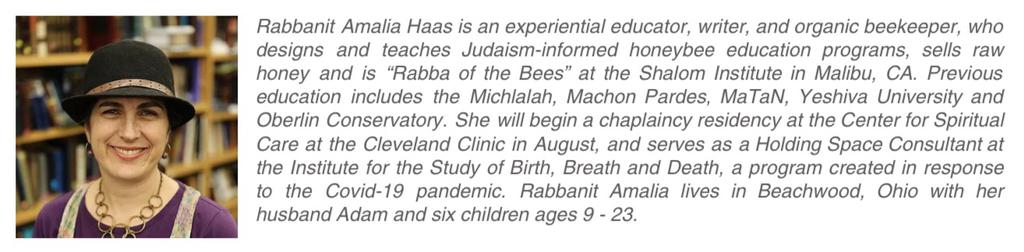
Rabbanit Amalia Haas
Class of 2020
In Parshat Vayera, the mitzvot of Bikur Cholim (God visits Avraham as he recuperates) and Hachnasat Orchim (Avraham rushes to welcome and care for three angels) occur right next to each other (Breishit 18:1-2). According to the midrash, Avraham Avinu is on day three of healing from the brit milah, from the circumcision he carried out on himself. We are told that day three is the crescendo of pain experienced from the brit, and yet Avraham is positioned at the entrance of his and Sarah’s tent looking for potential guests. Many sources view this as an unusual trait in Avraham. Without in any way diminishing the greatness of Avraham’s desire to perform hospitality, I would suggest that the sick in particular have much to teach us about true hospitality and what it means to התהלך לפני והיה תמים, walk mindfully before God and make oneself tamim - simple.
This fall I enrolled in CPE - Chaplaincy Pastoral Education - at the Cleveland Clinic. If you are familiar with medical residency, CPE is similar. From day one you put on a Chaplain I.D., and voila - you are viewed as a Chaplain. Sent to families who have just lost a loved one, those who have received bad news, and those who are actively dying, the expectation is that you know what you are doing. The approach is: swim as best you can, we’ll perfect your strokes later.
‘Later,’ it turns out, is every Wednesday from eight in the morning to four in the afternoon. Guided by our educator, an Episcopalian priest, four chaplains in training (a Caribbean Seventh Day Adventist, a Nigerian Anglican priest, a tenth generation Ohioan Methodist, and myself) engage in a process dubbed The Verbatim. Verbatims are numbered transcripts of each of our efforts at patient care. Doctors, think of the M&M, the confidential Morbidity and Mortality meetings where care attempts that went wrong are analyzed. We act out the scripts, and then our peers question our approaches, note our failures, biases, and improvements.
Participating in this system of giving and receiving critique week after week soon brings alive everyone’s unresolved family of origin issues - which is exactly the point. We bring our family of origin relationships everywhere - including into our patients’ rooms, when they are at their most vulnerable. If we do not heal and grow our awareness of what we carry into those rooms, our own unfinished work can interfere with the healing of our patients. We must learn to listen as God listens to Yishmael in Breishit 21:17: כי-שמע אלוקים אל-קול הנער באשר הוא שם, for God hears the boy’s voice where he is,” understood by Rashi to mean: just as he is now. God sees, listens, and hears the boy’s feelings just as they are, at this time. As if to say, ‘any and all feelings and needs are welcome. Right now, being Yishmael feels just like this.’
Early in CPE training, it was pointed out that patients generally have no say over who enters their room and over most of what is done to them. Nurses take blood, doctors wake patients during rounds, there are dozens of daily unsolicited visits, pokes and prods. A chaplain, however, provides a patient with the opportunity to accept or refuse a visit. We knock, ask permission to enter. If welcomed, we treat the patient’s room as their ohel - their tent. Yes, we are visiting the sick. But we are also receiving Hachnassat Orchim.
This hospitality goes beyond the choleh welcoming us into their space, however. Illness renders us vulnerable, it makes us feel helpless. If the words of Devarim 10:16 “Circumcise your hearts” ומלתם את ערלת לבבכם, are understood by Rashi as commanding us to remove the closure that covers our hearts and prevents God’s words from entering, the sick are shifted into an open-hearted state not by choice. We open to what Levinas calls the Other, to what the Sufis call the Friend. The rush of daily life that dulls us to the significance of every moment falls away against the backdrop of illness. Our hearts circumcised, we are attuned to time moment by moment, to the true preciousness of our loved ones’ faces, as we struggle in the face of pain and face our mortality. Even families of the sick have a heightened perception of the real value of time. Many adult children sitting by their ailing parents’ bedsides have asked me, “Do you still have your parents? Go see them!”
By placing Bikur Cholim and Hachnasat Orchim side by side, the text suggests that hospitality is more than feeding and opening our homes, although of course it is those too. True hospitality is something the seriously ill can teach us about if we are willing, like Avraham, to circumcise our hearts. Hospitality is about having a heart like an open tent, one that can welcome and find connection to a stranger. In the words of researcher Brene Brown: “Vulnerability is not weakness. I define vulnerability as emotional risk, exposure, uncertainty. I’ve come to the belief that vulnerability is our most accurate measurement of courage - to be vulnerable, to let ourselves be seen, to be honest.... Vulnerability is the birthplace of innovation, creativity and change.”
Yes, Avraham appears to ask God to wait while he tends to his guests. But he sees in the angels the presence of the One and thus is not really turning away from God. And we, when we are present with the weak and the ill among us, are also given the opportunity to know the numinous quality of Divine presence. To realize that what is extraordinary is the ordinary, and to awaken to the preciousness of time. Like Avraham, may we walk courageously in vulnerability and be tamim before God.