24 Cheshvan 5780 | November 22, 2019
Parshat Chayei Sarah
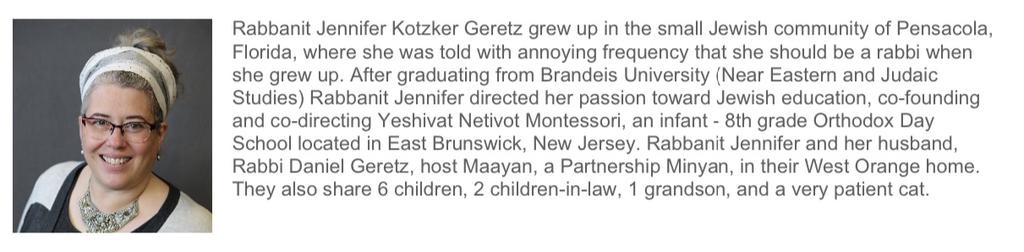
Rabbanit Jennifer Geretz
Class of 2020
Sarah “Imeinu,” “our mother,” was the first female Jewish ancestor, the wife and life partner of Abraham. As such, she provides an important model for women’s leadership, both in her time and today. Boca Raton Rebbetzin Yocheved Goldberg, in her Wednesday, November 13th , 2019 guest post on her husband’s blog (Wearing Many Hats: The Balancing Act of Today’s Rebbetzin) discusses some thoughts about Sarah after attending this year’s annual Rebbetzin Conference at Yeshiva University:
Rebbetzin Goldberg identifies Sarah Imeinu as “the world’s first rebbetzin,” and praises her for the service that she provides to others. One can nevertheless argue otherwise – in fact, Sarah’s selection by HaShem was not only due to her talents of service and self-effacement, but also as an equal partner to Avraham, a leader and prophet in her own right.
Sarah, famous for her hospitality, beauty and graciousness, was also a nevi’a, a female prophet. In his explanation of Genesis 21:12, Rashi explains clearly that Abraham’s ability as a navi was inferior to that of Sarah’s. Sarah’s life was full of deadly challenges. Having survived numerous ordeals including two kidnappings, extended infertility, and lengthy wandering, Sarah was finally defeated (according to the midrash) by despair over Abraham’s near sacrifice of their son, Yitzhak. Sarah’s death at the beginning of this week’s parsha brings to life God’s promise of the Land of Israel to Abraham and their children: Abraham purchases land for Sarah’s burial plot in what will become Eretz Yisrael.
The Torah gives us the awesome privilege of being able to see our patriarchs and matriarchs as whole people, faults intact. The meforshim make note not only of Sarah’s harsh treatment of Hagar, Yishmael’s mother, but also of her laughter upon hearing the news of Yitzhak’s impending conception and birth. (The commentators contrast Abraham’s joyous, accepting laughter with Sara’s mocking laughter of disbelief.) In spite of Sarah’s imperfections, God clearly finds her worthy of the ultimate veneration, being chosen as the primal mother of Am Yisrael.
Why was Sarah chosen for this role? Was she our first mother simply because she fulfilled her tasks as Abraham’s wife? Or was she selected as an independent human being, because of her abilities as a leader and prophet? How we think about this answer is important in a time when Jewish women struggle to understand our own identities and purposes. How we can best be worthy of honor? How do we best serve HaShem? As unique and distinct individuals, or through service to others?
A careful reader of Sarah’s narrative will note that her role changes from one of behind-the-scenes support to a more dynamic leadership and partnership with Abraham. This shift happens after what at first glance seems to be an ambiguous pasuk in the previous week’s parsha, Parshat Va’yeira. In Genesis Chapter 21, verse 1, we read:
(1) And HaShem “pakad” Sarah as He had promised, and HaShem did for Sarah as He had spoken.
The Shoresh “Pay” “Kuf” “Daled” is an interesting one. The usual translation of “pakad” is “taking note, paying attention to.” Rather than define this word, Rashi instead offers an interpretation of what “pakad” signifies – HaShem took note of Sarah, via her pregnancy, and caused her to conceive in spite of her previous infertility. Since this verse is followed immediately by the birth of Yitzhak, this interpretation has the virtue of being likely, especially when combined with a similar usage in Shmuel Aleph 2:21:
(כא) כִּֽי־פָקַ֤ד יקוק אֶת־חַנָּ֔ה וַתַּ֛הַר וַתֵּ֥לֶד שְׁלֹשָֽׁה־בָנִ֖ים וּשְׁתֵּ֣י בָנ֑וֹת וַיִּגְדַּ֛ל הַנַּ֥עַר שְׁמוּאֵ֖ל עִם־יקוק׃ {ס}
(21) For the LORD took note of Hannah; she conceived and bore three sons and two daughters. Young Samuel meanwhile grew up in the service of the LORD.
“Pakad” is used most frequently elsewhere in the Torah not to mean pregnancy, but rather “taking note” as part of a process of accounting or enrolling. For example, in Genesis 40:4, Yosef is “enrolled” in service to the chief steward. In Numbers 1:44, we read about the “pikudim,” the “enrollments,” of Moshe, Aaron, and the tribal leaders as they record the available battle-ready men of each tribe.
Accepting Rashi’s interpretation that Sarah’s pregnancy was a manifestation of her being taken note of, or enrolled, by God, in what process exactly has God enrolled her? How does Sarah’s role change via the use of the word “pakad” in this verse?
For our answer, we must go back a few steps in Sarah’s story. HaShem makes a covenant with Abraham alone. HaShem changes Sarah’s name from Sarai in conversation with Abraham rather than with Sarah herself. Even when the angelic messengers share the news that Abraham and Sarah will bear a child in their old age, Sarah overhears rather than being told directly – and the Torah describes her fright when her quiet response to herself is overheard. Yet, when HaShem “pakad” et Sarah, when He “notices” or “enrolls” her, things change. When God gives Sarah the task of giving birth to Yitzhak, Sarah comes out of the tent and uses her voice. She (spiritually) steps out from behind Abraham and comes to stand next to him.
Sarah says in Genesis 21:6: "ותאמר שרה צחק עשה לי אלוקים כל-השומע יצחק לי" – "And Sarah said: God has made me into a joke, for everyone who hears [about this birth] will laugh!" Her comment is notable in that it isn’t prefaced by anyone else’s words. Almost immediately after her original statement, she announces that Yishmael and Hagar have to leave because Yishmael is a poor spiritual and behavioral example for little Yitzhak. When Abraham balks at sending Yishmael and Hagar to their (likely) deaths out in the desert, God responds, somewhat astonishingly, in Genesis 21:12,
(יב) וַיֹּ֨אמֶר אֱלֹקִ֜ים אֶל־אַבְרָהָ֗ם אַל־יֵרַ֤ע בְּעֵינֶ֙יךָ֙ עַל־הַנַּ֣עַר וְעַל־אֲמָתֶ֔ךָ כֹּל֩ אֲשֶׁ֨ר תֹּאמַ֥ר אֵלֶ֛יךָ שָׂרָ֖ה שְׁמַ֣ע בְּקֹלָ֑הּ כִּ֣י בְיִצְחָ֔ק יִקָּרֵ֥א לְךָ֖ זָֽרַע׃
(12) But God said to Abraham, “Do not be distressed over the boy or your slave; whatever Sarah tells you, listen to her voice, for it is through Isaac that offspring shall be continued for you.
HaShem has now has “enrolled” Sarah as her own person, rather than simply as Abraham’s wife. She has transitioned from a supportive role into an equal partner in subsequent events.
Our original question, “Was Sarah chosen as the mother of Am Yisrael because of her position as Abraham’s wife, or because of her qualities as an independent person?” now gets the simple-yet-complicated answer of “Yes.” Sarah’s life took her through a desert search for God and her own identity. Sarah served Am Yisrael both quietly in the tent, via her support of others, and by standing proudly outside the tent, as an independent, strong leader with her own voice, wisdom, and power. In Sarah Imeinu lived the first Jewish wife, mother, rebbetzin, and rabbi. In Sarah’s merit, may we all be blessed to grow and inspire on our own journeys of self-actualization, service, and leadership.