


This sheet on Numbers 27 was written by Avner Moriah for 929 and can also be found here
Parashat Pinchas relates the story of the five daughters of Zelophehad and their appeal against the Jewish laws of inheritance. Israelite society was patriarchal, so when Zelophehad died without leaving sons to inherit, his portion would have been eliminated. His five daughters – Mahlah, Noah, Hoglah, Milkah, and Tirza – approached Moses and the chieftains contending that they, too, should have the right to inherit. Moses, in turn, asked God for a ruling, whereupon new inheritance laws were enacted establishing the right of daughters in a family with no sons to inherit their father’s land.
Are we to consider the daughters of Zelophehad an early model of the feminist struggle for equal rights? Or are we to understand that their real concern was only to perpetuate their father’s name? No doubt they displayed great courage in protesting the impending injustice, but reading their story as an ancient feminist episode may be a bit anachronistic. Avner Moriah’s thoughts in this regard are clear. By juxtaposing the stories of Zelophehad’s daughters and Ruth and Boaz, the artist is clearly suggesting that the daughters’ real concern was to maintain their family’s ancestral portion and to eternalize their father’s name.
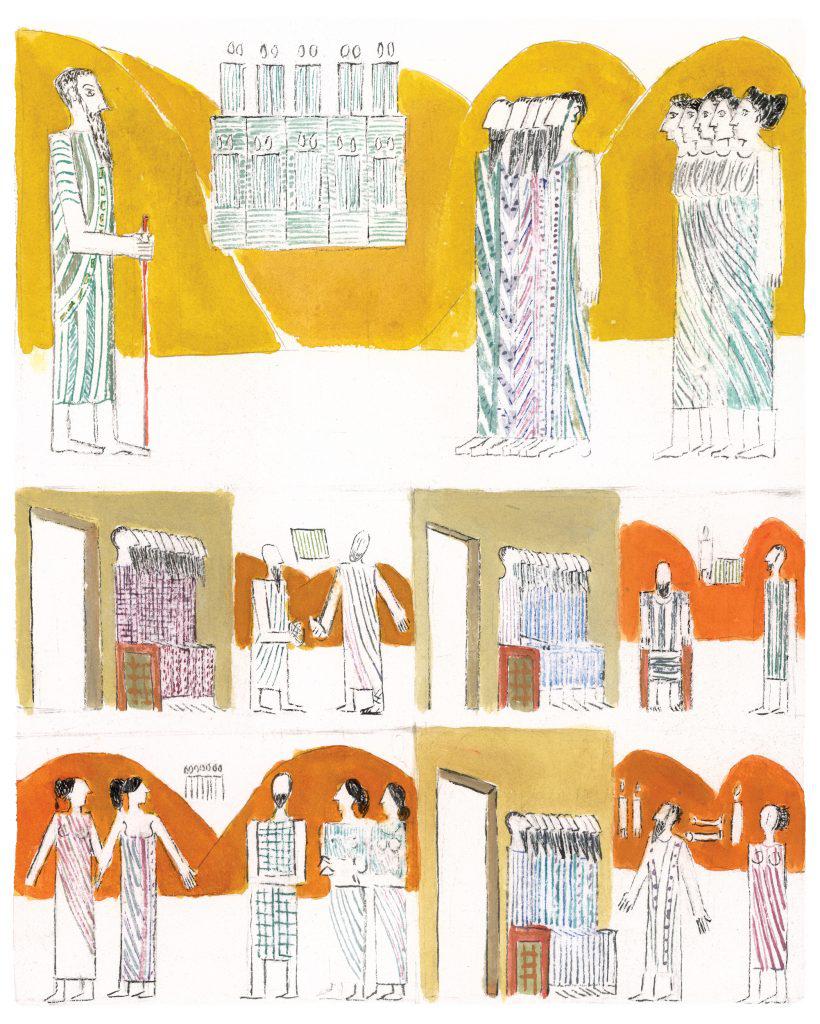
The painting is divided into three registers. On the top, we see Zelophehad’s five daughters standing together, figured with their eyes wide open, looking toward Moses, who is holding his staff. In front of the women are the chieftains, portrayed bearded but without facial features, their blank faces and their backs toward the daughters implying that they are not at all concerned with or sympathetic to their cause. In the space between Moses and the chieftains is an elevated minimalistic schematic scene of pairs of figures, some within a partial frame that resembles a marriage canopy and some above it. This curious inset alludes to a subsequent amendment to the laws of inheritance that precludes an ancestral portion being lost to the paternal tribe: “This is what the Lord has commanded concerning the daughters of Zelophehad: They may marry anyone they wish, provided they marry into a clan of their father’s tribe” (Num. 36:6).
The first scene on the right of the middle register visualizes a verse from the Book of Ruth: “Meanwhile Boaz had gone in the gate and sat down there. And now the redeemer whom Boaz had mentioned passed by. He calls, come over and sit down here” (Ruth 4:1). For Boaz to be allowed to marry Ruth, her redeemer (Naomi’s next of kin) must give up his rights to claim her and to buy her late husband’s and son’s lands. The next scene to the left depicts the required disclaiming ritual: “[For the act] of redemption or exchange to validate any transaction, one man would take off his sandal and hand it to the other” (Ruth 4:7).
In the lower register we see the wedding of Boaz and Ruth at the city gate in front of all the people, where Boaz declares: “I am also acquiring Ruth the Moabite, the wife of Mahlon, as my wife so as to perpetuate the name of the deceased upon his estate, that the name of the deceased may not disappear from his kinsmen…” (Ruth 4:10). The last scene on the left shows the birth of Ruth and Boaz’s child, who would keep the name of the deceased. Boaz words about the obligation to perpetuate the name of the deceased echoes the words of the daughters of Zelophehad, which strongly suggests their real concern: “Let not our father’s name be lost to his clan just because he had no son. Give us a holding among our father kinsmen” (Num. 27:4).
Are we to consider the daughters of Zelophehad an early model of the feminist struggle for equal rights? Or are we to understand that their real concern was only to perpetuate their father’s name? No doubt they displayed great courage in protesting the impending injustice, but reading their story as an ancient feminist episode may be a bit anachronistic. Avner Moriah’s thoughts in this regard are clear. By juxtaposing the stories of Zelophehad’s daughters and Ruth and Boaz, the artist is clearly suggesting that the daughters’ real concern was to maintain their family’s ancestral portion and to eternalize their father’s name.
The painting is divided into three registers. On the top, we see Zelophehad’s five daughters standing together, figured with their eyes wide open, looking toward Moses, who is holding his staff. In front of the women are the chieftains, portrayed bearded but without facial features, their blank faces and their backs toward the daughters implying that they are not at all concerned with or sympathetic to their cause. In the space between Moses and the chieftains is an elevated minimalistic schematic scene of pairs of figures, some within a partial frame that resembles a marriage canopy and some above it. This curious inset alludes to a subsequent amendment to the laws of inheritance that precludes an ancestral portion being lost to the paternal tribe: “This is what the Lord has commanded concerning the daughters of Zelophehad: They may marry anyone they wish, provided they marry into a clan of their father’s tribe” (Num. 36:6).
The first scene on the right of the middle register visualizes a verse from the Book of Ruth: “Meanwhile Boaz had gone in the gate and sat down there. And now the redeemer whom Boaz had mentioned passed by. He calls, come over and sit down here” (Ruth 4:1). For Boaz to be allowed to marry Ruth, her redeemer (Naomi’s next of kin) must give up his rights to claim her and to buy her late husband’s and son’s lands. The next scene to the left depicts the required disclaiming ritual: “[For the act] of redemption or exchange to validate any transaction, one man would take off his sandal and hand it to the other” (Ruth 4:7).
In the lower register we see the wedding of Boaz and Ruth at the city gate in front of all the people, where Boaz declares: “I am also acquiring Ruth the Moabite, the wife of Mahlon, as my wife so as to perpetuate the name of the deceased upon his estate, that the name of the deceased may not disappear from his kinsmen…” (Ruth 4:10). The last scene on the left shows the birth of Ruth and Boaz’s child, who would keep the name of the deceased. Boaz words about the obligation to perpetuate the name of the deceased echoes the words of the daughters of Zelophehad, which strongly suggests their real concern: “Let not our father’s name be lost to his clan just because he had no son. Give us a holding among our father kinsmen” (Num. 27:4).
Avner Moriah is a prolific Israel artist who is illuminating the entire Chumash.
Text by: Dr. Shulamit Laderman, who holds a PhD in Art History and has published extensively on Jewish and Christian influences on biblical interpretive illustration.
Text by: Dr. Shulamit Laderman, who holds a PhD in Art History and has published extensively on Jewish and Christian influences on biblical interpretive illustration.
929 is the number of chapters in the Tanakh, the Hebrew Bible, the formative text of the Jewish heritage. It is also the name of a cutting-edge project dedicated to creating a global Jewish conversation anchored in the Hebrew Bible. 929 English invites Jews everywhere to read and study Tanakh, one chapter a day, Sunday through Thursday together with a website with creative readings and pluralistic interpretations, including audio and video, by a wide range of writers, artists, rabbis, educators, scholars, students and more. As an outgrowth of the web-based platform, 929 English also offers classes, pop-up lectures, events and across North America. We invite you to learn along with us and be part of our dynamic community.
To join 929's listserv for new and dynamic content each week click here
To join 929's listserv for new and dynamic content each week click here
