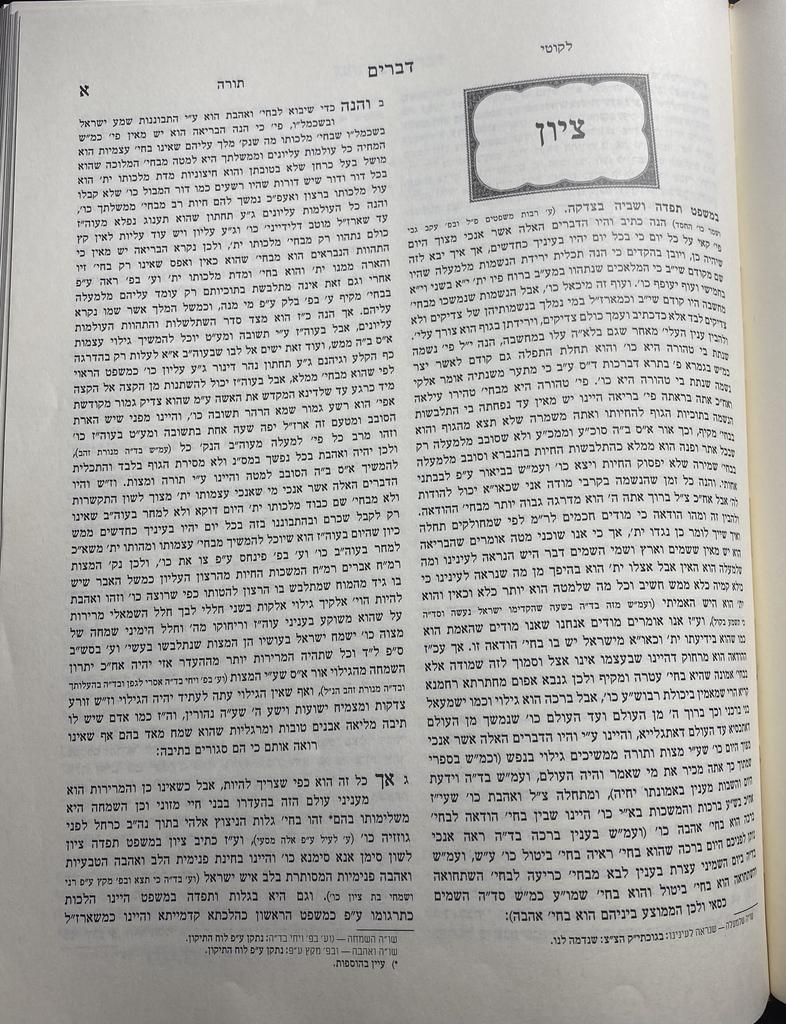
Parashat Devarim
from Likutei Torah by Rabbi Shneur Zalman of Liadi
Translation and Commentary by Rabbi Gedalia Potash and William Schecter, MD
This draft has neither been edited nor approved by Rabbi Potash
Friday July 16, 2021
The Elter Rebbe begins his discussion of Parashat Devarim by quoting the last Pasuk in this week’s HaTorah Portion (Isaiah 1:27): “Zion will be redeemed with justice, and those who return to her through righteousness”. This Haftorah is a harsh rebuke of the Jewish People by Isaiah read on the Shabat preceding the 9th day of Av but ends on the uplifting note just quoted. The Elter Rebbe then goes on to quote the second paragraph of the Shma: “And these words which I command you this day ….” which he interprets to mean that these words should be considered as new to you each day. He then asks how it is possible that these words, which we recite twice a day will appear as new each time we recite them. He explains that purpose of the descent of the souls, which are created in heaven prior to the creation of the universe is to transform the world and re-ascend towards their source in heaven (ירידה צורך עליה). The angels, he writes, were formed during creation by the breath of G-d, some say on the 2nd others on the 5th day of creation. But the souls (of man) which flowed down were first conceived by a thought (a G-dly thought) prior to creation. The Rabbis reject the concept that only the righteous are in G-d’s Kingdom by quoting another passage from Isaiah (Isaiah 60:21) “All of your people are righteous, (they will inherit the land forever) and so, the descent of their souls is for the purpose of re-ascent.
To further explore the issue of Ascent, the Elter Rebbe quotes the daily morning prayer: “Lord, the soul that you gave me is pure, you created it, you formed it, you breathed life into it, you guard it within me……”. The Rebbe points out that the soul is pure even prior to its creation and then quotes the Talmud (Masechet Brachot 60b) that one should recite this prayer immediately upon awakening. The Rebbe then questions the definition of purity and concludes that it represents the טהירו עילא (Tahiru Ilah) a Kabbalistic term for the eternal Divine light present prior to the creation of the universe ex nihilo. In other words, although it is said that the world was created ex nihilo (מאין ליש), this is not really true because the Divine represented by the Eternal Light (אור אין סוף ברוך הוא) has been, is and always will be present (הוא היה, הוא הוה, הוא יהיה). The creation of the soul then occurred when G-d breathed into it investing it within the material body to give it life.
The term “you guard it within me” alludes to the fact that the soul remains within the material body while the person is alive. The Elter Rebbe then states that the “guarding of the soul within the body” is an element of the concept of “מקיף” the G-dly presence from above surrounding all the worlds. Here he introduces two concepts: 1. Surrounding all the worlds (סובב כל העולמים—abbreviated as סוכ"ע) and 2. Filling all the worlds (ממלא כל העולמים—abbreviated as ממכ"ע)
Rabbi Potash explained that these are two very complex interrelated concepts of Divine energy active in the world. One external from on high surrounding and encompassing everything and the second infusing all things in the material world from within. Rabbi Potash used an example to simplify very complex concepts which we will explore in greater depth in the future. For now, we can think of concept 1 as a talent (such as music, art, dance, etc.) One has a thought and expresses that thought through a specific talent (G-d given). It is a specific act. Concept 2 can be compared to the feeling of love which is a very amorphous but powerful entity which can be expressed in many ways: e.g., by a simple act (giving a gift), poetry, music, emotion, physical acts, etc. It is hard to define but in a way is all encompassing. So, the guarding of the soul within the body referred to in the prayer, according to the Elter Rebbe, is one manifestation of concept 1.
The Rebbe analyzes the mistake we make when we consider creation ex nihilo. He does this by discussing the rest of the prayer alluded to above: “…You will guard it (the soul) within me, You will eventually take it from me only to return it to me in the time to come. And all the time that the soul is within me, I give thanks to You, the Lord my G-d, G-d of my fathers…. Blessed art Thou O Lord who returns souls to corpses.” The Elter Rebbe says that while each person can thank G-d, at the end of the Prayer it is necessary to bless G-d because this is a higher level of praise. To understand the word “praise”, we have to understand that we who dwell in this world talk about creation of the heavens and the earth ex nihilo because they are what we see. What is above the heavens and the earth, we call the void because we cannot perceive it. But for HaShem, the opposite is true. For G-d is the true reality and all of our experience in the lower material world is just a speck of the Divine experience.
And for this (creation) we say “We give thanks” (Modim …)
Comment: The word Modim, which we often translate as giving thanks (Todah) also means agree or admit, or give testimony. So, another way of interpreting this prayer is as follows.
We agree or admit that the Truth is in G-d’s Knowledge that each and everyone of the Jewish People has within him this attribute of thanks/agreement re: the Truth of G-d.
But with all of this, the “agreement” is given from a distance meaning that in essence it is not really close to one who agrees (testifies) rather in the agreement is based on faith which is the crown and encirclement from above of all the worlds. The Elter Rebbe now uses a famous anecdote in Aramaic to illustrate this point. Therefore, he says, “a thief standing at the opening of a cellar (who is about to steal something) prays to G-d for success in his endeavor” because he believes in the ability of G-d. He then goes on to quote the Talmud: But a blessing is a revelation and just as “Yishmael my son blessed me”
Comment: this seemingly strange reference refers not to Yishmael the son of Abraham but to Rabbi Yishmael ben Elisha. Here is the entire passage from Masechet Brachot page 7a:
"Similarly, it was taught in a baraita that Rabbi Yishmael ben Elisha, the High Priest, said: Once, on Yom Kippur, I entered the innermost sanctum, the Holy of Holies, to offer incense, and in a vision I saw Akatriel Ya, the Lord of Hosts, one of the names of God expressing His ultimate authority, seated upon a high and exalted throne (see Isaiah 6).
And He said to me: Yishmael, My son, bless Me.
I said to Him the prayer that God prays: “May it be Your will that Your mercy overcome Your anger,
and may Your mercy prevail over Your other attributes,
and may You act toward Your children with the attribute of mercy,
and may You enter before them beyond the letter of the law.”
and so “Blessed art Thou from the world and until the world etc.” (Psalm 106:48) which draws from the world of concealment to the world of revelation meaning that through “and these things which I command you this day etc. “(a passage from the Shm’a) that through the Mitzvot and the Torah study the revelation of the Soul is drawn to us. At beginning we must say “And you shall love the You’re your G-d etc.” (the Shm’a), and then Eighteen Blessings (the Amidah Prayer) we recite blessings and draw down the Light etc. meaning that between the prayer of thanks (agreement) and the blessings (in the Amidah Prayer) there is the attribute of love expressed in the Shm’a.
Comment: The passage above refers to the order of the prayer service instituted by Ezra the Scribe after the return of the Jews (by this time we are talking about Jews-Yehudim-members of the Tribe of Judah because the 10 Tribes were dispersed among the Nations by Assyrians when they conquered the Kingdom of Israel approximately 150 years prior to the Babylonian Exile in 586 BCE). Specifically, the heart of the Prayer Service is the 18 Blessings which are recited in silence while standing. The alternative name of this of the service is Amidah, which means standing. Actually, there are 19 blessings because an additional blessing was added later, probably in the early first century, because of the rise of heretical sects among the Jews. Although there are a total of 19 blessings, we still refer to this as the Shmonah Esrei (18) because that was the original number of blessings proscribed by Ezra.
These blessings occur toward the end of the Service. At the beginning of the Service, we give thanks (testimony) for the greatness of G-d in a part of the Service called the Pesukei diZimra which is a long series of Psalms and Piyutim (Poems) extolling the praise and greatness of G-d. This part of the Service is designed to awaken in the person praying a love of G-d. This love of G-d is then expressed in the Shm’a Prayer—the Watchword of the Jewish People— “Hear O Israel, the L-rd our G-d, the L-rd is One. And you shall love the L-rd your G-d with all your heart, with all your Soul and with all your Might…etc”. So, the prayer starts with agreement or testimony, progresses to love, and ends with blessings.
In order to reach the attribute of “You shall love ….” through contemplation of “Here O Israel the Lord our G-d, the Lord is One” and “Blessed is the Name of His Glorious Kingdom for ever and ever” we are able to come to a state where we can “love the Lord your G-d with all your heart, etc.”
Comment: the Elter Rebbe here is quoting the first two paragraphs of the Shm’a Prayer. The first statement is the powerful declaration of Monotheism. The second sentence is usually whispered or uttered silently. He argues that after appropriate preparation with the Pesukei diZimra and contemplation of the Unity of the Divine, we are now ready to feel an overwhelming love for G-d.
When we say “Blessed is the Name of His Glorious Kingdom for ever and ever”, the attribute of Malchuto (His kingdom) does not refer to G-d’s essence. He gives life to all the Supernal Worlds and governs our world below through the attribute of Kingship which rules without consent. That is, sometimes His Rule is rejected. But Malchut is an externality (a superficial connection). In each generation there are evil people such as the generation of the flood. The people did not accept the yolk of His kingship willingly and nevertheless great vitality was drawn down to them with the attribute of your government etc. and here all the supernal worlds, the lower Gan Eden which the wonderous delight from this world until the Rabbis said “it is better that he be judged….”,
Comment: This obscure phrase: “It is better to be judged….” refers to Rabbi Elisha ben Abuya a great Torah Scholar who subsequently became a heretic. After he died, there was a disagreement re: Rabbi Elisha’s fate. Should he go to Hell because of his heresy or Heaven because of his Torah Scholarship? The Rabbis consulted the distinguished Scholar, Rabbi Meir, who ruled that he should first go to Hell to be cleansed of his heresy and prior to experiencing the delights of Heaven because of his Torah Study.
and the Supernal Gan Eden and additional infinite ascensions all of which came into existence only in the attribute of his Kingship.
Comment: What is the Elter Rebbe talking about? Recall the 10 Sephirot of Kabbalah which are reflected in the Ten Attributes. The first three are the Intellectual Attributes: Chochma (Wisdom), Bina (Understanding) and Knowledge (Da’at). The remaining 7 are the Emotional Attributes: Gevurah, Chesed, Tiferet, Hod, Netzach, Yesod, and finally Malchut. There is a descending order of spirituality starting from Chochma and ending with Malchut. Malchut is the lowest attribute and the closest to our lower world. So, what is Malchut and how does it relate to “Boruch Shem Kvod Malchuto leolam voed (Blessed in the Glorious Name of His Kingdom (Malchut) forever and ever)”?
Rabbi Potash comments: Malchut is a system. The closer we get to the physical world, the more systemized it is and the further away we are from G-d. We are acknowledging that the more systemized something is, the more distant it is. We talk about the Malchut in reference to G-dliness. G-d says, I am deciding to create the world. I create a system. G-d says he is not going to individualize the world but rather systematize it. Though Malchut, G-d gives the life force to his creations in the lower world. Even if they reject Him.
For example, The Dor HaMabul (the Generation of the Flood) received their life force from G-d even though they were evil. Ultimately, they were punished. In the world of Malchut, you can live a long prosperous life, even if you don’t deserve it, although ultimately punishment will occur for evil deeds. So, Malchut is the system through which G-d acts in the world.
However, no one wants to be a number in a system. We want a relationship with G-d. The way to bypass Malchut and establish a real personal relationship with G-d is through the performance of Mitzvot.
Therefore, creation is called ex nihilo because the existence of the creations appears to be derived from nothing (which is not the case. G-d existed prior to creation but we are unable to comprehend this abstract concept) …… In This World repentance and good deeds can draw the revelation of the Infinite One Blessed be He. In the World to Come one can ascend only level by level from Sling Shot, Gehinnom (Hell), lower Gan Eden, Nahar Dinor, Supernal Gan Eden, etc. according to the appropriate judgment (relative to the transgressions previously committed).
Comment: The sling shot (כף הקלע), Hell, Lower Gan Eden, Nahar Dinor (the River of Fire), Supernal Gan Eden all refer to various stages and trials that the Soul undergoes for purification after death according to Kabbalah. The Sling Shot refers metaphorically to shooting the soul back and forth, like a boomerang, to achieve purification.
But in this world, one can completely change immediately. For example, if a man betroths a woman on the condition that he is a Tsadik Gamur (a complete Tsadik), even he is completely evil, he can immediately repent and become a Tsadik. Because of the illumination surrounding the world, the Rabbis said “one moment of repentance and good works are more beautiful than eternal life in the World to Come” (Pirkei Avot 4:17). Our discussion ended at this point.
Summary: Although the world appears to be created ex nihilo, that is not the case. We simply are unable to comprehend the infinite existence of G-d prior to creation. The G-dly energy descends to the world through the various Divine attributes the last of which is Malchut. Man’s purpose on earth is to create a Dwelling Place for G-d in our world. We can do this through Torah Study and performance of Mitzvot. By doing so, we can bypass the systemization of Malchut and establish a direct personal relationship with G-d.
.