11 Tammuz 5780 l July 3, 2020
Parshat Chukat-Balak
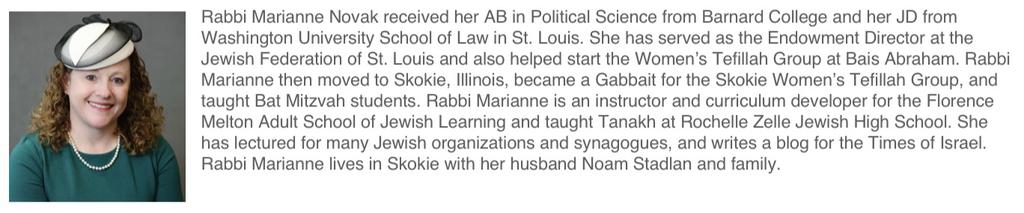
Rabbi Marianne Novak
Class of 2019
In the summer of 1989, after graduating from Barnard College in New York City, I moved to St. Louis to attend law school at Washington University. I rented an apartment and bought a car. On a particularly hot summer day, I went to get my new car registered. At the time, the registration process was quite cumbersome and involved going back and forth to two different offices to get certifications. Being the ever so savvy ex-New Yorker, I thought this system was completely ridiculous and I let one particular clerk know exactly how I felt—basically screaming at her. It was a mode of behavior that I had employed, sadly, many times when I lived in New York. I would yell at a clerk, the clerk would yell back, and then we would come to some sort of resolution. But, in the middle of my rant, this particular clerk at the St. Louis DMV didn’t yell back but kindly said instead, “Honey, are you having a bad day?”
I was immediately embarrassed and apologized. And even though in truth the car registration system was ridiculous, my anger didn’t solve the problem but only revealed something about me— I was indeed having a bad day - I was in a new city, trying to manage red tape, nervous about law school, and it was just.so.hot.
Similarly, when we find Moshe and B’nai Yisrael in Parshat Chukat, coming to the end of their journey in the seemingly very hot desert, they are indeed having a really bad day. Miriam has just died, and the people are now clamoring for water. (Bamidbar 20:2-5):
This is an all too familiar scenario. Thirty-nine years earlier, shortly after leaving Egypt, B’nai Yisrael didn’t have water to drink. They quarreled with Moshe (וירב העם עם משה), demanding water. B’nai Yisrael’s refrain there sounds very much like the one in our parsha (Shemot 17:3):
Moshe then runs to God for help, worried for his own safety. He tells God: These people are going to kill me! (עוד מעט וסקלוני) (Shemot 17:4).
Moshe is angry—angry at the people not only for wanting to kill him but also for their inability to trust in God despite experiencing God’s awesome power directly, angry at them for rebelling. God then instructs Moshe to go before the people and the elders of Israel and take his staff and hit a designated rock at Choreb. Moshe does so and water comes forth out of the rock and the people drink.
And in Chukat, 39 years later, we are presented with a narrative that is eerily similar to the Shemot narrative. But while God does not take Moshe to task for his anger in Shemot, Moshe’s anger in Bamidbar results in dire consequences— Moshe will die in the desert and will not join the Jewish people going into Eretz Yisrael.
Why the difference? Is it just because in our narrative Moshe hit the rock instead of talking to it? And since in the Shemot story Moshe had been commanded by God to hit the rock, why was his hitting now considered so egregious, tantamount to the sin of rejection of God? For God explains Moshe’s punishment with the words (Bamidbar 20:12):
If we look beyond the similarities of these instances and focus on the subtle differences, perhaps we can understand why the consequences of Moshe’s behavior here are so grave. A key difference is the identity of the stick that Moshe is commanded to take in each of these incidents. In Shemot (17:5) God explicitly tells Moshe to take מטך אשר הכית בו את היאור (“the rod with which you struck the Nile”). Moshe is asked to take the very rod that was used for all the plagues in Egypt—a very violent show of God’s power. This is the rod that was used for the ‘in your face’ miracles, the stick that was appropriate for the generation who were slaves and, sadly, understood things best through violence. Moshe hits the rock to show God’s power in a very visceral way. At this point, the people were not spiritually mature enough to relate to God in any other way but fear. And perhaps because they were in that phase developmentally, God does not reprimand Moshe for his show of anger and lack of faith in the people. Moshe does exactly as he is commanded and B’nai Yisrael drink.
By contrast, in Chukat, Moshe is told to take “the rod” (קח את המטה) (ַ֣Bamidbar 20:8). And the Torah states that Moshe “took the rod from before the LORD as He had commanded him.” ֵ(ויקח משה את המטה מלפני ה' כאשר ציוהו) (Bamidbar 20:9). The Rashbam in his commentary on these verses notes that the stick here is the one that was placed before the Edut — in the aron together with the two tablets containing the Ten Commandments. We last saw this staff a few Chapters back, at the end of the Korach incident. After Korach and his followers are swallowed up by the earth and a great fire, the people are horrified and blame Moshe and Aharon for their deaths. God then brings a plague which kills another 14,000 and only stops when Aharon brings an incense offering. God then instructs Moshe to gather all the wooden staffs of the tribal heads including Aharon. The staff of Aharon, an almond branch, blossoms and God tells Moshe to put it before the Edut ֵ(תלונותם מעלי ולא ימותו למשמרת לאות לבני מרי ותוכל) (“to be kept as a lesson to rebels, so that their mutterings against Me may cease, lest they die.”) (Shemot 17:25).
This is the staff that Moshe uses here, in Chukat, to hit the rock— a staff that is supposed to be seen as a sign of peace, the end of rebellion— a sign not only of God’s imminent power but also His love for the Jewish people.
Moreover, the people complaining in Chukat are not the same generation that left Egypt. This is the generation that has survived wars from without and rebellions from within and have essentially bought into a relationship with God—they are ready to go into the land of Israel. And, yes, they are complaining, but Moshe shows no faith in them; and with the staff symbolizing peace at the end of the rebellion in hand yells: (Bamidbar 20:10)
It is in his anger, before the entire congregation of Israel, that Moshe frankly loses it and hits the rock. At that moment, Moshe’s role as a leader is lost.
At that moment, Moshe had the opportunity to sanctify God by treating B’nai Yisrael as full covenantal partners with God and having them serve God out of love and devotion and not out of fear. Moshe had the chance to meet B’nai Yisrael where they were spiritually, but instead, because of his anger, he reverted to his old methods by invoking a God of force and power instead of sanctifying a God of love and understanding. And for that major misstep God tells Moshe that he will not lead B’nai Yisrael into the land of Israel.
God recognizes that Moshe is indeed having a bad day but as a leader, at this pivotal moment, Moshe doesn’t have the luxury to “lose it”. The people, at this moment, need a leader who believes in them. And it becomes clear that Moshe is not the kind of leader B’nai Yisrael needs at that point.
So, yes Moshe hits the rock instead of speaking to it. But his real transgression was his transmitting the wrong message and not understanding that the nation of Israel in Bamidbar was markedly different from the children of Israel who had just left Egypt.
Anger is one of those traits that the Rambam warns us against (Mishneh Torah, Hilchot De’ot 2:3):
וְכֵן הַכַּעַס מִדָּה רָעָה הִיא עַד לִמְאֹד וְרָאוּי לָאָדָם שֶׁיִּתְרַחֵק מִמֶּנָּה עַד הַקָּצֶה הָאַחֵר. וִילַמֵּד עַצְמוֹ שֶׁלֹּא יִכְעֹס וַאֲפִלּוּ עַל דָּבָר שֶׁרָאוּי לִכְעֹס עָלָיו... אָמְרוּ חֲכָמִים הָרִאשׁוֹנִים כָּל הַכּוֹעֵס כְּאִלּוּ עוֹבֵד עֲבוֹדַת כּוֹכָבִים.
So too is anger an extremely evil tendency and it is proper for man to remove himself from it to the other extreme. One should teach himself not to get angry, even over a matter which befits anger.... The sages of yore said: "He who yields to anger is as if he worshiped idolatry".
Our other Parsha of this week, Balak, also warns us of the dangers of misplaced anger. When Bilam, the Moabite prophet hired by King Balak to curse the Israelite people, sets out on his supernatural donkey to fulfill this task, he is thwarted three times by an angel of God. However, it is only the donkey who can see the angel swinging its knife at him. The donkey’s reluctance to go forward enrages Bilam and he proceeds to brutally beat his animal. When the angel finally appears to Bilam, surprisingly, he does not immediately take him to task for going to curse B’nai Yisrael, but rather says: (Bamidbar 22:32)
(32) The angel of the LORD said to him, “Why have you beaten your donkey these three times? It is I who came out as an adversary, for the errand is obnoxious to me.
Bilam in losing his temper also loses himself. His task became all about him to the exclusion of everything else, including his loyal donkey.
As human beings, it is so easy to slip into anger to the point where we lose ourselves. And even if our beefs are legitimate, we need to take a breath and try to control our anger. If we can learn anything from the parshiot of Chukat and Balak it is that even righteous indignation must be measured and limited.
So, thirty years later, I am forever grateful to the kind clerk from the DMV who prevented me from completely losing myself. And even though I was right — it was an overly cumbersome system for car registration— I learned a big lesson about righteous indignation—it’s never only about the wrong, but very often it’s about you— what’s bothering you, your bad day. And when it’s all about you, there is no room for God or anyone else in your life. Moshe Rabbenu learned this the hard way, but we don’t have to— even if we are having a really bad day.