Parashat Matot
from Likutei Torah by Rabbi Shneur Zalman of Liadi
Friday July 9, 2021
Translation and Commentary by Rabbi Gedalia Potash and William Schecter, MD
This draft has been neither edited nor approved by Rabbi Potash
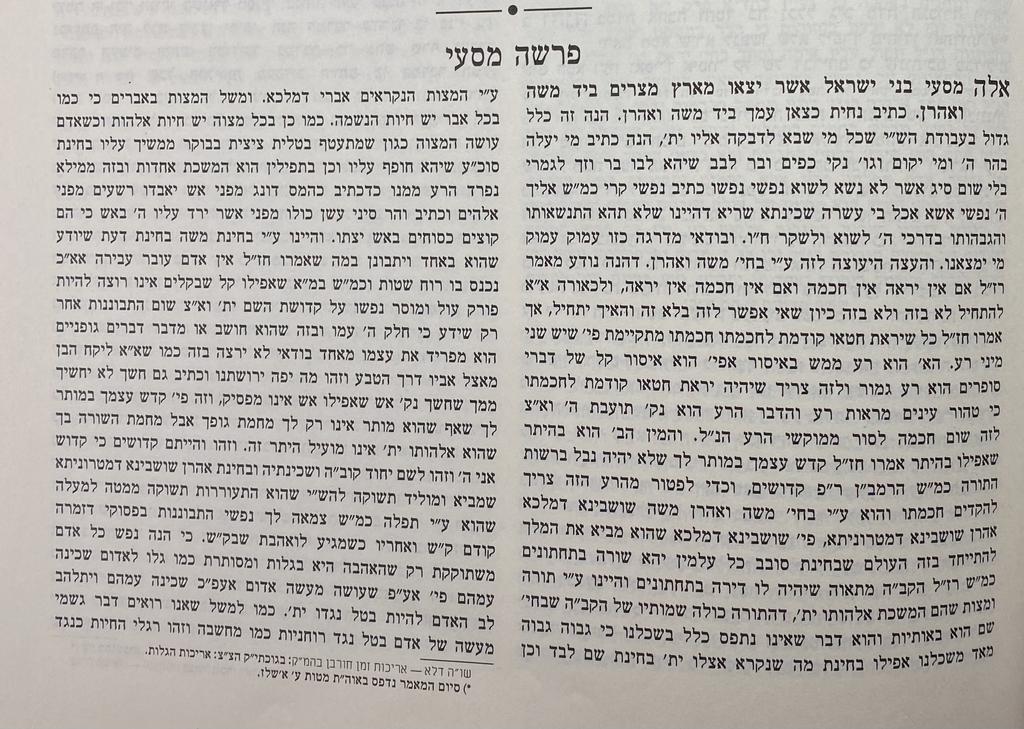
The Elter Rebbe begins his commentary by quoting the first passage of this week’s Parasha: “These were the marches of the Israelites who started out from the land of Egypt, troop by troop, in the charge of Moses and Aaron.” It is written that Your people were led like a flock by Moses and Aaron. This is a great principle in the Service of G-d for everyone who comes to cling to G-d. It is written ”Who may ascend the mountain of the LORD? Who may stand in His holy place? He who has clean hands and a pure heart”—whose heart is completely pure without any blemish— “who has not lifted His Soul in vain and taken a false oath --לֹא־נָשָׂ֣א לַשָּׁ֣וְא נַפְשו וְלֹ֖א נִשְׁבַּ֣ע לְמִרְמָֽה׃.” (Psalm 24:3-4) Commenting on the word “His Soul” in the last quotation from Psalm 24:3-4, the Elter Rebbe says that in the written version it says “His Soul” (נַפְשו) but when we read it, we say “My Soul-- (נַפְשִׁ֥י)” and then he quotes the passage “אֵלֶ֥יךָ אֲ֝דֹנָ֗י נַפְשִׁ֥י אֶשָּֽׂא׃ -- for on You, Lord, I set my Soul.” (Psalm 25:1)
Comment: In an old copy of the Tanach, written only in Hebrew, which I purchased in my college book store more than 50 years ago, the passage “who has not taken a false oath by His Soul (נַפְשו) has a notation next to it without further explanation. A copy of the Tanach which I have in English has a notation next to Psalm 24:4 indicating that the ancient version of the Psalm is written as His Soul but that it is read as My Soul ((נַפְשִׁ֥י) and that most modern texts are written as My Soul as is the case in this text and also in the text found in Sefaria both in Hebrew and English.
So, what is the point? Rabbi Potash comments: When a person elevates his Soul towards G-d he stimulates G-d to descend to our world. So, there is both a reaching up from below on our part and a reaching down from above by G-d. There will be a degree of reciprocity on the part of G-d so that a person will not raise up his Soul in vain. This concept will be explored further in the text below.
The Divine Presence rests upon every group of 10 (a minyan) meaning that one’s efforts to raise up oneself in the paths of the Lord will not be in vain or false, G-d forbid. And surely such a profound spiritual level who can find?
Comment: this appears to be a rhetorical question on the part of the Elter Rebbe. That is, it is unlikely that the average person would in fact be able to achieve such spiritual heights.
The advice given for this is through the attributes of Moses and Aaron. It is known from the sayings of the Rabbis of the Talmud that if there is no fear (יראה) there is no wisdom (חכמה) and conversely if there is no wisdom, there is no fear. (Pirkei Avot 3:17) Apparently, it is impossible to begin with one without the other so how is it possible to begin at all?
The Rabbis said that whenever the fear of sin precedes wisdom, wisdom exists. (Pirkei Avot 3:9)
Rabbi Potash comments: We translate the word יראה (Yirah) as fear or awe. Actually, the word for fear is Pachad (פחד) so יראה implies a degree of fear but also amazement, awe, at the Infinite Divine. Rabbi Potash then remarked that יראה implies an awareness of separateness. This was a very astute and interesting observation. The vocabulary of all Semitic languages is based on a root of three vowels. In the case of יראה (fear or awe), the root is ראה which means “to see”. So, by “seeing” the separateness and greatness of G-d, one experiences awe (Yirah) because one is aware of the separateness.
There are two types of evil says the Elter Rebbe. The first type is an act that is strictly forbidden. Even if it is a simple prohibition based on the sayings of the Rabbis, it is a complete evil and therefore “the fear of sin precedes wisdom” because when pure eyes see evil, the evil act is called an abomination of the Lord and one needs no wisdom at all to turn away from the evil obstacles as discussed above.
The second type of evil is an act that is permitted but that even in its permission the Rabbis said “sanctify yourself in that which is permitted to you so that you should not be a villain (transgressor?) of the authority of the Torah” as the Ramban wrote in the beginning of the Chapter Kedoshim.
Comment: Prior to discussing what is meant by “sanctify yourself in that which is permitted”, we should first identify the Ramban. The Ramban is the acronym for Rabbi Moses Ben Nachman otherwise known as Nachmanides (the son of Nachman in Greek). He was born in Girona, Catalonia (Spain) in 1194 and died in 1270 in Acre, Eretz Israel. He was a Rabbi, physician, philosopher and Biblical commentator. He lived in the generation after the Rambam (Maimonides) who died in 1205. The passage quoted by the Elter Rebbe refers to the Ramban’s commentary on Leviticus 19:2:2ו וַיְדַבֵּ֥ר יְהֹוָ֖ה אֶל־מֹשֶׁ֥ה לֵּאמֹֽר׃ “The LORD spoke to Moses, saying:
דַּבֵּ֞ר אֶל־כׇּל־עֲדַ֧ת בְּנֵי־יִשְׂרָאֵ֛ל וְאָמַרְתָּ֥ אֲלֵהֶ֖ם קְדֹשִׁ֣ים תִּהְי֑וּ כִּ֣י קָד֔וֹשׁ אֲנִ֖י יְהֹוָ֥ה אֱלֹהֵיכֶֽם׃ Speak to the whole Israelite community and say to them: You shall be holy, for I, the LORD your God, am holy." The Ramban in his commentary asks what means to be sanctified. His answer is abstinence, even from things that are permitted, so as to reach a higher spiritual plane.
Rashi, Rabbi Shlomo Yitzchaki (1040-1105), probably the greatest commentator on the Torah, commenting on Deuteronomy 14:21 wrote:
כי עם קדוש אתה לה'. קדש את עצמך במותר לך (ספרי קד), דברים המותרים ואחרים נוהגים בהם איסור, אל תתירם בפניהם: כי עם קדוש אתה לה׳
FOR THOU ART AN HOLY PEOPLE UNTO THE LORD — This implies: show yourself holy (abstinent) in respect to things which are permitted to you — i.e., things that are actually permitted but which some treat as forbidden you should not treat as permissible in their presence (Sifrei Devarim 104:7).
The Elter Rebbe continues. In order to be free of this evil, one has to advance his wisdom through Moses and Aaron. Moses is the entourage of the King (שושבינא דמלכא—Shosvinah diMalka). Aaron is the entourage of the Queen (Shosvinah dimatronita --שושבינא דמטרוניתא)
Comment: The two expressions used above are in Aramaic. Malka means King. The word Matronita, which we have translated as Queen, comes from the Latin, matrona, meaning a dignified married woman. The introduction of this Latin word into Aramaic is testimony to the influence of the Roman Empire and its culture in the Middle East at the time the Talmud was being redacted (2nd -5th centuries of the Common Era).
Rabbi Potash comments. The relationship between G-d and the Jewish People is often compared to that of a bridegroom (G-d) and a bride (the Jewish People). When a relationship is established, there is a natural hesitation on both sides. Am I making the right decision? Am I doing the right thing? Both sides need support. Both the bridegroom and the bride are accompanied to the Chuppah by their separate entourages providing support. In the case of G-d and the Jewish People, Moses is the person who is the entourage of G-d and intercedes with Him on behalf of the Jewish People. For example, it is Moses who intercedes on behalf of the Jewish People after the sin of the golden calf, after the rebellion of Korach and his followers following the episode of the 12 spies and after the sinning of the young men of Israel with the daughters of the Midianites in the year prior to entrance into the Promised Land.
Aaron is the entourage of the Jewish People. He is the one making sacrifices pleasing to the Lord on behalf of the Jewish People. He is the one who represents Loving Kindness and encourages the Children of Israel to fulfill the Mitzvot.
So even though both G-d and the Jewish People experience some hesitation regarding their “marriage”, the entourage of Moses with G-d and Aaron with the Children of Israel support them and encourage them to “consummate” the relationship.
The purpose of these entourages is to bring the King (G-d) to unite with this world through “surrounding all the worlds” so that He rests upon the lower worlds as our Rabbis wrote “G-d desires a dwelling place in the lower worlds” meaning that through Torah Study and performance of Mitzvot, His Divinity will be drawn down to our world. The entire Torah is composed of the Names of G-d in that the attribute of Name is in the letters of the Torah but this is something that is incapable of being grasped by our intellect for it is much higher than our intellect. Even Ma (מה) which refers to His Name alone is beyond our understanding.
Comment: Jews are forbidden to write out the name of G-d, particularly the Tetragram. However, if we spell out the four letters of the Tetragram in phonetic Hebrew-- יוד הא ואו הא -- and add up the numerical value of each of the letters in the phonetic alliteration, we come up with a value of 45. It turns out that in Gematria (Numerology frequently employed in Kabbalistic interpretation of words and phrases), the word מה (Ma), meaning “what”, has the numerical value of 45. So, Kabbalistically speaking, Ma is one of the names of G-d because it has the same numerical value as the spelling of the Tetragram. The Elter Rebbe is implying that there is an infinite combination of letters all of which spell the Name of G-d in the Torah and that even the simplest combination, Ma=45, is beyond our comprehension.
The Mitzvot are called the limbs of the King. The Elter Rebbe will now give an example to explain this confusing sentence. By way of example, the vitality of the Soul is located in each limb which carries out the Mitzvah. In every Mitzva there is a Divine Vitality such as when putting on a Talis (prayer shawl) in the morning. In doing so, man draws down upon himself the Divine attribute of “Surrounding all the Worlds” which will hover above him. Similarly, a man puts on Tfillin, he draws down the Unity of G-d and seamlessly separates himself from evil as it is written “just as the wax melts before the flame, so the evil doers will disappear (melt away) before G-d”. And it is written “And Mount Sinai is completely covered with smoke because G-d descended upon it in fire consuming all the thorns and thistles creating smoke. Meaning that through the attribute of Moses and the knowledge that He is One, man will contemplate that which the Rabbis said: “no man transgresses unless a spirit of foolishness enters within him”. And as it is written elsewhere, even the simplest person has no desire to free themselves from the yoke (of the Mitzvot—that is, to be licentious) and will sacrifice themselves himself for G-d (Kiddush HaShem). No other contemplation is required, only that he knows that a part of G-d is with him. By thinking or speaking material things (“Animal Thoughts”) he separates himself from the One and surely, he does not wish to do this just as it is naturally impossible to take a son from his father.
…………..
And this is what is meant by “you shall be holy because I am the Holy G-d and this is for the Unity of G-d and the G-dly Presence (Shechinah) and in the attribute of Aaron and the entourage of the Matronita (Queen) which brings forth and gives birth to the desire for G-d which is the awakening of a passionate desire for G-d in Heaven from below (our world) which occurs through prayer as it is written “my Soul thirsts for You” in the contemplation of the Psukei DiZimra recited prior to the recitation of the Shm’a and thereafter when one reaches the prayer Veahavta (And you shall love the Lord you G-d….—the second paragraph of the Shm’a prayer).
Summary
The Jewish People were led on their journey through the desert by Moses and Aaron. Moses interceded with G-d on behalf of the Jewish People when they transgressed bringing G-d down to our World from the Heavens. Aaron interceded with the Jewish People, encouraging them to fulfill the Mitzvot and made sacrifices to the Lord at the appointed times on behalf of the Jewish People. The whole point was to have the Divine Light descend to the People while the Souls of the People arose spiritually toward the Divine Light in a consummation of the relationship between G-d and the Jewish People.