5 Cheshvan 5781 l October 23, 2020
Parshat Noach
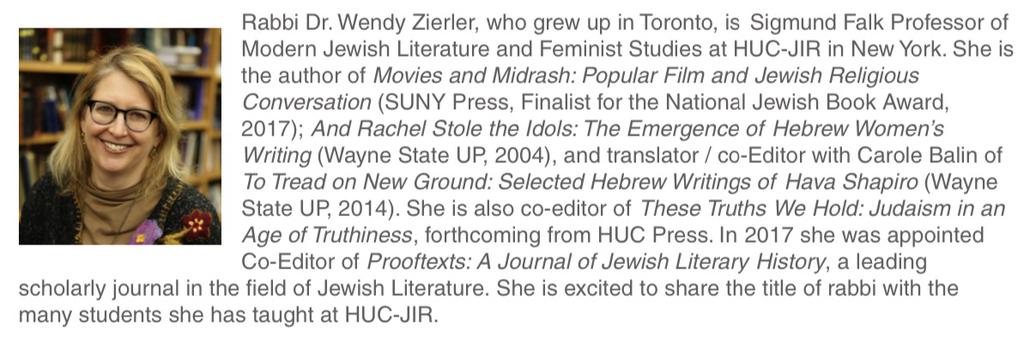
Rabbi Dr. Wendy Zierler
Advanced Kollel: Executive Ordination Track
Class of 2021
For Aliya Ryman
For the past year I have been studying Parashat Noaḥ with Aliya, a family friend, in preparation for her bat mitzvah. Together we wondered about how it is that this tale about the entire world getting destroyed could ever be considered a children’s tale, depicted on wall art in baby nurseries or in a Fisher Price arks. We talked about the similarities and differences between the Noah story and the Flood myth in the Epic of Gilgamesh. In those early months, the story was alien and remote: an ancient artifact.
Then came COVID19. A parent of a student in Aliya’s school was the first New Yorker to fall seriously ill with the virus, and Aliya’s family, like the rest of the families in their school, was quarantined. And so our classes moved from in-person to Facetime, for what we hoped would be just a few weeks. Then came the New York lockdown, and as the entire state moved indoors, our lessons moved for the foreseeable future to Zoom. Suddenly this story about a man who builds an ark for his family and a zoo’s worth of animals, in order to escape worldwide, deadly danger, seemed eerily relevant. We noted the link between the forty day-length of the flood according to Gen 7:17 and the notion of quarantine, a term that originated in 14th century efforts, as the CDC explained, to “protect coastal cities from plague epidemics. Ships arriving in Venice from infected ports were required to sit at anchor for 40 days before landing.” As the COVID weeks wore on, and we reached the section of the parsha where the flood waters finally subside and Noah “removed the covering of the ark, and looked, והנה חרבו פני האדמה-- and behold, the face of the ground was dried," (Gen. 8:13), we imagined what it was going to feel like, when the pandemic was over, and we’d finally be able pull the lid off our own individual, stay-at-home arks. What was the world going to look like when COVID was finally finished and done? Would that time ever come? We talked about God’s sending the Flood to punish everyone in the world, except for Noah and his family, and struggled to imagine how every single man, woman and child in that world could have been deserving of such punishment. While there was much about our own world to lament and much left to fix, we certainly didn’t view the pandemic as an act of God visited upon us to punish us for our sins. We looked at the verb used to describe the drying up of the land-- והנה חרבו פני האדמה-- and identified it as related to the word “ḥurban,” used to describe the catastrophic destruction of the first and second Temples. What awful sights were disclosed to Noah and his family by the receding Flood waters? How many dead bodies did Noah and his family have to confront upon their emergence from the ark? Likewise, what ḥurban was unfolding as a result of this global plague?
The experience of learning Parashat Noaḥ in the midst of a deadly pandemic has been one of nightmare myth coming to life, a story time-traveling from ancient Mesopotamia and Turkey all the way through the generations and to our own time. The sense of a story traveling across time in a word ark is itself embodied in the word used for ark, teivah. In Parashat Noah, the word teivah denotes a huge gopherwood sea vessel, with many rooms and compartments, used to save a family and the world’s animals from annihilation in a Flood. The word teivah itself does not remain lexically static, however. It time- and text-travels, from the primeval generations of Genesis to the time of the Exodus, where it refers to the tiny reed basket used to place an yet unnamed baby Moses on the Nile River, to save him from being thrown into the Nile as part of the death-sentence decreed upon on male Hebrew babies. In both cases the word connotes a vessel set upon water for purposes of salvation, though in the Moses story it becomes part of the story of the birth of a people. The word continues to time-travel and transform into various other meanings. In later liturgical tradition, it comes to refer to the ark in a synagogue, with the expression “over lifnei hateivah,” referring to the act of serving as a shaliah tsibbur to lead a congregation in prayer, an activity that Aliya trained to do for her bat mitzvah. It denotes a container or box, as in the boxes that we have all been forced to live and work in, in our daily Zooming lives. And it has also come to denote a single written word, suggesting a link between seafaring vessels and tools of speech or the language of prayer.
How one interprets the word teivah affects, of course, one’s interpretation of the various verses of the Noaḥ story itself. In Bereshit Rabbah, a debate is recorded with regard to the meaning of the directive to Noah in Gen. 6:16 of צהר תעשה לתבה. R. Abba Bar Kahana says that tsohar means ḥalon (window), while R. Levi says, tsohar means “margalit,” pearl. At stake in this debate is a practical question: if the ark was covered, like a box, it had to have been dark inside! What then was its source of light? Those who interpreted the word tsohar to mean window, assumed that Noah and family relied on natural daylight, meaning very dark nights. Those who imagined a gemstone tsohar, had in mind some form of illumination coming from the stone itself, some otherworldly source of light, perhaps like that of the Urim and Tumim.
Other interpreters, especially the Ba’al Shem Tov and other Hassidic masters, understood this verse by bringing together the various meanings of the word teivah, viewing the notion of צהר תעשה לתבה as related to the question of כוונה in the words of one’s tefilah. Noam Elimelech (by Hassidic master, Elimelech Weisblum of Lizhensk, 1717-1787) glosses this not only in relation to the words of prayer but to all human speech:
יש אומרים חלון ויש אומרים אבן טובה המאירה להם (רש״י). על פי רמז יש לפרש: תיבה – מלה, והכוונה—שכל מלה ומלה שאדם מוציא מפיו צריכה להאיר כאבן טובה, ושיהא מייקר את דבריו כמרגליות.
There are those who say [that the word tsohar means] window and others that say a gemstone that brings them light (Rashi). By intimation, one can explain: Teivah = word, and the intention of this is that every single word that a person lets out of their mouth should illuminate like a gemstone, and should make their words precious like pearls.
The Noam Elimelech’s interpretation of the phrase צהר תעשה לתבה transports these words from the original context of Noah’s building project and the world calamity that occasioned it, to an entirely different context of character building and a careful consideration of how one speaks and treats words, given that the ability to speak defines Bnei Adam as human beings. According to his interpretation, each one of us is a metaphorical, closed teivah / box, with a tsohar looking out to the world, namely our human faculty of speech. Every word we say thus has the capacity to be a life-saving, life-illuminating porthole. Conversely, every word misused has the capacity to do life-threatening harm and violence.
The time we are living through is one that has brought these the various meanings of the word teivah into stark relief and connection. For even more than the 150-day length of the Flood according to Genesis 7:24, we have all been confined to our domestic and personal teivot, venturing out tentatively like the raven and the dove, to do our essential work, or to attend outdoor tefilot, like the small tefilah that we will hold for Aliya’s Bat Mitzvah this Shabbat. We have looked out from our various technological tsoharim – the screens of our computers and our TV’s—to see and speak to one another and to follow the words of those entrusted to lead us through this time. We have seen how some of our leaders’ words have illuminated these dark times, brought guidance, reassurance, and hope, while others, sadly, have used their vital “teivot” for cynical, narcissistic purposes to inspire fear, confusion, and “ḥamas” – the word used in the Noah story to refer to the violence and hatred that occasioned the Flood to begin with.
The Zoom sessions that Aliyah and I have had every week over these many months, have been their own kind of “tsoharim lateivah” of an inspiring, love-filled, connective sort. They have kept our families in contact and deepened our relationship. They have allowed us to be puzzled and illuminated by the many aspects of the Parsha and the Torah.
The world as it stands right now is not what any of us could have imagined when Aliya and I started studying for her bat mitzvah. And the bat mitzvah she is about to have, is very different from what she and her parents initially envisioned. Like the word “teivah,” this occasion has been transformed and remade a few times over. But because of the kind of people that Aliya and her parents are, because, well-acquainted with life-threatening challenges, they have a special talent for putting a “tsohar” on the teivah that is their family and everything they do and say, the new vessel of mitzvah and spirituality which is Aliya’s bat mitzvah weekend, will float like Noah’s ark over the waters. It will keep them and us sound, safe, and inspired. And it will shine like a precious pearl in our minds for many weeks to come.